
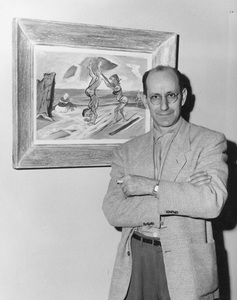
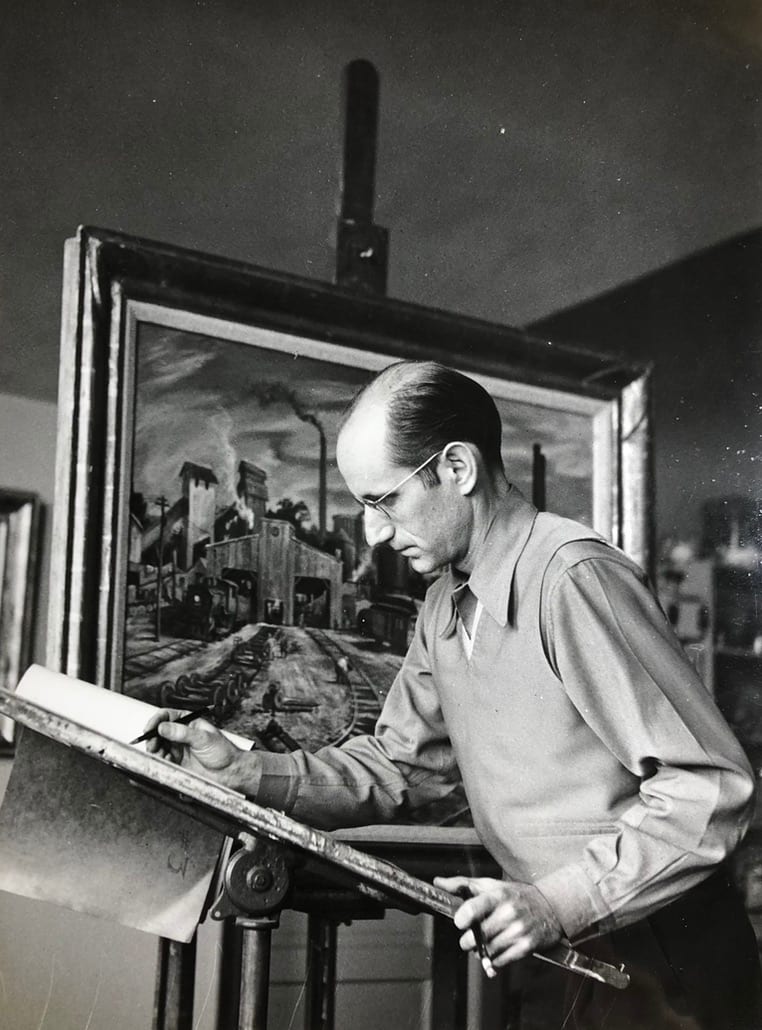
About this Archive
Welcome to the digital archive of Fred Shane (1906–1990).
This website is dedicated to locating, documenting, preserving, and sharing Shane’s body of work with collectors, researchers, and art lovers nationwide. Our goal is to build a comprehensive record of his artistic legacy by gathering information, researching provenance, recording current locations, and presenting high-quality images of his artworks — and, when appropriate, making works available for sale.
The catalog continues to grow as new pieces are identified and documented.
We invite you to explore his work, learn more about his story, and join us in sustaining his legacy. Every image, document, and recollection helps bring his remarkable contribution to American art into sharper focus for future generations.
For additional information, see Shane’s profile on Missouri Remembers: Fred Shane
About the Artist
Born in Kansas City, Missouri, on February 2, 1906, Fred Shane’s artistic journey both paralleled and quietly resisted the shifting currents of 20th-century American art.
Although he initially dreamed of becoming a cartoonist, by high school Shane had committed himself to painting. He began his formal studies at the Kansas City Art Institute in 1923–24, where he also undertook private study with Randall Davey. During the summers of 1925 and 1926, he attended the Broadmoor Art Academy in Colorado Springs (now the Colorado Springs Fine Arts Center), producing a substantial body of lithographs, drawings, and paintings. He spent the winter of 1926–27 in New York City before following Davey to Santa Fe in 1927, then a vibrant center for artists, writers, and poets.
Throughout these formative years, Shane was shaped as much by the artists around him as by his formal training. He was profoundly influenced by his connections to Robert Henri and John Sloan, as well as by the broader circle of socially engaged, realist painters who believed that art should be rooted in lived experience.
In 1928, Shane spent time in Spain, where he studied the masters and absorbed the intensity of Spanish art. Later that year, he joined many of his contemporaries in Paris, establishing a studio in the 16th arrondissement. In 1935, he met Thomas Hart Benton, the leading American Regionalist of the time. Through their close friendship, Benton influenced Shane’s artistic process, particularly his use of black-and-white value studies and clay models to develop compositions with a stronger sense of rhythm and sculptural volume. This approach helped Shane bring new depth and plasticity to his paintings, enhancing the way he rendered form and movement. Their creative bond endured for four decades, until Benton’s death in 1975.
Recognized as a prominent American Regionalist, Shane was appointed Professor of Art at the University of Missouri, Columbia in 1932. He served as Chair of the Art Department from 1958 to 1967 and was named Professor Emeritus in 1971. Throughout his academic career, he remained deeply engaged in public art and arts education, contributing to the Public Works mural project in Eldon, Missouri (1940–41), serving as Visiting Instructor at Kansas State Teachers College in 1936, and working as an Artist Correspondent for the U.S. Army Medical Corps in 1944.
Around 1948, Shane’s wife Louise was diagnosed with multiple sclerosis. For the next two decades, while he continued to teach and lead the department, he set aside much of his own creative work to care for her.
After Louise’s death, Shane rekindled a relationship with a former Broadmoor classmate. They married in California in 1970, and Shane relocated to Beverly Hills, where he built a new studio and resumed painting.
Fred Shane died in Beverly Hills, California, in 1990.
A Distinct American Vision
Fred Shane’s work bridges realism and imagination, revealing the humor, beauty, and complexity of American life through unflinching truth. His paintings consistently affirmed the dignity and vitality of ordinary people and places, rendered with empathy, clarity, and moral awareness.
In his early work, Shane painted working-class subjects with honesty and restraint, avoiding romanticization and instead acknowledging the hardships and routines of daily life. His time in Spain deepened his understanding of expressive form and color, particularly through the influence of El Greco. In Santa Fe, he absorbed the ideas of Robert Henri and the Ashcan School, embracing the belief that art should be rooted in lived experience.
After 1945, Shane’s work began to reflect the disillusionment of the postwar era. American Regionalism was declining as Abstract Expressionism, led by figures like Jackson Pollock, gained prominence. Personal challenges, including his wife Louise’s long illness, also affected his output, and for many years he focused primarily on teaching and departmental leadership.
Following Louise’s death and his subsequent relocation to California, Shane returned to painting with renewed energy, a brighter palette and lighter spirit. His later work demonstrates a remarkable flexibility of style, combining imaginative, eclectic, and sometimes satirical elements. Influences from Hieronymus Bosch, Pieter Bruegel, and the Surrealists appear in whimsical and unsettling dreamscapes that reflect both the chaos of the modern world and Shane’s enduring moral awareness.
Whether depicting the rolling landscapes of Missouri or the landscapes of the subconscious, Shane’s art remained deeply human and unmistakably his own. Throughout his life, he maintained lasting friendships with John Sloan, Robert Henri, Boardman Robinson, Milt Gross, Adolph Dehn, and Thomas Hart Benton, all of whom contributed to the richness of his artistic vision.
Legacy
Fred Shane’s impact on American art continues to be recognized through exhibitions and collections across the nation, reflecting the lasting significance of his work.
His works have been exhibited or collected by major institutions, including:
- Abbot Collection, Paintings of Army Medicine, Defense Department, Washington, D.C.
- Cantor Arts Center, Stanford University
- Colorado Springs Fine Arts Center
- Grunwald Center for the Graphic Arts, University of California, Los Angeles
- IBM Corporation, Collection
- Jefferson City, Missouri, Art Museum
- John Sloan Collection, Delaware Art Museum, Wilmington
- Los Angeles County Museum of Art
- Metropolitan Museum of Art, New York
- Museum of Art and Archaeology, University of Missouri–Columbia
- Museum of New Mexico, Santa Fe
- Nelson-Atkins Museum of Art, Kansas City
- Scruggs-Vandervoort-Barney Collection, University of Missouri–Columbia
- Smithsonian American Art Museum
- St. Louis Art Museum
- Stevens College, Columbia, Missouri
- Springfield, Missouri Art Museum
- State Historical Society of Missouri
- Susan Teller Gallery, New York City
- Tyler Art Gallery, State University of New York, Oswego
- U.S. Post Office Mural, Eldon, Missouri
- Whitney Museum of American Art, New York
Credits / References
- Essay by Sidney Larson, Fred Shane Paintings 1923–1979: Retrospective Exhibition at the Museum of Art and Archaeology, University of Missouri–Columbia and the State Historical Society of Missouri, September 14 – October 31, 1982, ISBN 0-010501-00-9
- Essay by Dr. Henry Adams, Brochure: A Traveling Exhibition, September 1988 – June 1989, ISBN 0-932845-30-4