
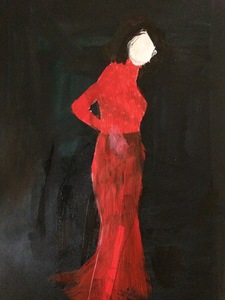
Fflur Donnghaile
London
Artist with a practice encompassing painting, drawing, participatory interventions, site specific works and installations, film & photography.
MessageAs an artist from a working-class background, with a parallel career in law and politics (born out of both economic necessity and a commitment to human rights); my work is a direct response to the social, political, and historic/ cultural landscapes that shape our lives. I grew up in council housing and relative poverty. My maternal Irish great-great-great grandparents came to England at the time of the Irish famine in the 1840s. They travelled from Newport in County Mayo (one of the hardest hit areas) and settled in Church Stretton in Shropshire. Their circumstances are unknown, other than what the record tells us of the Great Famine and displacement of people who were poor, landless, and Roman Catholic. Subsequent generations were part of the Industrial Revolution – working on the construction of the railways, and in building trades. My maternal grandfather was a master builder in demand across the country for his skills, e.g. building tall chimneys.
My maternal great-grandmother was born into abject poverty in the Scotland Road area of Liverpool. She later moved to the infamous area known as Little Ireland in Manchester. My grandmother’s father and grandfather had menial jobs as a driver and dock labourer and may have spent time in prison for the theft of copper wiring from the Manchester Docks. Perhaps unsurprisingly, my maternal grandmother who grew up with profound neglect, not knowing her father and abandoned by her mother – rejected her Irish antecedents. A link was broken that can now only be transcended through art.
My paternal Scottish great-great grandfather was a marine engineer and diver who worked on the construction of the Forth Railway Bridge and the Manchester Ship Canal. He came from Greenlaw, in Berwickshire. His ancestry may trace back in part to the Isle of Harris.
The dearth of information about my ancestors creates a gap through which I can explore my diaspora heritage, using myth, archaeological finds, illuminated manuscripts, early photographs of the Industrial Revolution and the squalor of poverty in Manchester. Painting allows me to approach subjects with a more intuitive, emotional lens, to explore themes of identity, belonging, loss, resilience, structural violence and social justice across different generations and epochs of history. Painting and drawing provide a boundless space for imagination, a contrast to the structured worlds of law and politics. This duality feeds my creativity, enabling me to bridge worlds, tell stories, and confront social structures through my practice. Art, for me, is a tool for empathy, reflection, and connection — an invitation to see, feel, and act.
Statement
Fflur Donnghaile
b. 1976, Manchester
Her practice encompasses painting, drawing, participatory interventions, site specific works and installations, film & photography. Her painting revels in colour, gesture, texture, with scratched out mark making and both abstract and figurative images. She works in oils and incorporates natural materials and household paints.
Committed to painting in her studio - she explores themes such as the Irish diaspora and Famine, displacement and loss, social justice and reparation, feminism and mythologies, poverty, industrialisation, working-class identity, and the housing crisis.
Her drawings and works on paper have an intimacy and immediacy that speaks to childhood experiences of neglect and trauma, but which also confidently anchor emotions in the here and now. Drawing as catharsis opens space to reflect and heal, and to regain a certain playfulness.
Whilst working at the Barbican and Whitechapel Gallery in causal customer roles she would do quick sketches - a practice that she has continued. These works were exhibited in a group show of artists who worked as invigilators and in front of house roles to highlight the low pay and economic circumstances of creatives in the capital.
Uniquely for a painter she also trained as a housing lawyer and has held elected office. Pushed to be academic as a child coming from a northern, deprived council estate, she has oscillated between the worlds of Art and Law/ Politics. Acting to translate people’s trauma and experiences of injustice into legal advocacy and formal policy language felt like a loss of humanity, flattening contradictions, nuance, and complexity. She uses an investigative approach to interrogate ethics & social norms, erased histories, and contested geographies. The tension between political activism – acting in the world and making images drawing on personal histories/ myths and the stories we tell ourselves, are at the heart of her work.
As an art student, inspired by Hans Haacke, she created disruptive interventions and installations, from taking pencil rubbings of gallery signage at Tate Modern, that allowed visitors to cross boundaries, to outing her parents as notional art thieves and presenting fabricated ‘evidence’ of their duplicity. She used humour to create publicly displayed A0 sized posters grading the fictional performance of her art tutors; and alarmed a blank canvas in the studios which went off every time a student walked past, much to the consternation of her peers. Her site-specific work includes a tour of ‘dead’ or defunct galleries that have closed in questionable circumstances, tracing a line from New Bond Street to Mason’s Yard.
Her current series of paintings seek to remediate the lack of a grounded cultural identity and the (colonially imposed) loss of a connection with Ireland. Her ancestors who fled the Irish Great Famine have left sparse traces in public records. She has undertaken in depth family and historical research to locate the Co. Mayo estates they may have left in the 1840s; alongside a parallel dive into the histories of her Scottish and Welsh artisan forebears, who came to settle in Manchester, contributing to the industrialisation of the North West of England. The paintings seek to trace the outlines of erasure and to occupy a gap that perhaps only art can now fill.
Powered by Artwork Archive