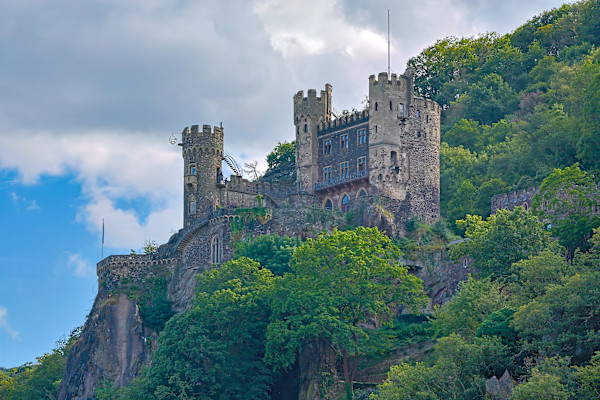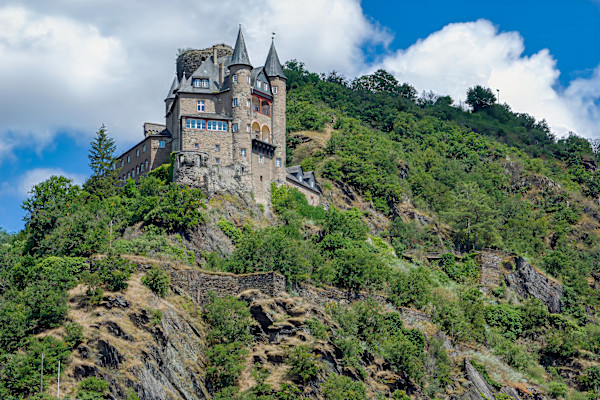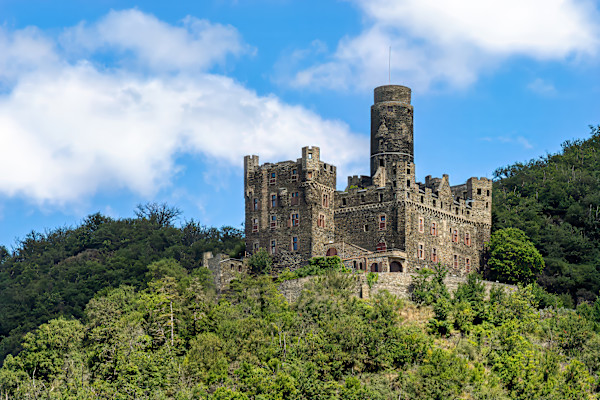


Burg Sooneck was constructed as early as the 11th century and takes its name from the nearby Soon Forest. It was built, along with Burg Reichenstein, Burg Heimburg, and Burg Vauzburg, to protect the area around Niederheimbach, which was owned by the abbey of Cornelimunster. In 1254, Burg Sooneck and Burg Reichenstein castles were besieged by the League of Rhenish Towns to end attacks by robber knights who enriched their coffers with tolls and taxes collected on the Rhine. After the territory around Niederheimbach was purchased in 1270, peace was restored between the Archbishop of Mainz and Phillip von Hohenfels. However, unrest would return upon violating the treaty with Phillip's son, Dietrich von Hohenfels. As a result, Burg Sooneck was destroyed in 1282 by troops of King Rudolph I, who then imposed a ban on rebuilding the castle. In 1346, the Elector Heinrich III of Mainz granted Johann, Knight Marshall of Waldeck, with Burg Sooneck, Burg Reichenstein, and Burg Heimburg. After the prohibition of construction was withdrawn by Emperor Charles IV in 1349, Burg Sooneck was rebuilt with its corner turrets of the Keep and Great Hall representative of the style during the middle of the 14th century. In 1689, Burg Sooneck was destroyed by King Louis XIV's French troops during the War of the Palatine Succession, along with the other castles on the left bank of the River Rhine. In 1774, the ruins of the castle were granted to residents of Trechtinghausen, who established vineyards inside and outside the castle grounds. In April of 1834, the castle ruins were purchased by members of the Prussian royal family, and the restoration of Burg Sooneck castle began in 1842. It represented the third Rhine castle to undergo rebuilding by the Prussian royal family, following Burg Rheinstein and Schloss Stolzenfels, rebuilt to become more grandiose and romantic. In contrast, efforts regarding Sooneck concentrated on restoring the castle to a functional state, in addition to its utilization as a royal hunting lodge. Apart from King William visiting the castle in 1863 and 1875, it was never used as a hunting lodge as intended. Eventually, the castle passed to state ownership in 1918. After World War II, Burg Sooneck was placed under the control of the Administration of the Castles of the State of Rheinland-Palatinate, who still manage the castle's upkeep.
- Subject Matter: landscape
- Collections: Architecture, Castles, Germany
Other Work From David Whited