
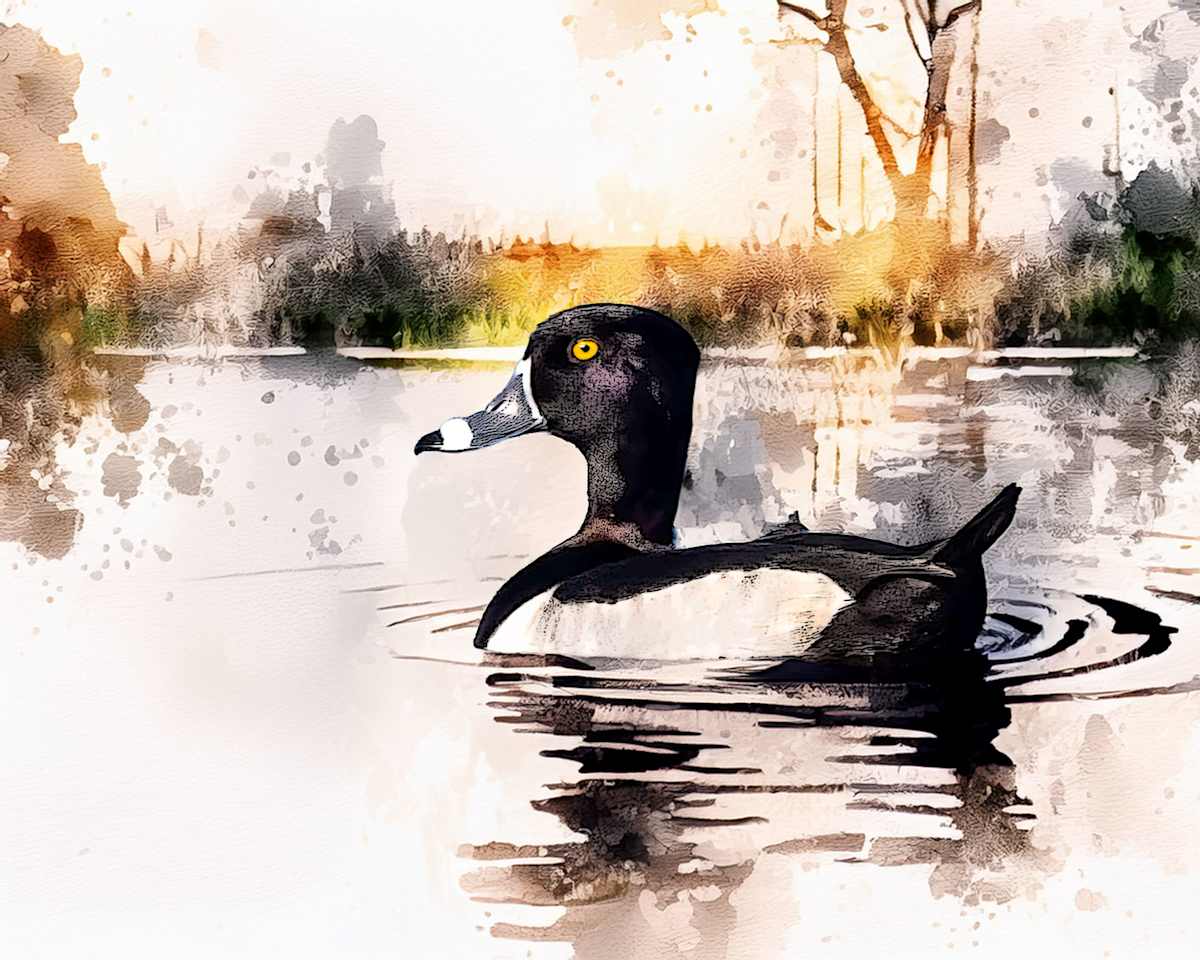
The Ring-necked Duck (Aythya collaris) is a compact diving duck of North America, with the breeding male showing a glossy black head with a subtle purple sheen, a black back and breast, and pale gray flanks set off by a bold white vertical stripe just in front of the wing, a field mark that's actually more useful for identification than the bird's namesake feature, a faint chestnut ring around the neck that's often nearly impossible to see in the field. Females are more subdued, with warm brown plumage, a grayish face, a white eye-ring, and a peaked head shape that helps distinguish them from similar diving ducks like scaup. Breeding primarily across the boreal forests and prairie pothole regions of Canada and the northern United States, Ring-necked Ducks favor shallow, acidic, vegetation-rich ponds, marshes, and beaver ponds, diving underwater to feed on aquatic plants, seeds, and invertebrates, and their peaked crown along with a distinctive bill pattern, a pale gray-blue bill ringed with white near the black tip, are actually the most reliable ways to identify them at a distance. They winter across the southern United States, Mexico, and Central America in freshwater lakes, reservoirs, and flooded timber, and despite the misleading common name, birders and hunters alike more commonly refer to them informally as "ringbills" in recognition of the more visible bill marking over the obscure neck ring.
- Subject Matter: Wildlife, birds
- Collections: Birds, Digital photography , Mixed Media , Wildlife