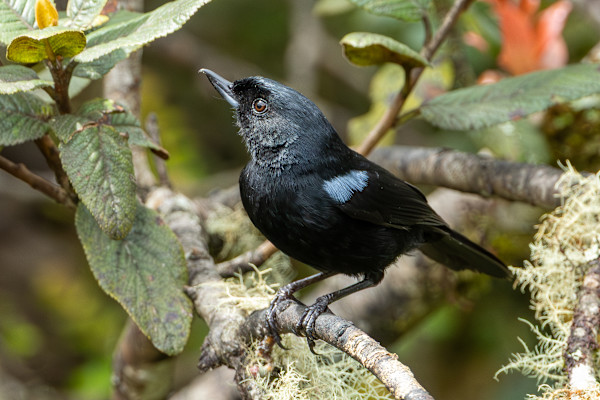

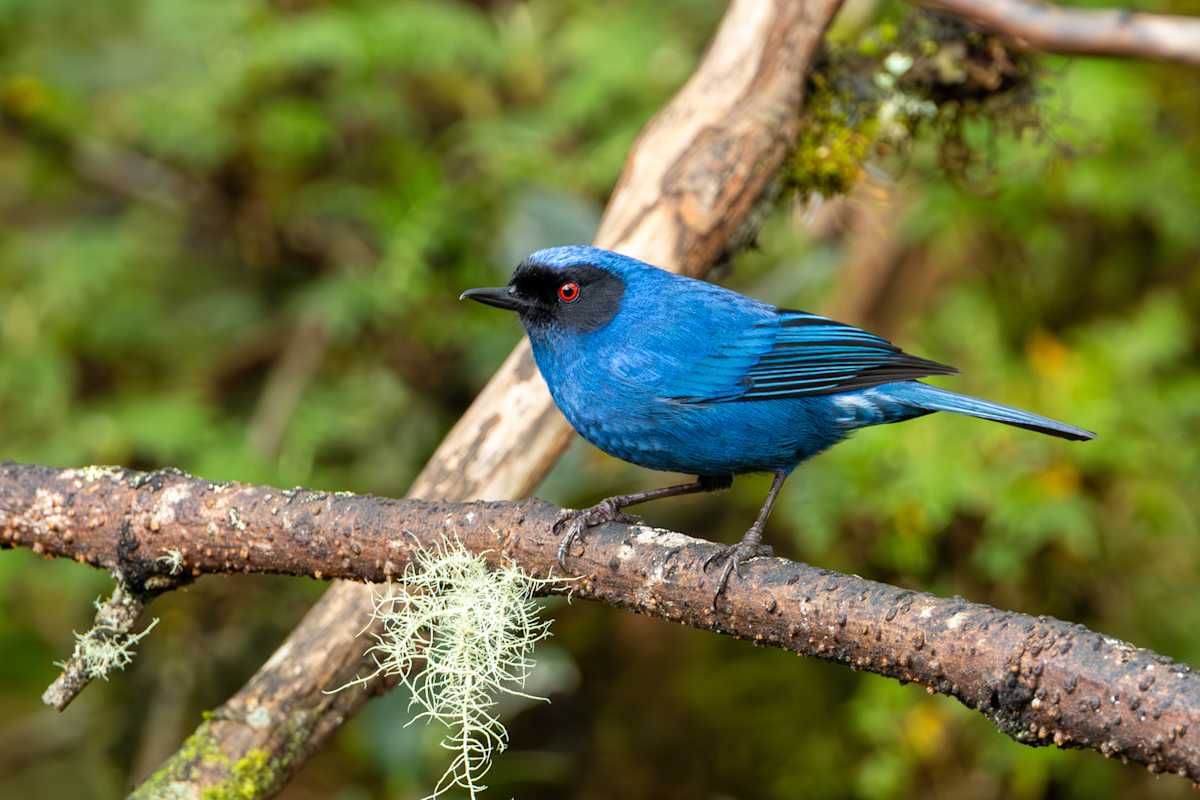
The Masked Flowerpiercer (*Diglossa cyanea*) is a striking and aptly named small bird found across the Andean cloud forests of South America, ranging from Venezuela and Colombia south through Ecuador, Peru, and Bolivia, where it inhabits forest edges, shrubby slopes, and gardens at elevations typically between 2,000 and 3,500 meters. The male is a vivid, deep indigo-blue overall — a rich, saturated color that can appear almost violet in certain lights — set off by a sharply contrasting black mask that sweeps across the face from the bill through the eye region, giving the bird its distinctive "masked" appearance. The female is more cryptically colored in grayish-brown tones with subtle streaking below, though she retains a hint of the masked facial pattern. The most defining anatomical feature of this species — and indeed of all flowerpiercers — is its uniquely adapted bill: the upper mandible is tipped with a sharp, hook-like downward curve, while the lower mandible is sturdy and pointed upward, forming a tool perfectly designed for "piercing" the base of flowers and robbing them of nectar without ever touching the reproductive parts of the bloom, making it a notorious nectar thief that provides no pollination service in return. This clever but ecologically parasitic feeding strategy sets it apart from legitimate nectarivores like hummingbirds, and it has been observed targeting a wide variety of Andean flowering plants, supplementing its diet with insects and berries as well.
- Subject Matter: Wildlife, birds
- Collections: Birds, Digital photography , Ecuador and Galapagos, Wildlife