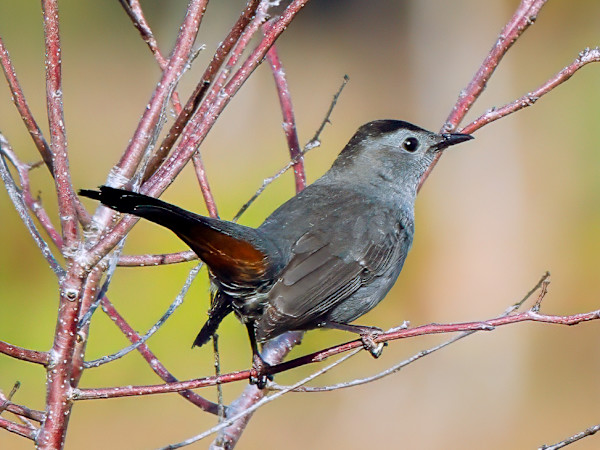

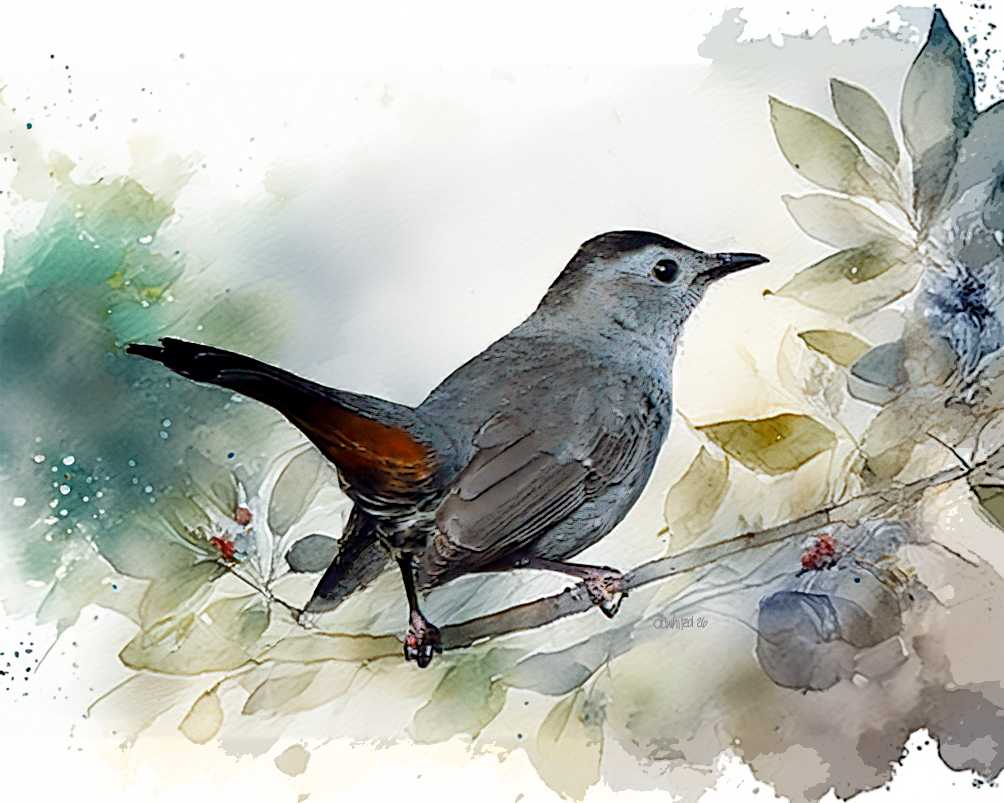
The Gray Catbird (*Dumetella carolinensis*) is a medium-sized, slender songbird found across most of North America, breeding from southern Canada down through the eastern and central United States and wintering in the southeastern U.S., Central America, and the Caribbean. It is a subtly handsome bird, dressed almost entirely in smooth slate-gray plumage with a neat black cap on the crown and a warm rusty-chestnut patch beneath the tail — a detail often hidden but revealed in flight or when the bird moves through dense shrubbery. A member of the mimid family, which includes mockingbirds and thrashers, the Gray Catbird is a gifted and prolific singer, capable of producing long, rambling sequences of musical phrases, squeaks, whistles, and imitations of other bird species, though unlike the Northern Mockingbird it rarely repeats phrases in succession, instead weaving them into a continuous, improvisational stream. Its common name comes from one of its most distinctive vocalizations — a sharp, descending, mewing call that sounds remarkably like a cat, and which it delivers with great conviction from deep within a thicket. The species is strongly associated with dense shrubby habitats — hedgerows, forest edges, overgrown gardens, and bramble patches — where it forages for insects, berries, and small fruits, and where its tendency to stay hidden in tangled vegetation means it is far more often heard than seen. Bold and inquisitive by nature, it will sometimes approach humans closely, and it is well known for aggressively ejecting the eggs of Brown-headed Cowbirds from its nest, making it one of the few species that actively resists brood parasitism.
- Subject Matter: Wildlife, birds
- Collections: Birds, Digital photography , Mixed Media , Wildlife