
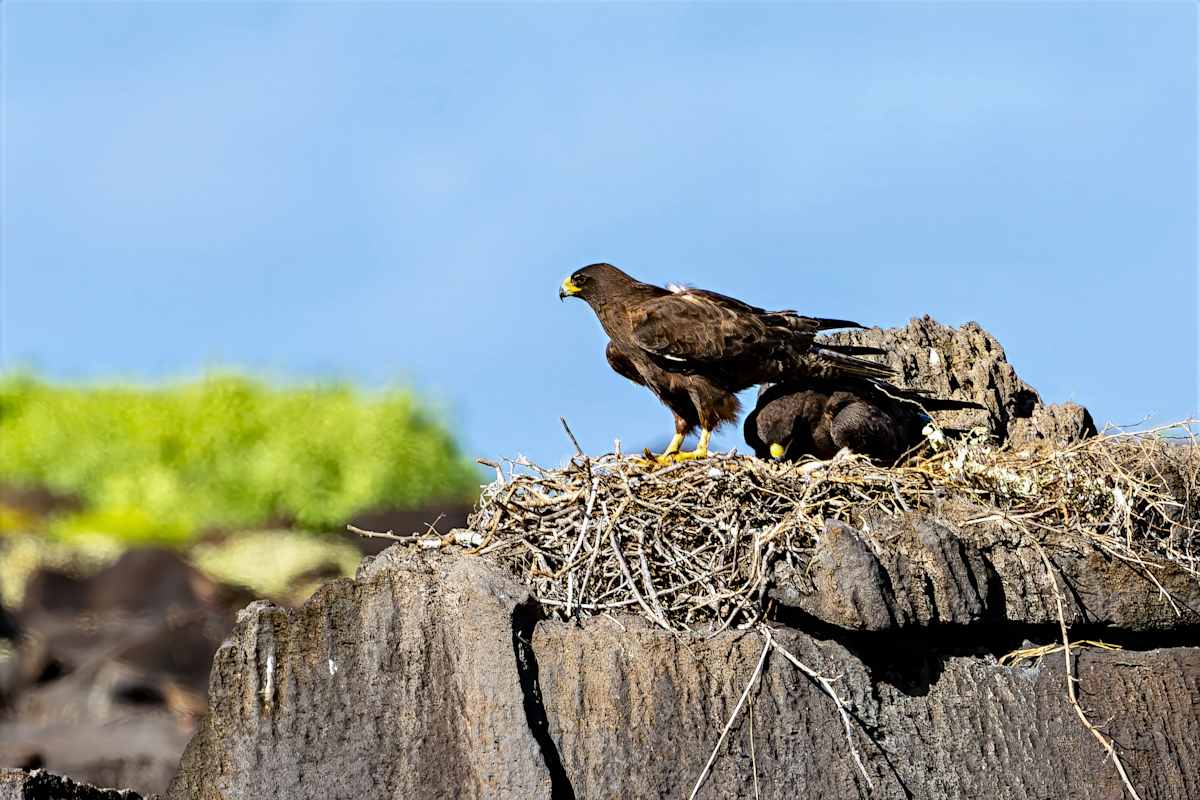
The Galápagos hawk (Buteo galapagoensis) is a large bird of prey endemic to the Galápagos Islands and serves as the archipelago's top terrestrial predator, filling the ecological niche that would otherwise be occupied by multiple raptor species elsewhere. It has broad, rounded wings and dark brownish-black plumage with lighter mottling, and adults typically measure around 22 inches in length, with females notably larger than males, as is common among raptors. Uniquely, it practices a rare mating system called cooperative polyandry, where a single female may mate with and share nesting duties among two to four males simultaneously, all of whom help incubate eggs and raise the young. Its diet is opportunistic and varied, including lava lizards, snakes, insects, small birds, rodents, and carrion, and it plays an important role in controlling populations of introduced species like rats. Having evolved without significant natural predators, the Galápagos hawk shows little fear of humans, a trait sometimes called "island tameness." Despite this fearlessness toward people, the species is considered vulnerable, with a total population of only a few hundred breeding pairs, threatened by habitat degradation, persecution by farmers protecting livestock, and introduced predators and diseases affecting their prey base.
- Subject Matter: Wildlife, birds
- Collections: Birds, Digital photography , Ecuador and Galapagos, Wildlife