
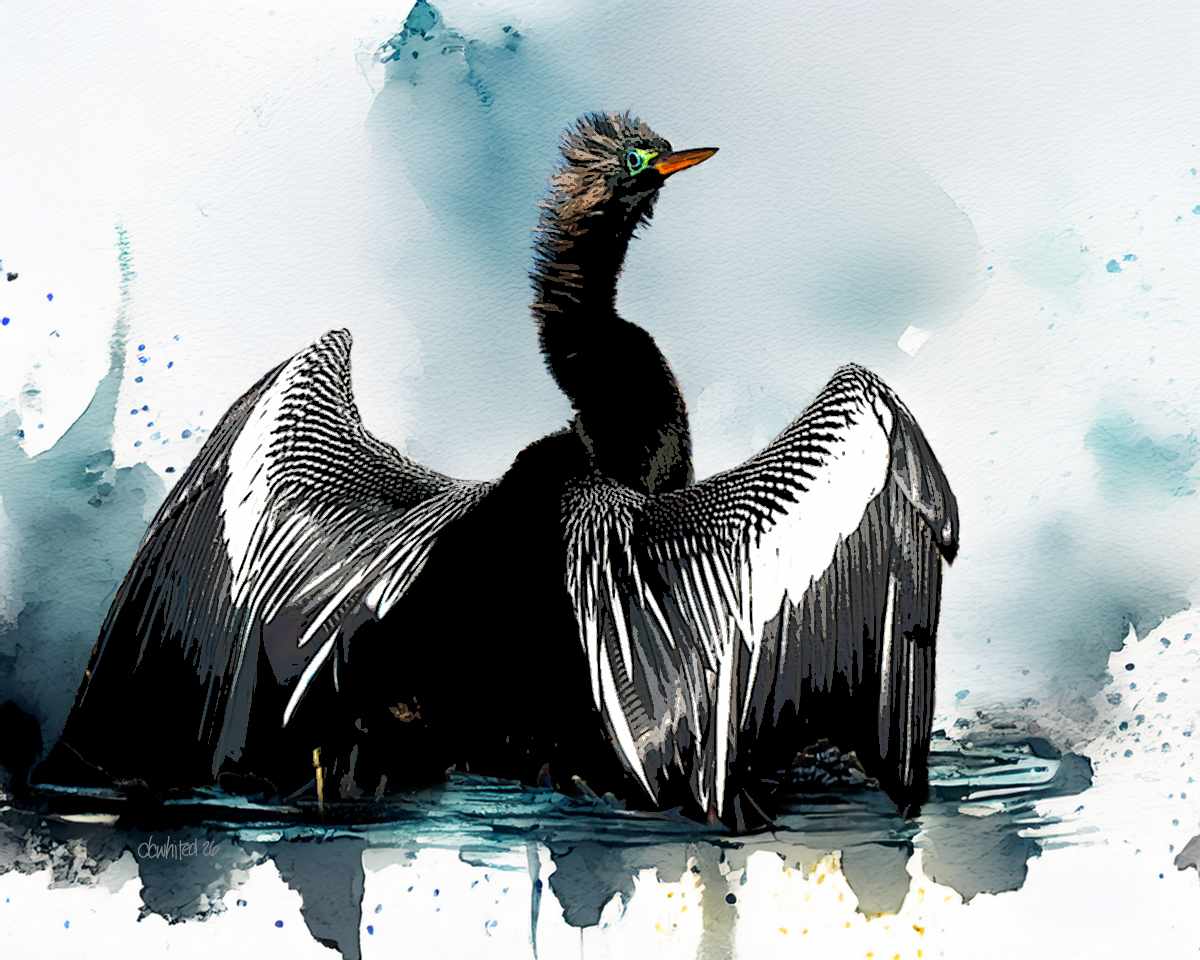
The anhinga (*Anhinga anhinga*), sometimes called the "snakebird" or "water turkey," is a large, prehistoric-looking waterbird found across the southeastern United States, Central America, and much of South America, frequenting freshwater lakes, swamps, marshes, and slow-moving rivers fringed with dense vegetation. It measures about 85 cm in length with a remarkable wingspan of up to 120 cm, and has a slender, sinuous neck, a long fan-shaped tail, and a sharply pointed, dagger-like bill that it uses to spear fish underwater with startling speed and precision. Males are dressed in glossy black and dark greenish plumage with striking white spots and streaks on the wings and upper back, while females and immatures sport a pale buff or tan head and neck that contrasts with their darker body. Unlike most waterbirds, the anhinga's feathers lack waterproofing oils, which reduces buoyancy and allows it to dive and swim with ease — but it comes at a cost, as the bird must spend considerable time perched with its wings spread wide to dry in the sun, a posture so characteristic and iconic that it has become the anhinga's most recognizable trademark. It is an extraordinarily graceful swimmer, propelling itself through the water entirely with its feet while its long neck undulates with an almost reptilian fluidity, well earning it the evocative nickname "snakebird."
- Subject Matter: Wildlife, birds
- Collections: Birds, Digital photography , Mixed Media , Wildlife