-
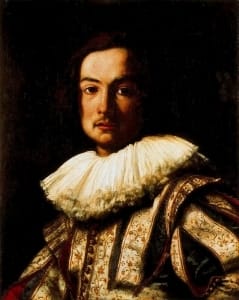
Artist: Stefano Della Bella (1610-1664)
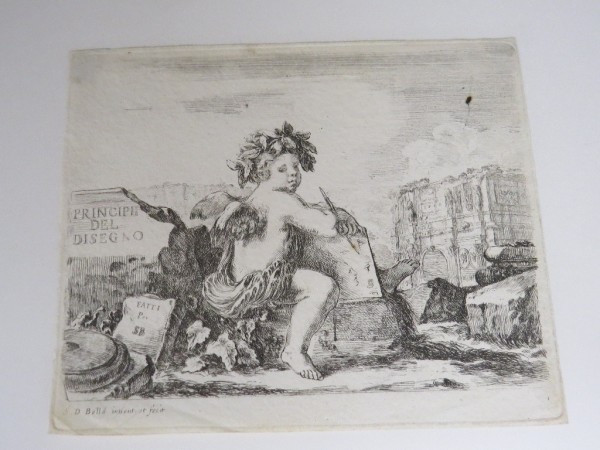
To begin, Stefano was born to an artistic family, as his father, Francesco della Bella, was a sculptor in Giambologna’s studio. Sadly, the patriarch died while the artist was a young child. Stefano and his brothers apprenticed in various specialties. One brother became a goldsmith, another a metalsmith, a third a sculptor, and the fourth trained as a painter. Stefano, on the other hand, began training as a goldsmith, and then he began studying painting with the Florentine painter Cesare Dandini. After painting, Stefano began studying with the etcher Remigio Cantagallina, who previously trained the French-born Medici Court artist Jacques Callot. Ultimately, Callot’s work inspired Stefano; however, he set himself apart in his capacity to step away from Callot’s mannerist tendencies and developed his own personal touch through lyrical and graceful etchings.
Unlike Callot, Stefano rarely worked indoors, preferring the city of Florence as his studio. He documented theatrical events, hunting parties, and tournaments, which provide a glimpse in to the lavish life of the late Medici Court. In 1627, at the age of seventeen, Stefano published his first work entitled The Banquet of the Piacevoli. The work details the festive Medici event, and the impressive detail of the etching led to further commissions and Medici patronage.
Stefano was listed on Don Lorenzo de’ Medici’s payroll, and he used the stipend to travel to Rome for further his training. He resided in Rome from 1633 to 1639, although he returned to Florence occasionally for events like Ferdinand II’s funeral, as documented through an etching. His walks along the Roman campagna rendered topographic material, and his style became more natural as he studied the Roman countryside and Roman works from the Classical and Renaissance past.
In 1639, Stefano traveled to Paris, where he joined Baron Alessandro del Nero’s entourage. At this time, print culture was flourishing in Paris, and he etched plates for François Langlois (then called Ciartres, 1589-1647), Israël Henriet (1590-1661), and Pierre I Mariette (1603-57). In Paris, one of his famous commissions included four sets of instructive cards to teach the young Louis XIV about history, geography, and mythology.
While in France, Stefano also worked for the Cardinals Armand de Richelieu and Jules Mazarin. Richelieu sent Stefano to the battle lines to depict the devastation of the Thirty Years’ War. The city of Paris was also experiencing financial and political turmoil, which created tension and hostility. The Italian born Cardinal Mazarin lost popularity, and hostility was ultimately extended towards all Italians living in Paris.
As a result, Stefano returned to Florence in 1650. From Florence, he continued to send plates and prints to Parisian publishers, and he also remained on the Medici payroll through Prince Mattias de Medici. He undertook the role of teacher and provided drawing lessons to Matthias’s nephew Cosimo III, who was Grand Duke Ferdinand II’s son. He would make a final trip to Rome, but he remained a Florentine resident until his death in 1664. Stefano’s etchings are a chronicle of life as seen through the eyes of a seventeenth-century traveling artist, and through his etchings, he shares his observations of the varied and inequitable world.