
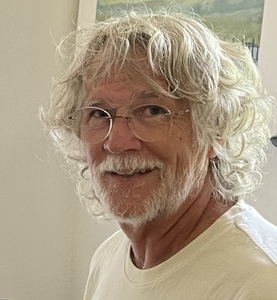
David G. Hyatt
Fayetteville, Arkansas
NW Arkansas artist David Hyatt blends a background in building and systems science into watermedia art exploring landscape, history, and human ambition.
MessageAbout David Hyatt
David Hyatt is an artist based in Northwest Arkansas working primarily in watermedia and wood. His artistic journey is anchored in a fascination with history, craftsmanship, and how things are put together. He is widely recognized for his artisan work reviving the nearly lost historical craft of gourd banjo-making. By hosting workshops and placing his custom-built instruments with professional recording musicians, David has spent years connecting the past and the future of the instrument—an experience that deeply shaped his transition into fine art.
Since 2021, David has focused his creative energy on watermedia to explore the sustainability and transience of human endeavor. He applies his unique background in systems science—the study of how social and ecological systems interact—to capture the search for a sense of place. Drawn to the quiet erosion of rural landscapes, his paintings feature weathered farm buildings, old machinery, and natural ecological cycles.
Current Work & Exhibitions
David is currently developing a 15-piece semi-abstract series titled Collapse and Renewal in Dust Country. This project traces the history of the Midwestern high prairie: its massive plow-up, its subsequent ecological collapse during the Dust Bowl drought, and its ultimate renewal through the waters of the Ogallala aquifer.
While David's work has primarily been collected for private homes, he is actively expanding his presence in the regional art scene. His work has been featured in group exhibitions across Northwest Arkansas, including:
- Mount Sequoyah (Fayetteville)
- Arts on Main (Van Buren)
- Olive and Opal Gallery (Siloam Springs)
- Fenix Arts (Fayetteville)
- Artists of Northwest Arkansas Gallery (Rogers)
Background & Education
David's diverse life experiences provide the raw material for his canvas. Raised in the Blue Ridge Mountains of Virginia, he originally trained and worked as a brick and stone mason. After moving to Arkansas, he specialized in restoring architectural antiques before pivoting to study accounting and systems science. He holds a Doctorate in Sustainable Systems Design from Case Western Reserve University and is an Emeritus Research Associate Professor from the University of Arkansas.
Across all his careers—from laying stone to academic research and painting—the underlying thread has always been design principles. David studied under acclaimed Arkansas watercolorist Richard Stephens and continues to refine his technique through extensive independent study.
Statement
My art comes from a pretty unusual mix of lives. I spent years working as a mason and custom contractor, went on to get a doctorate researching sustainable systems design, and eventually ended up teaching university supply chain courses. On paper, those fields don't seem to have much in common. But to me, they are all trying to answer the exact same question: how do we as humans build things, adapt, and try to root ourselves in a specific place?
For decades, my research focused on systems thinking—looking at how corporations, nonprofits, and nature collide. In the studio, that academic lens goes right onto the canvas. I’ve always been fascinated by the incredible optimism it takes to build a global shipping network or lay down a brick foundation. At the same time, my background reminds me that nothing we build lasts forever. My paintings look closely at that tension: our drive to create, the inevitable decay that follows, and the quiet way nature always reclaims its territory.
I mostly work with watermedia, focusing on the physical reminders of these cycles—think weathered machinery, old barns, and shifting landscapes. To tell these stories, I like to jump between styles. My impressionistic pieces are intuitive, using light and shadow to find the quiet, human traces left on the land. When I want to step back and look at the bigger picture, I move toward abstract forms. I use heavy texture and bold colors to map out massive, long-term histories like environmental collapse and renewal.
This abstract approach is the backbone of my recent series, Collapse and Renewal in Dust Country. I use structural grid motifs to show a major conflict from the Dust Bowl era: the sheer hubris of forcing rigid, artificial map lines onto a fragile, unpredictable ecosystem.
Ultimately, my paintings are my way of celebrating human ambition while staying completely clear-eyed about its limits. And, about having fun painting fun subjects.
Powered by Artwork Archive