
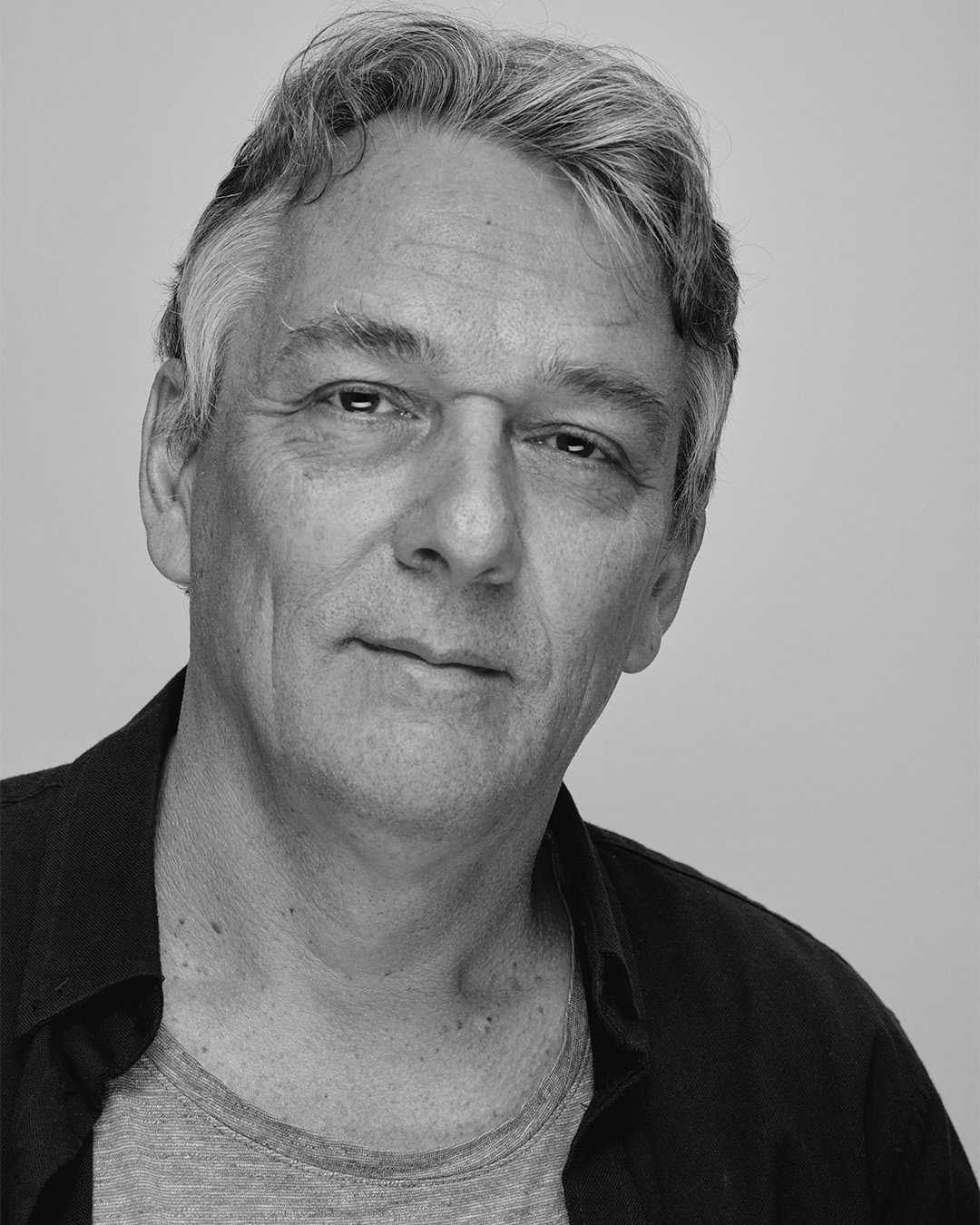
Bjarne Werner Sørensen (b. 1960) is a Danish-Faroese artist based in Copenhagen. He is known for his abstract paintings and graphic works, characterized by organic forms, rhythmic patterns, and a gestural use of color and texture. Working with a rich and nuanced palette, he creates contrasts between warm and cool tones, ranging from intense, vibrant compositions to more muted and subtle expressions.
His works often evoke natural structures—such as water, leaves, or microscopic organisms—through fluid, organic forms. A recurring element is a strong sense of movement, where repetitive patterns and lines generate rhythmic compositions. Balancing improvisation with control, his paintings frequently unfold in complex layers, inviting close attention to surface and depth. While rooted in observations of natural systems, his work remains distinctly abstract, often carrying a meditative quality.
Bjarne Werner was raised in Syria and Lebanon, and later in northern Copenhagen. Throughout his formative years, he moved between the Faroe Islands—his mother’s birthplace—and Copenhagen, where his father was born. This duality between remote landscape and urban environment has become a defining undercurrent in his work.
In 1975, his parents relocated to Iran, where he visited them before their return to Denmark in 1979. From 1982 to 1986, they lived in Thailand, where he attended art school, graduating in 1985, and continued his stay there the following year.
He has exhibited widely in Denmark, the United States, and internationally. His work has been supported through residencies in Helsinki, Bergen, Paris, Berlin, Iceland, and New York. He is the recipient of several grants and awards, and his works are included in public collections such as the National Gallery of Denmark and the New Carlsberg Foundation.
Statement
The paintings begin from a central core—an internal structure from which forms emerge and evolve. Working the canvas from all sides, the composition is continuously rotated, twisted, and reconfigured throughout the process. While the works share a consistent format, each develops its own distinct balance of color, rhythm, and spatial tension.
Rooted in a fundamental perception of movement, the paintings unfold as an interplay between chaos, energy, and order. Scattered and gathered at once, they form shifting, organic geometries—like systems in constant transformation. The visible brushstrokes and encounters between colors emphasize the physical act of painting, oscillating between tactile immediacy and associative drift, where space seems to open behind the surface.
The works are non-representational, yet suggestive of natural phenomena—inner forces rather than external motifs. Improvisation plays a central role: a process akin to nature itself, unfolding without fixed beginning or end. In this sense, painting becomes a continuation of natural processes—an exploration of form, matter, and movement returning into awareness.