
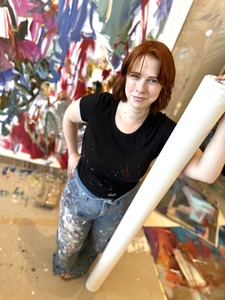
While growing up in rural Kansas, Annie Monfort aspired to be a ‘starving artist’ because it seemed ‘tragically romantic’. She painted her first acrylic still life at age 18 and didn’t touch a brush again until she was 39.
Instead, Annie achieved a BFA in graphic design, establishing a career and life in Kansas City, MO with her partner, Brian Dolny.
In 2018, at age 36, Annie became a ‘young widow’ when Brian unexpectedly died. She packed their belongings into storage and left life in Kansas City behind.
In the subsequent 11 months Annie traveled to 14 countries — starting in India and Southeast Asia, venturing as far east as Bali before winding west through Istanbul, the Balkans, and Western Europe. Annie absorbed memories of colors, patterns, and foreign cultures while moving through the landscape of complicated grief and uncertainty.
Her travels were put into limbo when the COVID-19 pandemic struck, leaving Annie back in Kansas on the family farm. During this time of remote stillness and grief, Annie felt a deep pull to bring these emotions out through abstract painting.
No longer using the representational style of her youth, abstract painting became a channel for personal transformation. Her large-scale acrylic paintings explore impulse and compulsive actions, as well as the necessary steps of reacting to what’s in front of you instead of ruminating on futures that will never be — accepting what is without trying to attribute higher meaning or significance. Much of her process is a subconscious conversation with instinct, trusting that something captivating will emerge transformed from beginning gestures and strokes — building on the past, even if painful, to create a future existence.
Primarily self-taught, Annie has attended workshops learning from abstract expressionist painters including Julie Schumer, Cat Tesla, Julie Tarsha, Beverly Todd, Toni Lyons-Phillips, and Jane Burton.
Statement
The many deaths of ourselves
are multifarious— some apocalypses,
but more often insignificant ends
that happen daily if we look closely.
We reincarnate with the memory of what was
—the before, the after—existing in tandem
while we are pulled between.
The past is nothing but a story,
a fractured memory with gravitational pull.
The future slipped away.
I am forgetting the words
that gave us shape.
Something that was lost its cohesion,
uncertainty remains behind.
Impressions and artifacts
leave questions unanswered,
vestiges are rewritten over time.
I search for you in dreams of infinity,
but it’s my face that I find.
After my personal apocalypse, what remained for me but the volta — or, in poetry, the dramatic turn in thought — taking me somewhere unexpected? In the time since, I am learning to turn into the discomfort to emerge in new places with a sense of freedom and space to be seen vulnerably. In many ways, my return to painting is a return to childish whims and romanticisms that I let go of when my life seemed more certain and within control.
I can’t separate this moment of creative reawakening from the tragedy of my past any more than I can fully cover layers of paint without seeing traces and shadows showing through. I’ve lived with the loss of my partner for six years now — and I am forced to accept what is — but the process of therapizing and analyzing kept my pain raw, like a rash that doesn’t itch until you notice its presence.
Instead, I seek liberation and possibility on canvas — an infinite source of what-ifs. I spread my fingers through paint, reaching to brush possibility back into my life, while leaving vestiges behind. I’m pivoting towards instead of away. I’m daring to live, instead of just exist.
Powered by Artwork Archive