
Akiko Oncken
Sisters, OR
I’m Akiko Oncken, a contemporary artist based in Oregon. I create work in the space between observation and emotion.
Message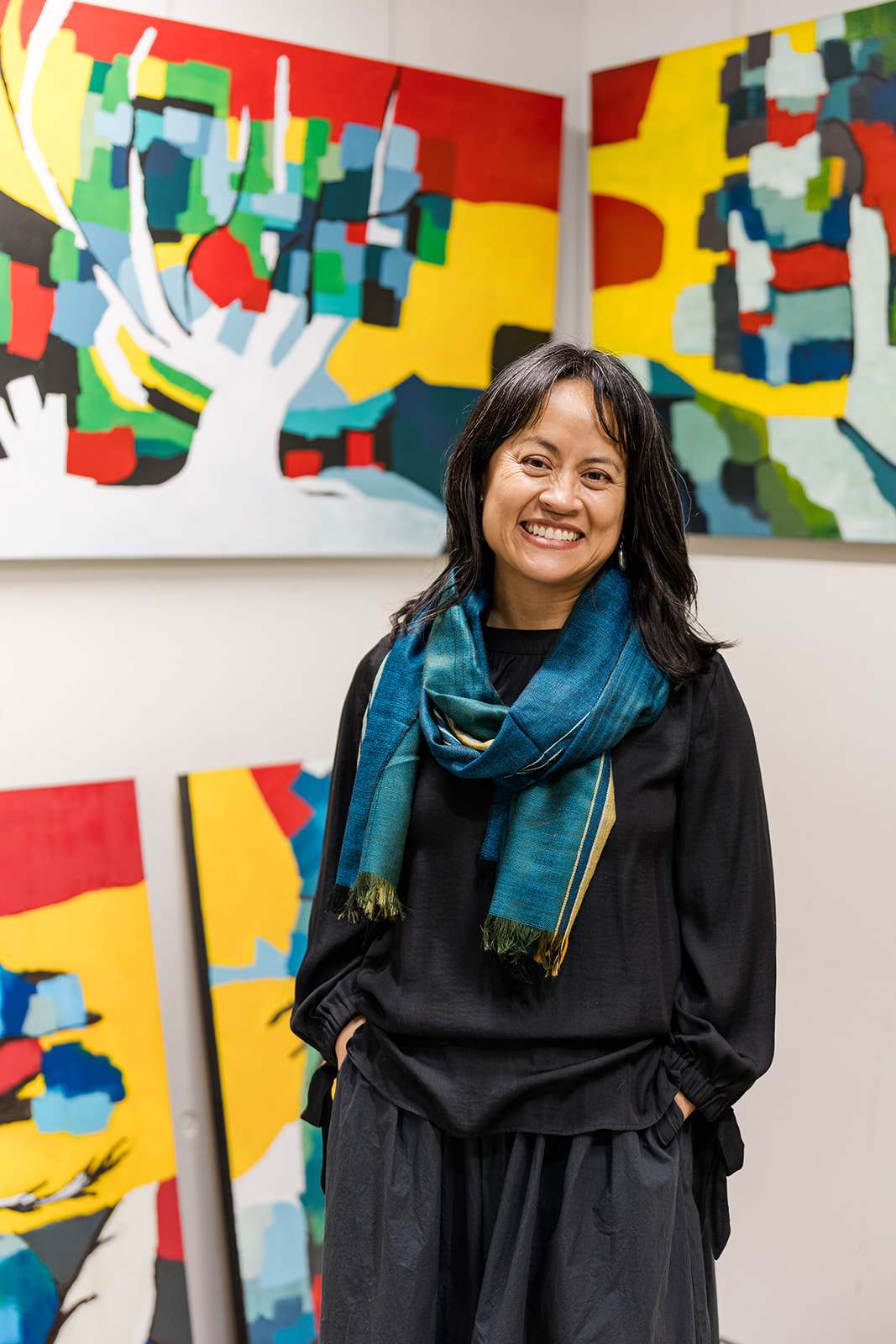
I'm Akiko Oncken, a contemporary painter and photographer creating from my studio in Sisters, Oregon, where the high desert light shifts hourly and the mountains remind me that beauty exists in both the vast and the intimate.
I'm Japanese-Ecuadorian, born in South America and raised celebrating both heritages — a blend of cultures that shaped my worldview, my curiosity, and the way I connect with the world. This bicultural foundation informs everything I create, from the subjects I'm drawn to, to the way I see color and form.
I love to inhabit as an artist the space between observation and emotion — where a still life becomes a study in attention, a landscape transforms into feeling, and abstraction gives form to what cannot be named.
Working across painting, mixed media, and photography, I explore different ways of seeing. Photography allows me to capture subjects with realist precision, evoking specific feelings through composition and light. Painting and mixed media offer something else entirely — territories for rediscovery where I'm less interested in realism than in what's evocative, intuitive, emotionally true.
Figuration and still life has drawn me in since adolescence for its quiet intensity. There's a serenity in building a composition from carefully chosen elements, in allowing my attention to refine as I observe each object. The ordinary becomes luminous when you look long enough. A bowl, a flower, the way light falls across fabric — these aren't just objects. They're invitations to slow down, to see what's actually there.
Landscapes and urbanscapes pull me in through empathy. I'm often captivated by the human figure within these spaces—the way someone stands in a doorway, moves through a street, inhabits a moment. I find myself imagining what it would be like to be in their shoes, to embody their posture and movement. That emotional response—the feeling they evoke, the story I imagine—guides what I choose to paint. These works often live between fauvism and abstract expressionism, where feeling takes precedence over precise representation.
My process is intuitive and unbound. I may begin on watercolor paper with loose washes of color and texture, layering acrylics, gouache, watercolor, then moving into charcoal and pastels. Other times, a subject arrives fully formed and I move directly to large canvas. I work with gesso, palette knives, favorite brushes, my hands and fingers. Lately, corrugated cardboard has entered as collage, adding unexpected texture and dimension.
I don't follow prescribed methods. I follow the energy of the piece. Some works begin as studies on paper and evolve into larger canvases. Others demand immediate scale. I often work on multiple pieces simultaneously, flowing between them as each asks for attention.
Abstraction happens when I need to let emotional and energetic states emerge unimpeded — no subject, no representation, just color, gesture, mark-making. These pieces expand the horizon of possibilities, unconfined by particular styles or movements. They exist purely as emotional and energetic expression.
Before I commit to a subject, I ask myself: What draws me here? What aspect of my inner landscape is reflected in this impulse? I journal, I reflect, I let ideas percolate — thematic concepts arrive while driving, walking, observing. Sometimes the answer reveals a series worth exploring. Other times, the subject and the impulse present themselves so clearly that all that's left is to approach the canvas and create.
I'm always discovering my creative voice. It remains in perpetual evolution — exhilarating and vulnerable in equal measure. I'm inspired by light, by the way it casts ordinary elements into extraordinary relief. By patterns. By the expressive nature of mark-making. By color as emotional language.
My current collection, Juniperus, grew out of a lifelong tension: the longing to feel rooted, and the reality that rootedness is something you choose and build. I grew up in Ecuador in a body that didn’t “match” what people expected. With an Ecuadorian mother and a Japanese father, I learned early what it feels like to have to prove you belong. Junipers thrive in harsh conditions — they contort, adapt, shelter, and hold the soil. I’m even allergic to them, which makes the metaphor more honest: sometimes what you’re drawn to also challenges you.
In Juniperus, I set constraints on purpose — bold, primary energy; vibrancy held evenly, never chaos. These paintings live at the intersection of warmth and restraint, spark and structure — nature as identity, and adaptation as intelligence.
Statement
I love to inhabit as an artist the space between observation and emotion — where a still life becomes a study in attention, a landscape transforms into feeling, and abstraction gives form to what cannot be named.
Working across painting, mixed media, and photography, I explore different ways of seeing. Photography allows me to capture subjects with realist precision, evoking specific feelings through composition and light. Painting and mixed media offer something else entirely — territories for rediscovery where I'm less interested in realism than in what's evocative, intuitive, emotionally true.
Figuration and still life — nature morte — has drawn me in since adolescence for its quiet intensity. There's a serenity in building a composition from carefully chosen elements, in allowing my attention to refine as I observe each object. The ordinary becomes luminous when you look long enough. A bowl, a flower, the way light falls across fabric — these aren't just objects. They're invitations to slow down, to see what's actually there.
Landscapes and urbanscapes pull me in through empathy. I'm often captivated by the human figure within these spaces—the way someone stands in a doorway, moves through a street, inhabits a moment. I find myself imagining what it would be like to be in their shoes, to embody their posture and movement. That emotional response—the feeling they evoke, the story I imagine—guides what I choose to paint. These works often live between fauvism and abstract expressionism, where feeling takes precedence over precise representation.
My process is intuitive and unbound. I may begin on watercolor paper with loose washes of color and texture, layering acrylics, gouache, watercolor, then moving into charcoal and pastels. Other times, a subject arrives fully formed and I move directly to large canvas. I work with gesso, palette knives, favorite brushes, my hands and fingers. Lately, corrugated cardboard has entered as collage, adding unexpected texture and dimension.
I don't follow prescribed methods. I follow the energy of the piece. Some works begin as studies on paper and evolve into larger canvases. Others demand immediate scale. I often work on multiple pieces simultaneously, flowing between them as each asks for attention.
Abstraction happens when I need to let emotional and energetic states emerge unimpeded — no subject, no representation, just color, gesture, mark-making. These pieces expand the horizon of possibilities, unconfined by particular styles or movements. They exist purely as emotional and energetic expression.
Before I commit to a subject, I ask myself: What draws me here? What aspect of my inner landscape is reflected in this impulse? I journal, I reflect, I let ideas percolate — thematic concepts arrive while driving, walking, observing. Sometimes the answer reveals a series worth exploring. Other times, the subject and the impulse present themselves so clearly that all that's left is to approach the canvas and create.
I'm always discovering my creative voice. It remains in perpetual evolution — exhilarating and vulnerable in equal measure. I'm inspired by light, by the way it casts ordinary elements into extraordinary relief. By patterns. By the expressive nature of mark-making. By color as emotional language.
My current collection, Juniperus, grew out of a lifelong tension: the longing to feel rooted, and the reality that rootedness is something you choose and build. I grew up in Ecuador in a body that didn’t “match” what people expected. With an Ecuadorian mother and a Japanese father, I learned early what it feels like to have to prove you belong. Junipers thrive in harsh conditions—they contort, adapt, shelter, and hold the soil. I’m even allergic to them, which makes the metaphor more honest: sometimes what you’re drawn to also challenges you.
In Juniperus, I set constraints on purpose — bold, primary energy; vibrancy held evenly, never chaos. These paintings live at the intersection of warmth and restraint, spark and structure — nature as identity, and adaptation as intelligence.