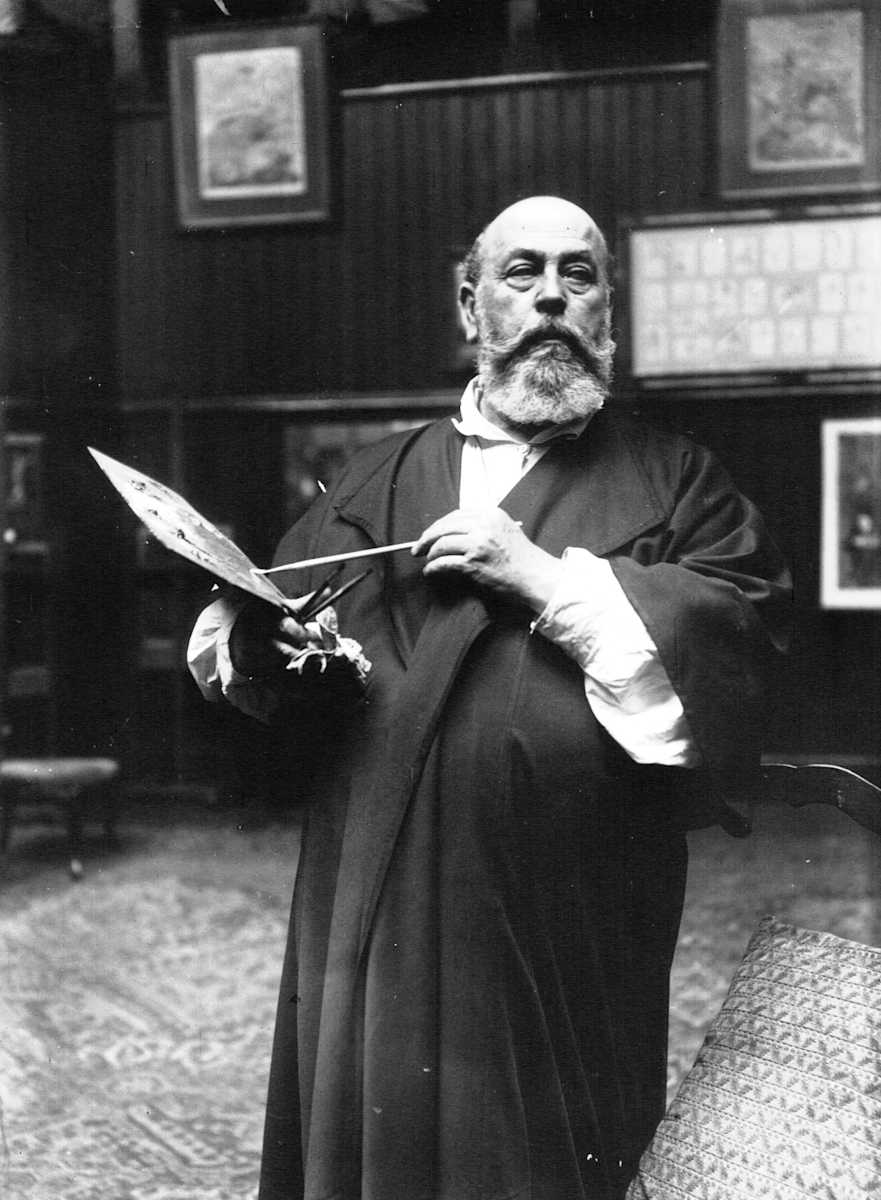
Paul-Albert Besnard (1849–1934), commonly known as Albert Besnard, was a French painter and printmaker celebrated for his portraits, public murals, and expressive treatment of light and color. Born in Paris on June 2, 1849, he entered the École des Beaux-Arts in 1866 and studied under Alexandre Cabanel. In 1874, he won the prestigious Prix de Rome for The Death of Timophanes, which enabled him to continue his training in Italy. Académie française
After his stay in Rome, Besnard spent three years in England with his wife, the sculptor Charlotte Dubray. His mature style combined academic drawing and composition with the freer handling of color and light associated with Impressionism. He painted portraits, landscapes, and scenes of family life, while also developing a substantial practice in etching. In 1890, he helped found the Société Nationale des Beaux-Arts. Académie française
Besnard became an accomplished decorative painter, receiving commissions for major Parisian buildings, including the Hôtel de Ville, the Sorbonne, the Comédie-Française, and the Petit Palais. His travels to Algeria and India also supplied subjects for his paintings. Among his notable portraits is Madame Roger Jourdain (1886). Académie française
His later career brought prominent institutional appointments: he joined the Académie des Beaux-Arts in 1912, became director of the French Academy in Rome in 1913, and was appointed director of the École des Beaux-Arts in Paris in 1922. Elected to the Académie française in 1924, he died in Paris on December 4, 1934, aged 85. His work connects the traditions of French academic art with the interest in light and color that reshaped painting during his lifetime. Académie française