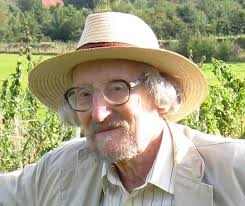
A painter-etcher, writer, and for ten years, 1983-93, editor of the Journal of the Royal Society of Painter-Etchers, Michael was a lover of art, jazz and animals; he also had an eye for the humour in life.
Born and raised in Hove, where his father ran a newsagency, Michael Blaker’s paternal grandfather and grand uncle had both been aldermen and, turn and turn about, mayors of the municipality of Brighton & Hove. His maternal grandparents ran the Elite café and oyster bar beneath the Brighton promenade. They were Swiss immigrants of Italian extraction; he a Lanfranchi (Dante had met an ancestor in Hell) and she a Giuliani, granddaughter of a Longhi, and descendant of the Venetian painter Pietro Longhi (1701-1785). Blaker’s mother had attended Brighton School of Art.
Michael described this ‘revelation’ and the excitement of his discovery in his Autobiography.
"The very atmosphere of the etching room, with the white dishes of dangerous green acid, the procedure of dampening down the best rag paper, of smoking the beeswax ground – the air of devoted, monastic dedication, seemed archaic…We lived for the Friday all-day sessions, and I spent a great deal of time studying the history and methods of my new interest. From that moment when I had looked through the fanlight from my scaffolding and seen the etching room at work I had known by divine intuition that it was to be my selected way of life. Nevertheless, I was still involved, and was to continue to be so – we are, after all, essentially Painter-Etchers … with painting, modelling and sculpture"
Educated at Brighton Grammar School, except during a brief period of War time evacuation to Kendal, Michael became increasingly interested in animals, beetles and the natural world in general, and took up taxidermy. As a boy and young man his bedroom in the Brighton family home was reminiscent of a ‘cabinet of curiosities’ such as collected by artists of the 16th-18th centuries. An early etching showed one of his favourite haunts, the Skeleton Room of Brighton Museum. In the Sixth Form Michael was allowed to take on a small room adjacent to the art room as his studio.Blaker was enrolled at the Brighton School of Art in 1945. In his first two years he followed the usual Intermediate course, a traditional introduction to different areas of the fine arts, but which did not include etching. It was while painting a mural on the staircase wall in the School overlooking the etching room that his future interest in etching was determined. For his final two years of his course he chose to specialise in Illustration, in which etching was part of the curriculum.
Blaker would return to Brighton School of Art nearly a decade later, as a dedicated student of etching. In between these two stints at the School of Art, Blaker visited Paris, and spent some time in London, running his own art gallery in a cellar behind New Bond Street, where he also produced an Art Gazette (which ran to four issues) before returning to Brighton.
Extremely short-sighted, Blaker was exempted from National Service, so back in Brighton he returned to the School of Art in 1955-56 for a period to take advantage of the Friday Etching classes.
Working directly into the plate, sometimes adding aquatint, or roughening the surface to get a mezzotint effect, he made portraits of his fellow students. He began to use zinc rather than copper for larger plates.In 1957 Michael was elected an Associate of the Royal Society of Painter-Etchers. The same year, at Brighton School of Art he and friends formed a spasm jazz band, The Eminent Victorians, and for a while jazz-playing occupied much of his spare time. Brighton had a very active Traditional Jazz scene at this period.Also in the late 1950’s and early ‘60’s Michael spent time at Ditchling. As a temporary job one summer he painted inn signs for Crosby Cook who lived in Brangwyn’s former home, The Jointure. Cook had been a lithographic printer and worked with Brangwyn on his posters. After Brangwyn’s death, he and his family moved into The Jointure, from where he ran a sign painting business. His daughter Diana was a student at Brighton College of Art in 1957 and Michael helped her with her etching.
Michael was friends with some of the artists of the Guild of St Dominic, some of whom taught at Brighton College of Art. During Michael’s first stint at Brighton he was taught silversmithing by Guild member Douglas Pruden and it was Pruden who suggested he sleep in the now empty gypsy caravan near their workshops. Pruden had built it earlier.
By the late 1950’s Eric Gill had long left the Ditchling community but Michael also spent a few weeks at Pigotts, near High Wycombe, at Gill’s last guild workshop. There were too, travels to the Continent.
It was only in the mid-1970’s, when he met and married Catriona McTurk, that Blaker moved on from his peripatetic rather Bohemian way of life. In 1978 they bought a house with a garden in Rochester, soon acquiring a cat and two dogs; it was their home until they moved to Ramsgate in 1987.
Michael decided to make his living primarily from selling etchings through commercial galleries, and in relation to this began to hand-colour his impressions with watercolour washes, an unusual procedure at that time.
Blaker’s Autobiography (published 1986) opens with
An etching should, of course, traditionally, be in black and white. It has “always been” and to the mind there at once leaps the image of a thin black frame enclosing a vast white mount in which the print - ideally rather small – sits enshrined with rather more authority about it than an old master drawing. There is, and always has been as Sickert inferred, something about an etching.
However,
It was pointed out to me (by the galleries in the late 1970’s) clearly and incisively that monochrome etchings, however painstakingly delineated, would not sell. Colour, was all they bought. Did they? I didn’t. Nor did many people I knew. Nor did the painter-etchers of the old school favour it. Colour to a painter-etcher had been an anathema. However, the whole new modern school of printmaking went in for colour wholesale. My own approach was admittedly, unmitigated Nineteenth Century; but that was what I liked… I was not going to change, because I only wanted to draw what I saw, and what I saw was seen with the eyes of that period, even when I inserted a contemporary car into a plate.
Interest of subject matter and detail were his overriding preoccupations.
“Why not colour them as you colour your watercolours?” Said Catriona.
“Or like the Eighteenth century aquatints - gentle, delicate washes - ”
I commenced to do this.
And sales duly followed. In 1985 one of his exhibits at the R.A. Summer show, printed in an edition of 200, completely sold out.
Blaker had been exhibiting etchings at the R.E. from 1957 and at the Royal Academy from 1965. It was only from 1965 that he began to print editions from his plates. Over the following years he increased the potential size of his editions, in some cases to 300, though usually far fewer impressions were actually printed.
Michael’s etchings are like a mirror on his life.