EN.WIKIPEDIA.ORG
Artistic Career and Political Engagement
In the late 1920s, Rowe's work designing posters for a left-wing bookshop led to his introduction to the Communist Manifesto, profoundly influencing his political views. This ideological shift prompted a significant period in his life; in 1930, he traveled to the Soviet Union, where he spent 18 months working at the Foreign Workers' Publishing House. This experience deepened his commitment to socialist principles and reinforced his belief in art as a vehicle for social change.
EN.WIKIPEDIA.ORG
Upon returning to Britain, Rowe co-founded the Artists' International Association (AIA) in 1933 alongside artists such as Pearl Binder, Misha Black, James Fitton, James Boswell, James Holland, and Edward Ardizzone. The AIA aimed to unify artists in opposition to imperialist wars, fascism, and colonial oppression, advocating for peace, democracy, and cultural development. The association engaged in designing propaganda materials and sought to improve working conditions for artists, emphasizing the role of art in societal progress.
EN.WIKIPEDIA.ORG
Artistic Style and Legacy
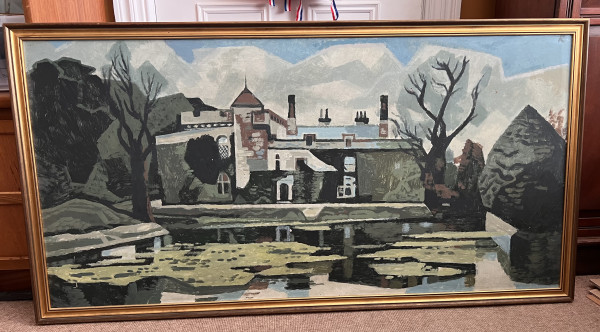
Rowe's artistic oeuvre is characterized by a focus on industrial scenes and the daily lives of working people, reflecting his socialist ideals. Initially influenced by Socialist Realism, his style evolved over the decades, becoming more abstract in the 1960s while maintaining a consistent emphasis on labor and industry. Notable works include "The Fried Fish Shop" (1936), which captures everyday urban life, and "Woman Looking Through a Microscope," highlighting the role of women in scientific fields.
ARTUK.ORG
Throughout his career, Rowe also contributed illustrations and designs for various publications, including those of the Communist Party of Great Britain, to which he remained affiliated throughout his life. His commitment to creating socially relevant art has left a lasting impact, with many of his works held in public collections, notably at The People's History Museum.
PHM.ORG.UK
Cliff Rowe's legacy endures as a testament to the power of art in advocating for social justice and reflecting the experiences of the working class.
As well as his painting output, Rowe produced dust jacket designs and illustrations for books, he did promotional commissions for the Attlee Labour government, designs for the 1951 Festival of Britain, commercial work for trade unions, and a number of illustrations for political publications. The majority of Rowe’s work is in The People’s History Museum collections.