Series Title: Survival Series (full subtitle: The Survival Series: Making Earth Systems Visible)
Timeframe: 1970 to 1973
Exhibitions:
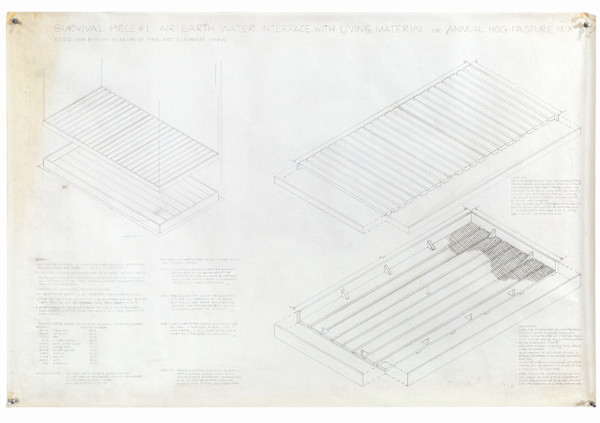
- Feb 1971, Survival Piece #1: Hog Pasture, Museum of Fine Arts, Boston, MA (commissioned for the group exhibition Earth, Air, Fire, Water: Elements of Art) Curated by Virginia Gunter
- May 11 – Nov 7, 1971, Art and Technology, Los Angeles County Museum of Art (LACMA), Los Angeles, CA (featured in the Art and Technology exhibition)
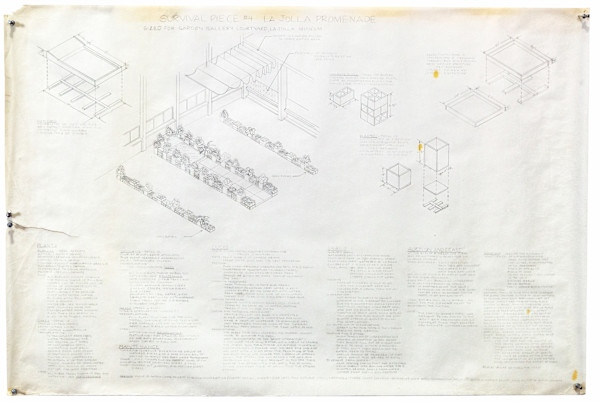
- 1971, Survival Piece IV La Jolla Promenade, Museum of Contemporary Art San Diego, La Jolla, CA
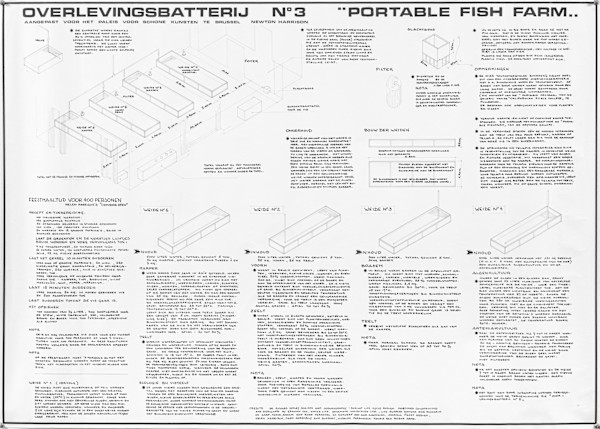
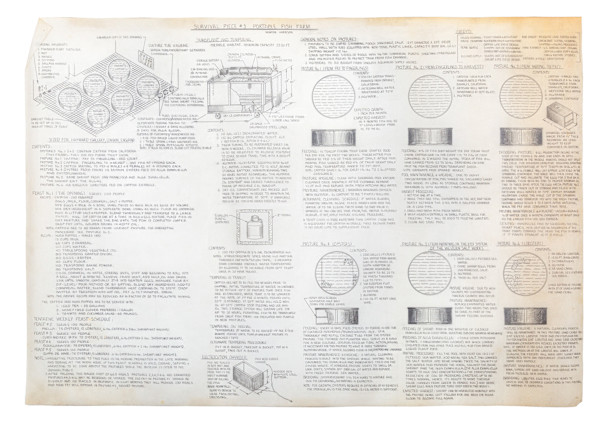
- Dec 1971 – Jan 1972, Survival Piece #3: Portable Fish Farm, Museum of Contemporary Art (MCA), Chicago, IL (solo installation / performance showing life cycle, harvesting, and feast)
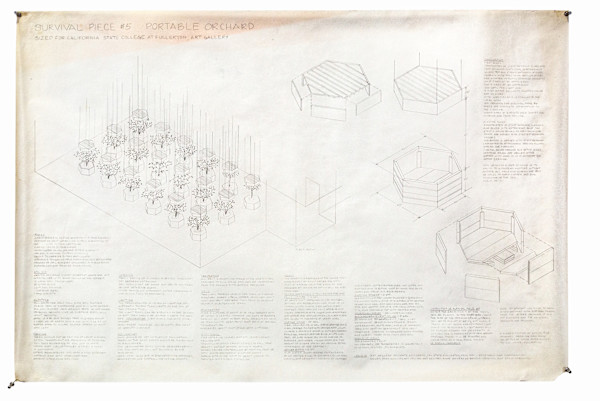
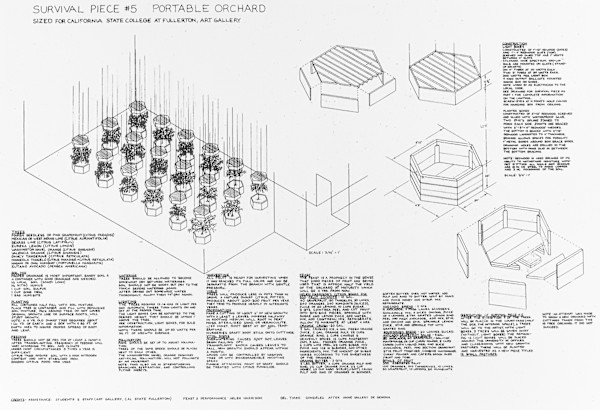
- 1972, Survival Piece V Portable Orchard, California State University, Fullerton, CA
- 2016, Hippie Modernism, Walker Art Center, Minneapolis, MN
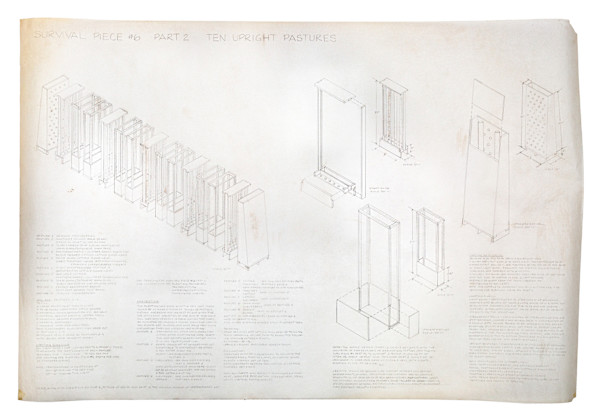
- 1972, Survival Piece VI Portable Farm, Contemporary Arts Museum Houston, TX
- 2009, Survival Piece VI Portable Farm, Barbican Centre, London, Great Britain
- 2013, Survival Piece VI Portable Farm, Contemporary Arts Center, Cincinnati, OH
- 1972, Survival Piece #5: Portable Orchard, California State University, Fullerton, CA (first presentation of the indoor 18-tree citrus grove)
- 1972, 11 Los Angeles Artists Exhibition, Palais des Beaux-Arts Brussels, Belgium
- 1973, Survival Piece III, Hayward Gallery, London, UK
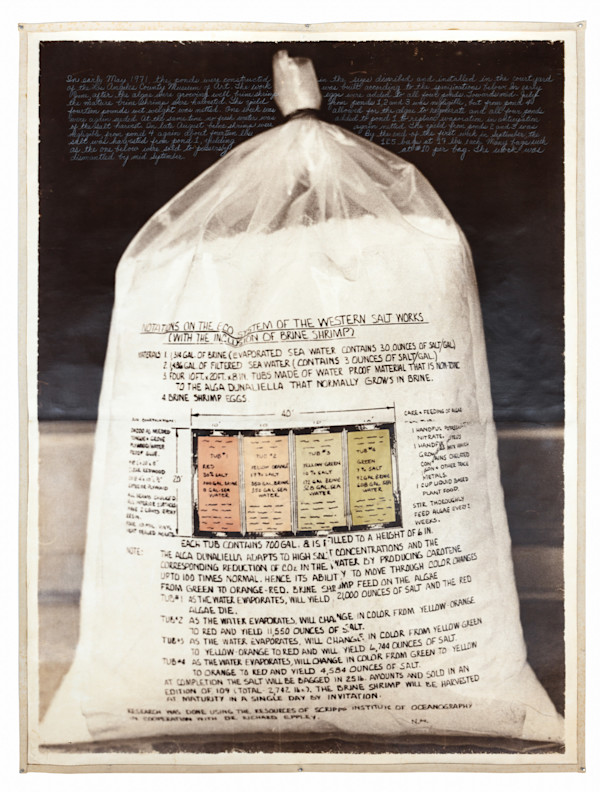
- 2002, Survival Piece II Notations on the Ecosystem of the Western Saltworks with the Inclusion of Brine Shrimp, Les Abattoirs, Toulouse, France
- June 29, 2024 – Jan 5, 2025, Survival Piece #5: Portable Orchard, Whitney Museum of American Art, New York, NY (first standalone museum restaging of the fully realized 18-tree citrus grove installation)
- Sept 19, 2024 – Jan 19, 2025, Helen and Newton Harrison: California Work, La Jolla Historical Society / San Diego Public Library, San Diego, CA (PST ART exhibition featuring original sketches, drawings, and plans from the Survival Series)
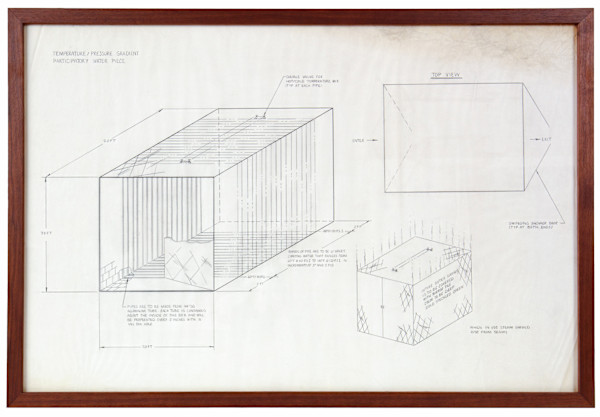
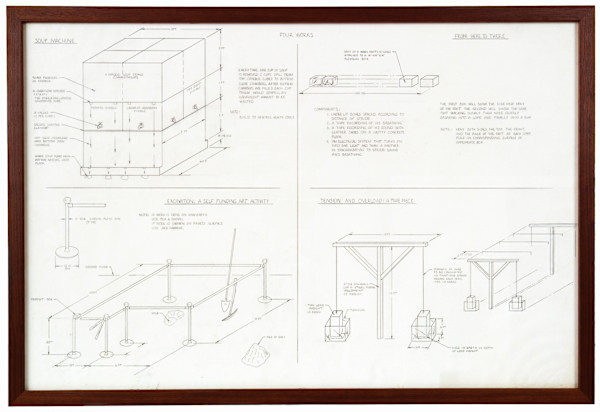
The Survival Series (1970–1973) transformed gallery spaces into functional, self-contained food production systems to directly address ecological stability and food security. By integrating agriculture, aquaculture, and soil creation into art institutions, these pioneering installations challenged audiences to confront the vulnerability of natural resources and reconsider humanity’s relationship with the biosphere. Today, the series remains a foundational blueprint for ecological art, bio-design, and environmental stewardship.
-
Making Earth (1970)
- A foundational performance-installation focused on topsoil creation as the fundamental basis of life. Organic waste, clay, sand, and manure were systematically layered, turned, and watered indoors to generate fertile compost, highlighting the time and labor required to rebuild degraded land.
-
Survival Piece #1: Hog Pasture (1970–1971)
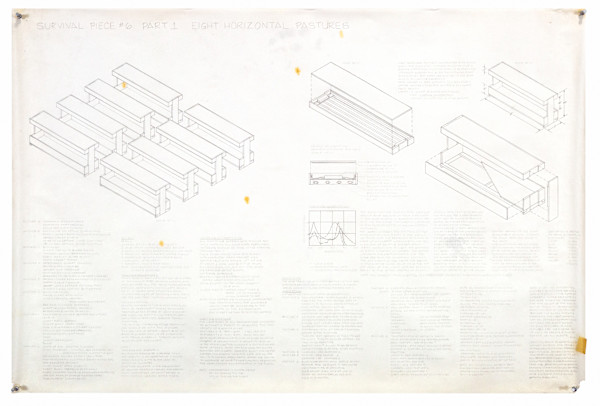
- A live indoor meadow constructed using a variety of pasture grasses and clover. Originally proposed for the Museum of Modern Art (MoMA), the piece was intended to be grazed by a small herd of hogs, directly connecting agricultural cycles with the art gallery context.
-
Survival Piece #2: Notional Eco-System / Full Farm (1971)
- A conceptual master plan mapping out an integrated, self-sustaining agricultural system. It established the theoretical framework for combining crop production, aquaculture, and waste recycling into a unified, closed-loop urban farm.
-
Survival Piece #3: Portable Fish Farm (1971)
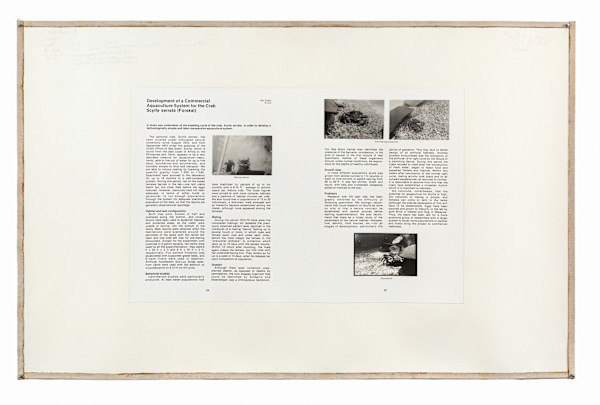
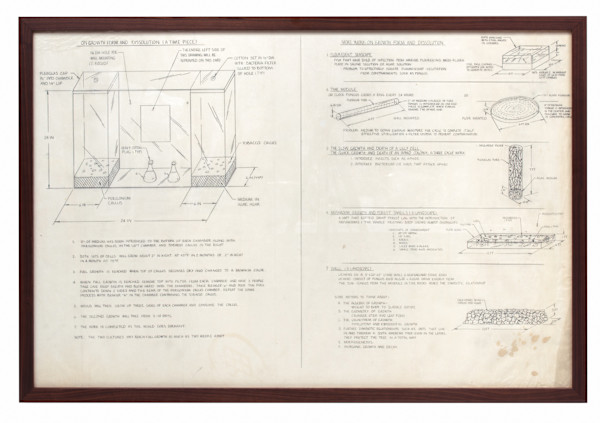
- A functional indoor aquaculture installation consisting of several large, shallow wooden tanks stocked with catfish, lobsters, and brine shrimp. The work culminated in a public harvest and feast, forcing museum visitors to confront the industrial processing and ethics of food production.
-
Survival Piece #4: Portable Farm / La Jolla Promenade (1971)
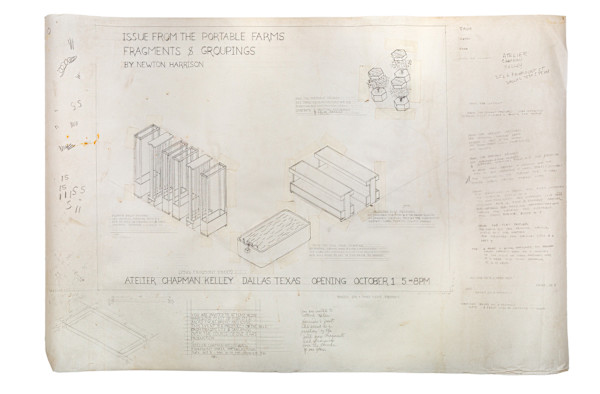
- A series of elevated, modular growing beds installed at UC San Diego. Designed to test community self-reliance, the beds produced high-yield crops (including tomatoes, cabbages, and greens) using efficient drip irrigation techniques.
-
Survival Piece #5: Portable Orchard (1972–1973)
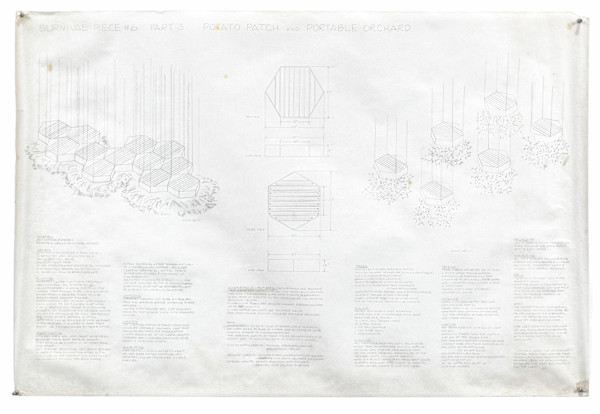
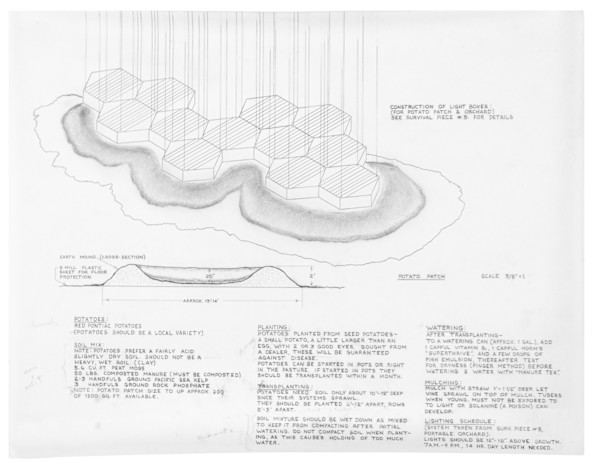
- An indoor grid of 18 citrus trees housed in custom hexagonal wooden planters. Each tree was equipped with its own overhead grow light and drip irrigation system, creating an artificial biosphere that questioned the future of agriculture in urbanized or climate-compromised environments.
-
Survival Piece #6: Meadow Farm (1972)
- An outdoor ecological restoration experiment designed to study native meadow growth and soil regeneration without synthetic inputs, providing a model for sustainable pasture management.
-
Survival Piece #7: Multi-Sited Eco-System (1973)
- A expansion of earlier models into broader regional contexts, mapping out decentralized, interconnected food systems across multiple urban and suburban sites to demonstrate regional resilience.