The Second Lagoon Sea Grant
Our choice of creature for the Portable Fish Farm in 1971 had proved to be problematic. The catfish that were shipped to London from California were wrongly packed, and most did not survive. Graham Cox, an aquarium director, was dispatched to bring a new school of fish, and he did this with amazing skill. Nonetheless, the fish would not mate in the tanks.
Graham introduced us to Ranil Senanayake, a herpetologist from Sri Lanka. He told us about a fast-growing, edible, cannibalistic crab in Sri Lanka, Scylla serrata, that was very hardy. It was the last to die when the tidal ponds dried up and could crawl across the land to find another pond; it mated in ponds four paces by five paces across and waist high. It was a favorite food of his people, but the foreign fleets were fishing them out.
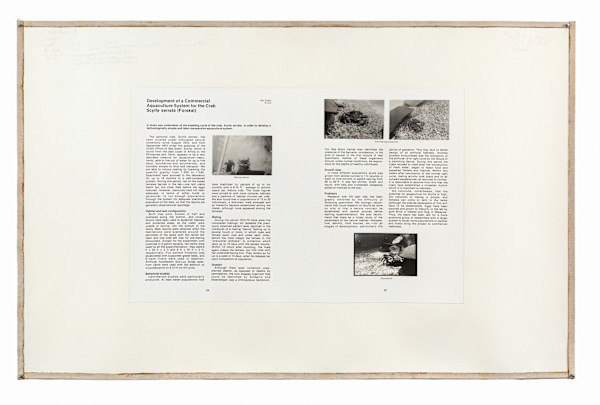
We got permission via Scripps Institution of Oceanography to import the crabs for study, with the specific restriction that they were not to be released into domestic waters (due to the problems associated with exotic species). In April of 1972, Ranil’s mother went to the market in Colombo, Sri Lanka, and collected about 30 live crabs, some still with pegs in their claws. She wrapped them in wet banana leaves, packed them in a cardboard box, and shipped them express. When they arrived, most of them were still alive! We transferred the survivors into two tanks that we had built at the Pepper Canyon facility at University of California, San Diego: four paces by five, waist high. From that point, the Second Lagoon was concerned with discoverymating, cannibalism, disease, taxonomic identification—the stuff that experimental science is actually all about.
We did our best to simulate lagoon conditions in our laboratory. Ranil visited the lagoon at Trincomalee, Sri Lanka and collected and sent to us mangrove seeds, mud suckers, flathead mullet (Mugil cephalus), and bottom mud. But in November, the crabs began behaving strangely; they stopped eating and nearly stopped moving. Eventually we figured out that it was monsoon time in Sri Lanka, and the monsoon changed the salinity of the water and enriched the food supply. So we used a hose and fresh water to improvise a monsoon, and almost immediately the crabs became animated and began to behave differently. Soon they began to mate.
Several months after the first mating, an egg mass appeared on the underside of the female’s stomach, and she was our first gravid female. We did our best to enrich the water in the tanks so that some of the eggs would move through the many larval molts necessary for a mature juvenile to emerge—and failed. Nonetheless, by simulating the monsoon we had answered questions about the mating behavior of this decapod crustacean that no oceanographers had managed to answer. Later we learned that a couple of scientists (from Hawaii and Australia) had jointly brought larvae to first juvenile molt; it was nice to know that our work had such a useful fit with other research. The stakes, however, turned out to be much higher than simply making a museum installation. Japanese and Russian fleets were fishing out the lagoons in Sri Lanka and manyother places; Scylla serrata—otherwise known as the poor man’s food—which had once been abundant, were disappearing, and the population was at risk of collapse. We began envisioning a work of art that was a work of restitution, with ethical implications. We would create a protected environment in which the crabs could mate, and then release the gravid females back into the lagoons of Sri Lanka, replenishing the population. There was no political will elsewise to protect them from being harvested to extinction.
Sargon Tont was an oceanographer at Scripps and the assistant to John Isaacs (also at Scripps, and director of the University of California Institute of Marine Resources). Sargon told John that we had decoded the mating behavior of Scylla serrata (Forsskål). John whom we knew well from earlier projects and from committee meetings at the university, came by the Pepper Canyon studio, looked at the work, and told us that we had just outdone a similar lobster project. He asked how much our work had cost, and we explained that we’d spent less than 15 000 dollars. The lobster project had received a 300 000 dollars California Sea Grant, but they had not gotten the lobsters to mate. John said, “Why don’t you go for a Sea Grant, and do it right?” Our first application was returned to us—which is perhaps not a surprise, given that such grants are normally reserved for marine scientists, and not artists. But the following year, with a rewritten application, we were awarded a grant to study Scylla. “Doing it right” turned out to be working with a group of Sea Grant trainees and repeating our accomplishments a number oftimes in order to prove that what we had done was replicable, therefore meeting the requirements for “respectable” science. After doing the required repeating and note taking, we sent in our results, which were published in the prestigious Sea Grant Law and Policy Journal.
Our choice of creature for the Portable Fish Farm in 1971 had proved to be problematic. The catfish that were shipped to London from California were wrongly packed, and most did not survive. Graham Cox, an aquarium director, was dispatched to bring a new school of fish, and he did this with amazing skill. Nonetheless, the fish would not mate in the tanks.
Graham introduced us to Ranil Senanayake, a herpetologist from Sri Lanka. He told us about a fast-growing, edible, cannibalistic crab in Sri Lanka, Scylla serrata, that was very hardy. It was the last to die when the tidal ponds dried up and could crawl across the land to find another pond; it mated in ponds four paces by five paces across and waist high. It was a favorite food of his people, but the foreign fleets were fishing them out.
We got permission via Scripps Institution of Oceanography to import the crabs for study, with the specific restriction that they were not to be released into domestic waters (due to the problems associated with exotic species). In April of 1972, Ranil’s mother went to the market in Colombo, Sri Lanka, and collected about 30 live crabs, some still with pegs in their claws. She wrapped them in wet banana leaves, packed them in a cardboard box, and shipped them express. When they arrived, most of them were still alive! We transferred the survivors into two tanks that we had built at the Pepper Canyon facility at University of California, San Diego: four paces by five, waist high. From that point, the Second Lagoon was concerned with discoverymating, cannibalism, disease, taxonomic identification—the stuff that experimental science is actually all about.
We did our best to simulate lagoon conditions in our laboratory. Ranil visited the lagoon at Trincomalee, Sri Lanka and collected and sent to us mangrove seeds, mud suckers, flathead mullet (Mugil cephalus), and bottom mud. But in November, the crabs began behaving strangely; they stopped eating and nearly stopped moving. Eventually we figured out that it was monsoon time in Sri Lanka, and the monsoon changed the salinity of the water and enriched the food supply. So we used a hose and fresh water to improvise a monsoon, and almost immediately the crabs became animated and began to behave differently. Soon they began to mate.
Several months after the first mating, an egg mass appeared on the underside of the female’s stomach, and she was our first gravid female. We did our best to enrich the water in the tanks so that some of the eggs would move through the many larval molts necessary for a mature juvenile to emerge—and failed. Nonetheless, by simulating the monsoon we had answered questions about the mating behavior of this decapod crustacean that no oceanographers had managed to answer. Later we learned that a couple of scientists (from Hawaii and Australia) had jointly brought larvae to first juvenile molt; it was nice to know that our work had such a useful fit with other research. The stakes, however, turned out to be much higher than simply making a museum installation. Japanese and Russian fleets were fishing out the lagoons in Sri Lanka and manyother places; Scylla serrata—otherwise known as the poor man’s food—which had once been abundant, were disappearing, and the population was at risk of collapse. We began envisioning a work of art that was a work of restitution, with ethical implications. We would create a protected environment in which the crabs could mate, and then release the gravid females back into the lagoons of Sri Lanka, replenishing the population. There was no political will elsewise to protect them from being harvested to extinction.
Sargon Tont was an oceanographer at Scripps and the assistant to John Isaacs (also at Scripps, and director of the University of California Institute of Marine Resources). Sargon told John that we had decoded the mating behavior of Scylla serrata (Forsskål). John whom we knew well from earlier projects and from committee meetings at the university, came by the Pepper Canyon studio, looked at the work, and told us that we had just outdone a similar lobster project. He asked how much our work had cost, and we explained that we’d spent less than 15 000 dollars. The lobster project had received a 300 000 dollars California Sea Grant, but they had not gotten the lobsters to mate. John said, “Why don’t you go for a Sea Grant, and do it right?” Our first application was returned to us—which is perhaps not a surprise, given that such grants are normally reserved for marine scientists, and not artists. But the following year, with a rewritten application, we were awarded a grant to study Scylla. “Doing it right” turned out to be working with a group of Sea Grant trainees and repeating our accomplishments a number oftimes in order to prove that what we had done was replicable, therefore meeting the requirements for “respectable” science. After doing the required repeating and note taking, we sent in our results, which were published in the prestigious Sea Grant Law and Policy Journal.