


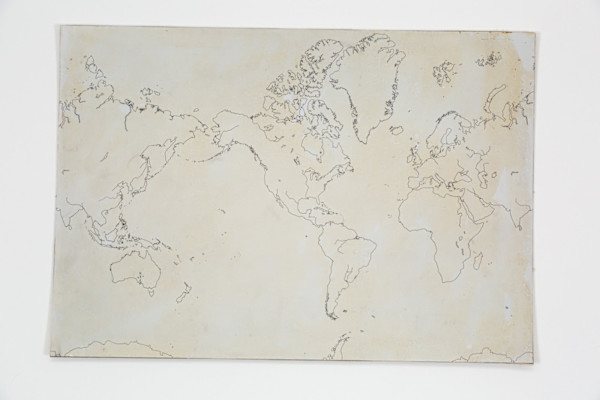


Series Title: Law of the Sea (full subtitle: Law of the Sea: Where the Appetite is Discovered to be Endless)
Timeframe: 1976 to 1977
Exhibitions:
- July 18 – Oct 10, 1976, 37th Venice Biennale (La Biennale di Venezia: Attualità Internazionali 1972–1976), Venice, Italy
- Jan 10 – Feb 8, 2014, Global Mapping, Ronald Feldman Fine Arts, New York, NY (gallery survey featuring historic mapping projects including Law of the Sea)
- Sept 17 – Dec 10, 2016, The Time of the Force Majeure, Center for Art, Design and Visual Culture (CADVC), UMBC, Baltimore, MD (career retrospective survey)
We got a letter one day, somewhat official looking, from Pierre Restany, the prominent French art critic. He was interested in
the San Diego phenomenon (that being Eleanor Antin, David Antin, Allan Kaprow, ourselves, and maybe Emanuel “Manny”
Farber), and he was coming to town. We met him at the airport. Suddenly it was important that we go to the nearest bar.
Drinking took place. More drinking took place. One of us got into an argument with him about Immanuel Kant, proposing
Drinking took place. More drinking took place. One of us got into an argument with him about Immanuel Kant, proposing
that Kant’s categorical imperative was a contradiction in terms. (After all, if one was to spend a lot of time thinking about that
which was categorical, imperativeness disappeared. Conversely, if something was already that imperative, who had the time to
worry about categories?) We said that we understood the intention, that is to say, find a rule, the following of which would
save you from doing wrong. But it seemed like an awful lot of work in order to be saved from doing wrong. We liked Pierre.
He had evidently written to all of us separately. We brought him around, and he was fascinated by the Lagoon Cycle.
A year passed, and in late 1975 we heard from him again. He had become one of the commissioners for the 1976 Venice Biennial.
They were creating the artist groupings, including many conceptual artists—Hans Haacke, ourselves, the Antins—and
would we do a work? The answer, of course, was yes. Who turns down the Venice Biennial?
At about the same time, Sargon Tont showed up in our studio with a map. (He knew we liked maps.) He said, “Can you believe this? Look at what the United Nations Convention on the Law of the Sea wants to do with the world ocean.” The map presented a hypothetical division of the sea floor, showing how it might look if it were divided along lines equidistant from the closest points of adjacent or opposite coastal states and islands, as a basis for the establishment of exclusive rights to the exploitation of deep sea minerals.
Clearly, the map gave every country that had land at the edge of the waters of the ocean the right to extract minerals from the ocean bottom, fish in any amount—and minerals from the ocean water, too, if anybody thought about it. Among the many problems that leaped off the surface of this map was who did well and who did poorly. (If your country did not touch the
ocean, you were just plain out of luck.) So we redrew the map, putting the corresponding country’s flag in each section of the
ocean. We called the work Wherein the Appetite Is Discovered to Be Endless; later we added two commentaries, with additional
maps. The first commentary, Wherein the Argument Is Discovered to Be Endless, points out a few of the anomalies and ironies that result from any politically based system of division that ignores the workings of the ecology. The second, More on the Endless Argument, addresses the essential metaphor embedded in the concept of this style of division. Viewers of the work also found it disturbing and wrote comments, some caustic, some political, some amused.