Series Title: A Grand Round for San Diego
Timeframe: 1983 to 1988
Exhibitions: Not Exhibited
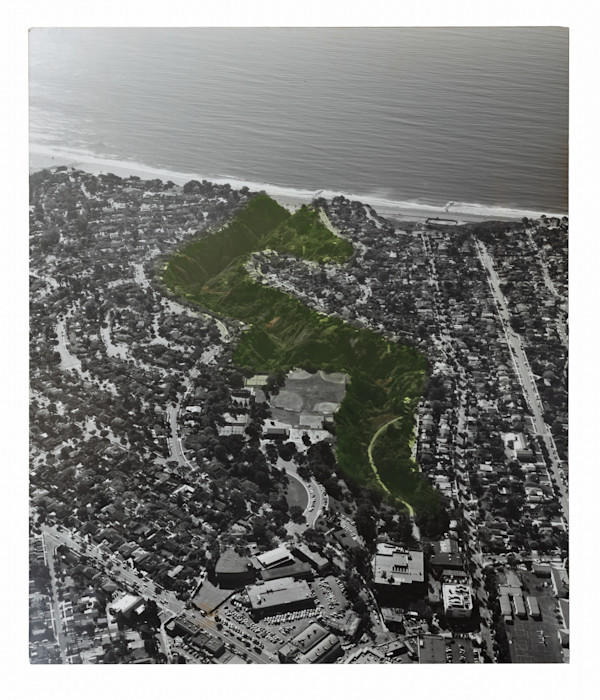
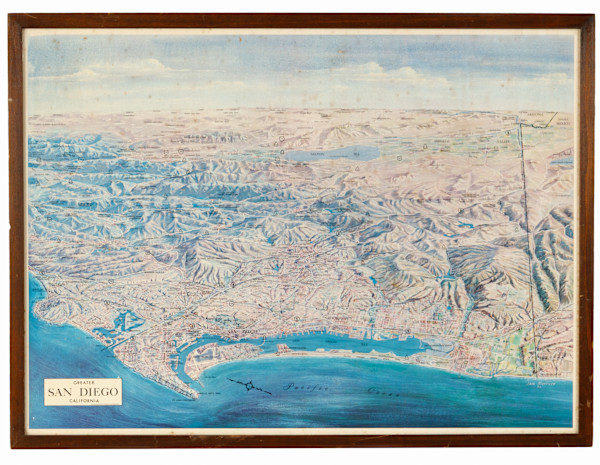
In 1984, several teams of architects were formed by the architectural community of San Diego, seeking ideas that would add value to the city. We were asked to join, so we had a large aerial photo of the city made and began to meditate on it.
The question we posed to ourselves was this: Is there a way to see San Diego as a whole place? Is there a way to have, within an hour or two, an experience of the diversity of it? In other words, could we make a new kind of amenity? By this time the new shopping center by Jon Jerde, a marvelous place, had been built and would soon open. The Arts District was booming, a Convention Center was on the books. A large middle-brow downtown population was growing, hotels had shot up around the waterfront, the airport was enlarged, the navy presence was shrinking a little bit. That is to say, a lot was happening. San Diego had a river that most had forgotten. It had an outfall at the edge of the city, in the valley that had once been a great farm and had now become a shopping center.
A series of artificial lagoons had been created to the right of the outfall. They were beautiful from the air. Twentieth-century capitalism was hard at work, and growth was the name of the game. San Diego was beginning the change from a small town of 40 000 or 50 000 to a region of several million. In the late seventies we could see this wanting to happen. Within the maelstrom was all this activity, all this desire, this virtually stupefying reach for growth and reach for wealth. What kind of a work of seeing could we add?
A series of artificial lagoons had been created to the right of the outfall. They were beautiful from the air. Twentieth-century capitalism was hard at work, and growth was the name of the game. San Diego was beginning the change from a small town of 40 000 or 50 000 to a region of several million. In the late seventies we could see this wanting to happen. Within the maelstrom was all this activity, all this desire, this virtually stupefying reach for growth and reach for wealth. What kind of a work of seeing could we add?
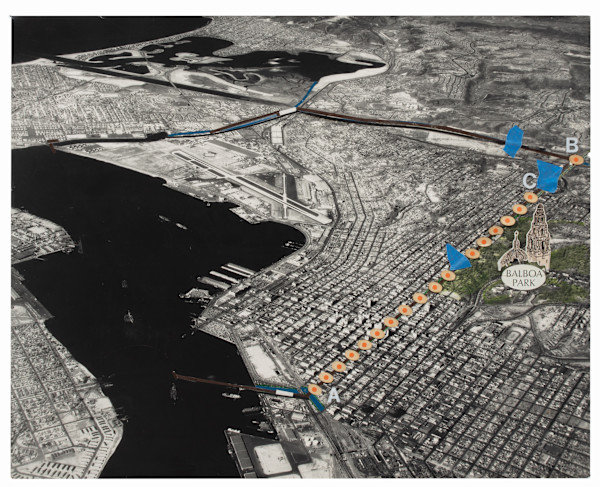
At the edge of San Diego’s great park, Balboa Park, is Sixth Street. It is a 20-minute walk along Sixth Street from the lower edge of Balboa Park, bordering the Arts District, to the harbor. We began to imagine making a small inlet at the bottom of Sixth Street where one could place a vaporetto and weave through the harbor seeing the city from beyond. (A vaporetto is one of those marvelous “people ferries” that populate the Venetian canals.)
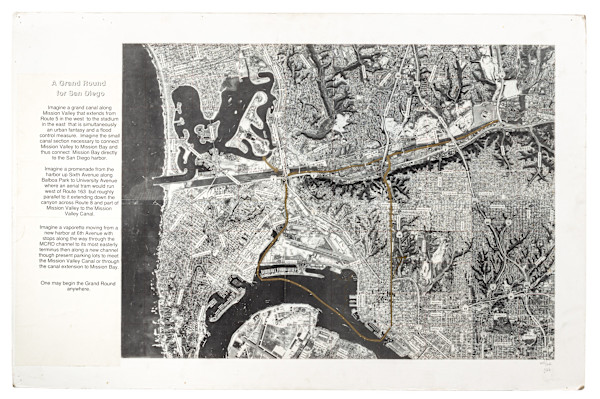
Imagine a grand canal along
Mission Valley that extends from
Route. 5 in the west to the stadium
in the east that is simultaneously
an urban fantasy and a fl00d
Control measure. Imagine the
small
canal section necessary to connect
Mission Valley to Mission Bay and
thus connect Mission Bay directly
to t.4e San Diego harbor.
Imagine a promenade from the
harbor up Sixth.Avenue along
Balboa Park to University Avenue
where an aerial tram would run
west of Route 163 but roughly
parallel to it, extending down the
canyon across Route 8 and part of
Mission Valley, to the Mission
Valley Canal.
Imagine a vaporetto moving from
a
new harbor at 6th Avenue with
stops along the way, through the
MCRD channel to its most easterly
terminus, then along a new
channel
through the present parking lots to
meet •
the Mission Valley Canal, or
through
the canal extension to Mission
Bay.
One may begin the grand round
anywhere.