
Provenance:
Wilson Rae-Scott Esq., London (c.1930s)
Thence by descent
On loan to Villanova University from a Private collector, Ireland
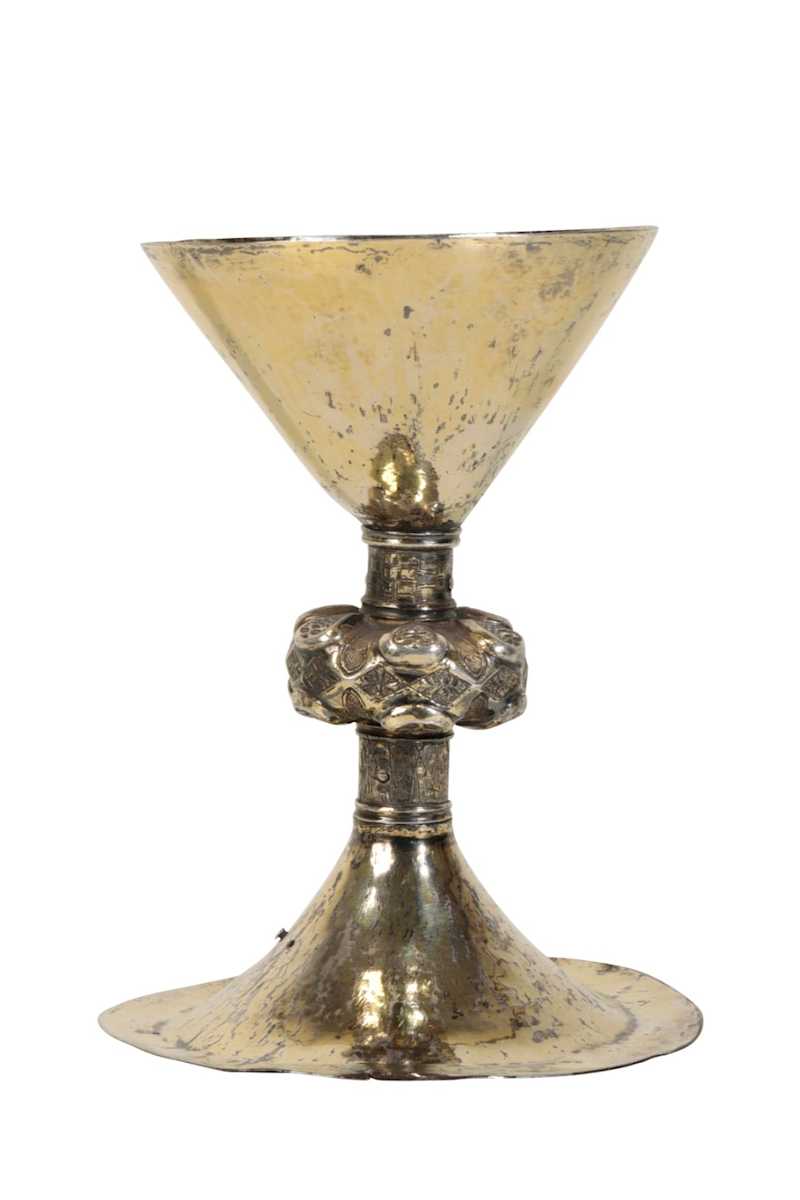
We may never know how the Ó Learghusa Chalice, an exceptionally rare fifteenth-century Irish silver-gilt chalice, survived. Most medieval Irish silver and goldwork were destroyed or stolen during the Cromwellian invasion and subsequent settlement of Ireland, when Catholic monasteries were regularly plundered by the English as part of a broader policy of punishment, land confiscation and suppression of the Gaelic Irish and their religion. In 2020, this chalice was discovered in an old box in an outbuilding of a large county house in Dorset, England. The estate owner was the grandson of Wilson Ray-Scott, a London financier and well-known silver collector, who bought the chalice at auction.
In order to ascertain the age and provenance of the Chalice, Dr. Małgorzata Krasnodębska-D’Aughton, an expert in Irish ecclesiastical silver at the University College Cork, led a research study which included technical analysis, including an x-ray and scan, performed at the Tyndall National Institute and at the National Museum of Ireland. It’s conical bowl, ornate knop, decorative scratchings, and hand-hammered shape reflect a late-medieval Irish style. It resembles the de Burgo-O’Malley Chalice (dated to 1494, from County Mayo) and the TP-IEP Chalice (dated to 1589).
Since its rediscovery, the Chalice has traveled widely, both as a devotional object and as a cultural emblem. It was first exhibited at Villanova University in 2022, where it was also used in Mass, celebrated by President Peter Donohue, O.S.A. It then traveled to Maryland, Albany, the National Basilica in Washington, D.C., the University of Notre Dame, and the Princess Grace Irish Library in Monaco. In 2025, it was used to celebrate Mass in Ireland’s oldest Catholic cathedral, Waterford’s Cathedral of the Most Holy Trinity, before returning on long-term loan to Villanova University.
Nearly fifty news features, exhibitions, and studies now document the remarkable journey of the Ó Learghusa Chalice–a vessel that bridges medieval Ireland with the modern world, carrying forward a story of faith, artistry, and endurance across centuries.
Other Work From Villanova University Art Collection





Please Note: These records are part of an active and evolving database. It may include information sourced from historical documentation that has not been recently reviewed and may be incomplete or inaccurate. Some language or imagery may reflect outdated, offensive, or harmful views. These records are shared in the interest of transparency and research. Our work to research, update, and expand the collection is ongoing. We welcome your insights.
Questions, suggestions, or feedback? Please reach out to us at [email protected]