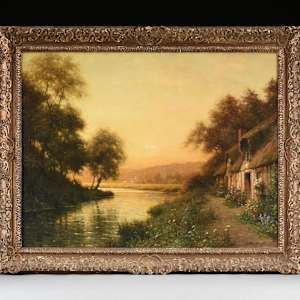
- LOUIS ASTON KNIGHT (American 1873-1948)
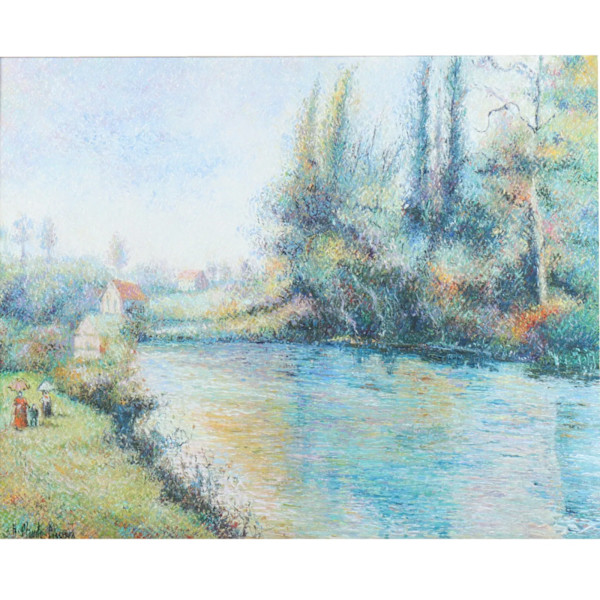
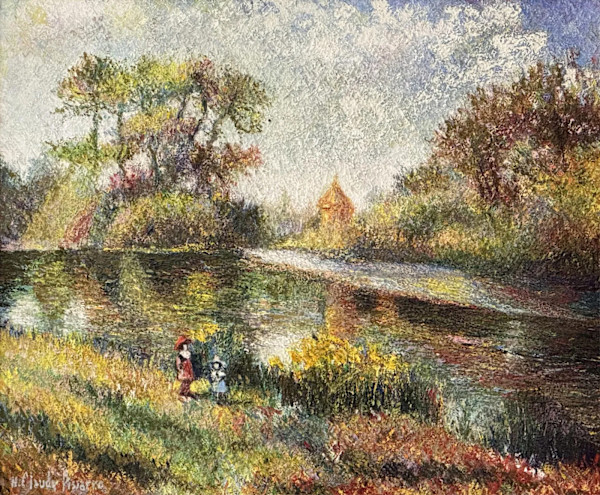
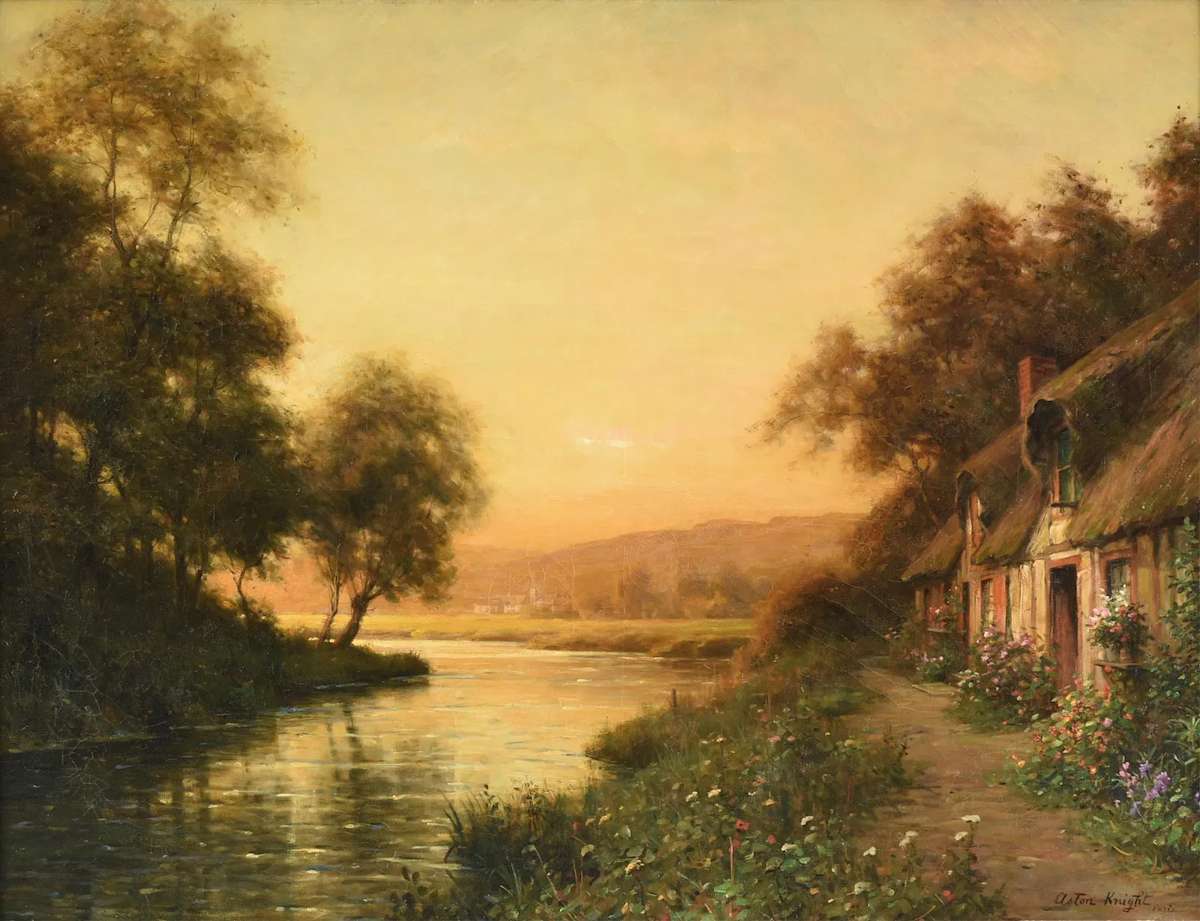
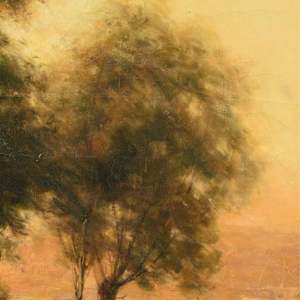
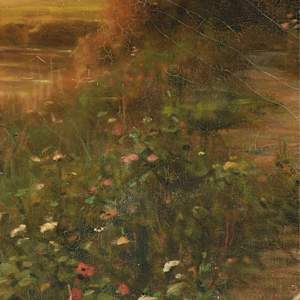
- "A Cottage by the River at Sunset,", 20th Century
- Oil On Canvas
- 34 x 44 in (86.36 x 111.76 cm)
- Framed: 42 x 53.5 in (106.68 x 135.89 cm)
- Inv: 1264 Von Schmidt Famil...
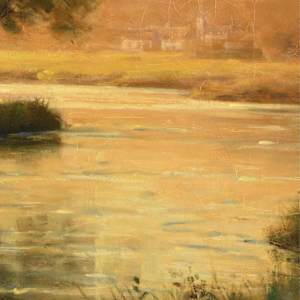
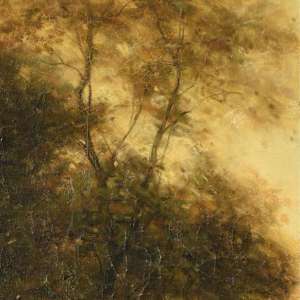
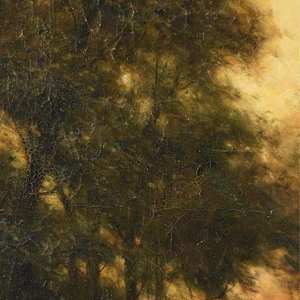
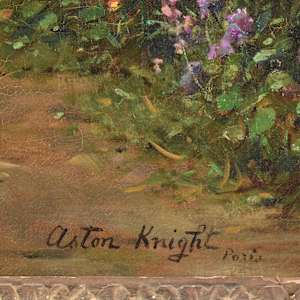
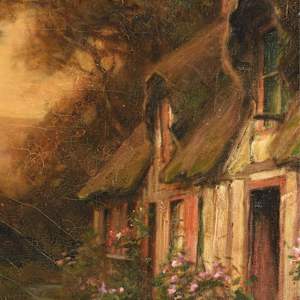
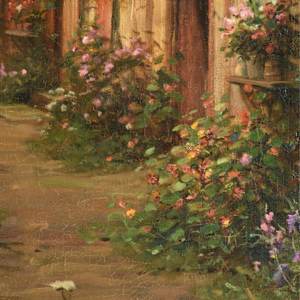
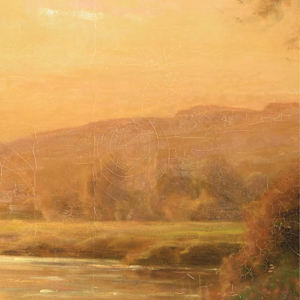
This landscape oil painting by Louis Aston Knight depicts a quiet cottage beside a slow meandering river at sunset. The warm light of the setting sun reflects on the water and the surrounding foliage. Louis Aston Knight is an artist who, with an American lineage and European upbringing, painted the natural world without inhibition or pretension. Knight was not self-conscious in a quest to define a unique “school” of art, rather his agenda was simple: to paint “nature as it is.”
Knight was born in Paris in 1873 to Daniel Ridgeway Knight and Rebecca Morris Webster. His father was an American expatriate artist who had moved to Paris in 1872, earning critical acclaim for his realistic paintings of peasant life. Knight had two brothers, Charles, who worked as an architect, and Raymond, who was an aviator.
Knight grew up in the Cháteau de Poissy, fifteen miles west of Paris. In 1887, he began attending boarding school at Chigwell in Essex, England. During his summer holidays, Knight would return to France and take sketching trips with his father throughout Normandy and Brittany.
Upon his graduation in 1891, Knight returned to France where he studied drawing and painting at the Académie Julian. His teachers included Jules Lefebvre and Tony Robert-Fleury. Knight also continued to take instruction from his father, Ridgeway Knight. Knight progressed quickly under his father’s tutelage and debuted at the Paris Salon in 1894 at age twenty-one.
Knight distinguished himself through his skill with watercolor early on. A reviewer from The New York Times noted in 1905, “In water colors . . . Mr. Aston Knight has found his best medium so far. He is more individual here.” Knight also identified his style as separate from his father’s by adopting a slightly more spontaneous technique, utilizing bold brushstrokes in an impressionistic manner. Furthermore, while Ridgeway Knight often depicted people in his landscapes, his son’s landscapes often omitted these figures.
In 1900, Knight’s watercolor The Riverside Path (whereabouts unknown) received a bronze medal at the Paris Exposition Universelle. Knight was then awarded an honorable mention at the Paris Salon in 1901. He followed this with gold medals won at Rheims, Cherbourg, Lyons, Geneva, and Nantes. In 1905 and 1906, Knight was awarded two more gold medals at the Paris Salon, making him hors concours. This title meant Knight’s work was welcomed into any future Salon exhibition without having to pass the normal selection process.
During this period of early recognition, Knight spent much of his time painting on a yacht travelling up and down the Seine River with a crew of fellow artists. In early 1907, Knight met Caroline Ridgeway Brewster, a distant cousin from Rochester, New York, while she was traveling through Europe with her mother. Knight returned to America with Caroline in October, and they married in Somerville, New Jersey. The couple settled in Paris and had three children together between 1911 and 1913.
Knight spent most of his life before 1940 living in France with his family; however, he exhibited frequently in America where the press considered him an American “by blood and law.” Knight also maintained an apartment in New York City where he lived with his family for the duration of World War I.
Knight returned to France in 1919 and purchased a Normandy country home at Beaumont-le-Roger. This brick and stone cottage and its surrounding garden and brook became a great source of inspiration for many of Knight’s paintings. Several images of the stream were painted while Knight was standing waist-deep in the water, earning him the nickname “The Man in the High-Water Boots” by Scribner’s. While living at Beaumont-le-Roger, Knight came to know Claude Monet who lived thirty miles away in Giverny. Knight was obviously influenced by Monet’s subject matter, although his more linear style is considered more closely related to the Norwegian impressionist Frits Thaulow.
During the 1920s, Knight had several exhibitions in New York City at the John Levy Galleries. He also had a private showing for President Calvin Coolidge at the White House. His popularity in the United States was further enhanced when, in 1922, President Warren G. Harding purchased Knight’s The Afterglow for the White House collection.
In 1930, Knight traveled to California for the first time. He traveled up and down the coast around San Francisco, painting sea views and coastal gardens. Knight also took painting trips to Jamaica and Haiti, and throughout the Midwest of America. In June 1940, after the fall of France during World War II, Knight and his wife moved permanently to New York City. In August 1944, the American Air Force destroyed Knight’s house at Beaumont-le-Roger during a bombing operation intended to cut off the German retreat. Shortly after learning of the destruction of his home, Knight had a stroke. He painted infrequently during the following years before dying in 1948.
Throughout his career, Knight liked to work outdoors in the natural light, and he was consistently praised for his ability to “catch the trick of running water.” Both European and American audiences embraced his paintings for their frank directness and universal subjects.
American publications praised Knight’s achievements as exemplary of American artistic excellence overseas, while the French government recognized Knight’s accomplishments by promoting him to a commander of the Legion of Honor in 1934.
- Subject Matter: Landscape
- Collections: Von Schmidt Family Trust Collectable Paintings Collection