
- Barton Lidice Beneš
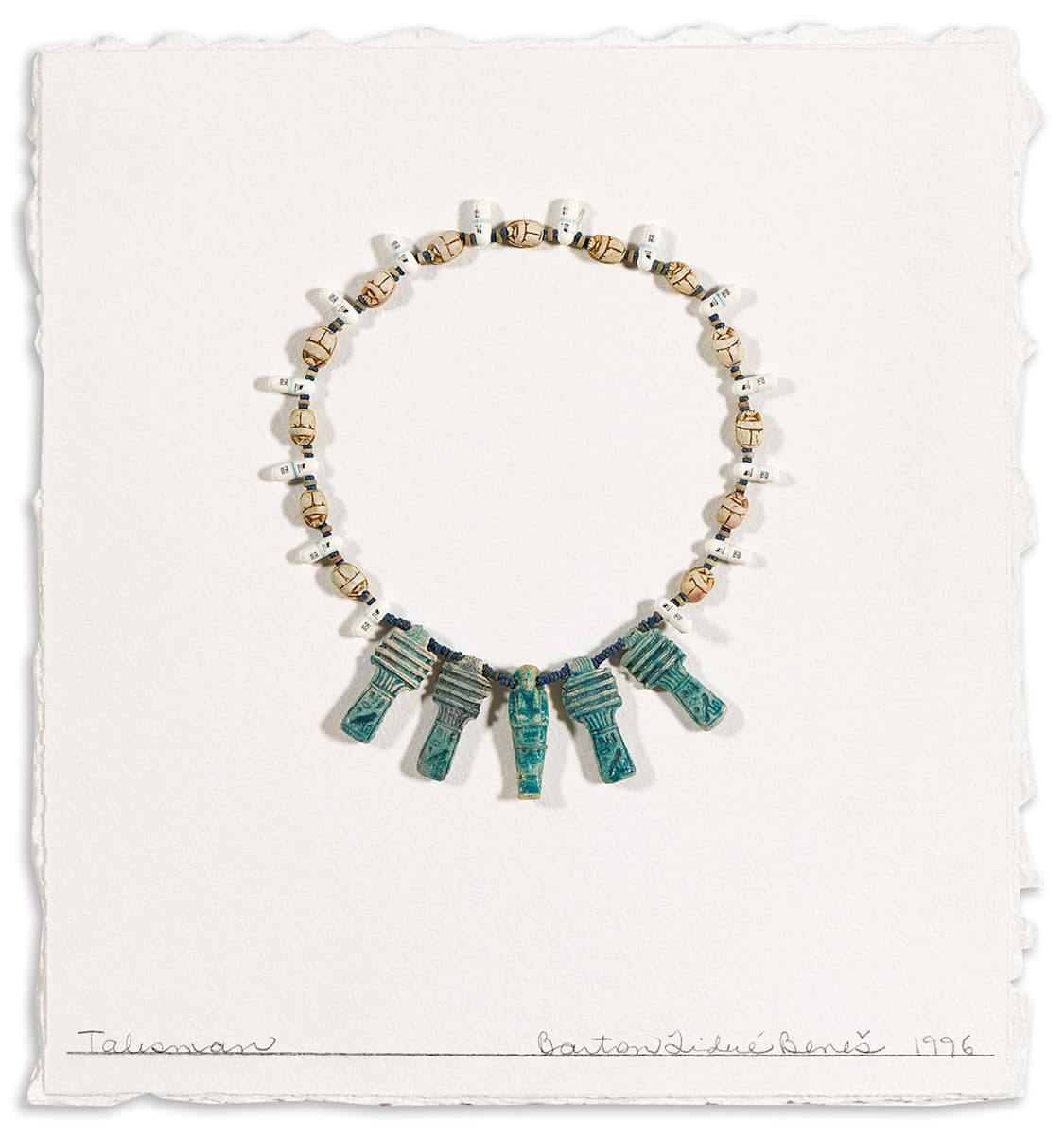
- Talisman, 1996
- Necklace composed of Y9C 100m9 Retrovir capsules with various found "good luck" pieces (Egytian amulets) on white wove paper support sheets
- 16 x 15.25 x 2 in (40.64 x 38.74 x 5.08 cm)
- Framed: 16 x 15.25 x 2 in (40.64 x 38.74 x 5.08 cm)
- Signature: Titled, signed, and dated in pencil on front
- Inv: 2026.7.3
Much of Barton Lidicé Beneš’s work speaks to the complexities of the HIV/AIDS crisis following its emergence in the 1980s. His Talisman pieces juxtapose AZT tablets with various found objects, including a crucifix, money-covered wishbone, Egyptian amulets, and found beads. When AZT first entered the market, it was described by the New York Times in 1989 as “the most expensive prescription drug in history.” By presenting life-saving medication as a talisman or good-luck charm, Beneš highlights the tension between medical treatment and uncertainty, where in many cases, survival depends not only on access to care, including cost, but also on hope, chance, and the limits of medicine itself.
- Attribution: Gift of John R. Burger
- Current Location: Collection Storage - Flat Storage
- Collections: Gender & Sexuality Studies, Recent Acquisitions 2025-2026, Religious Studies, Sculpture & Relief