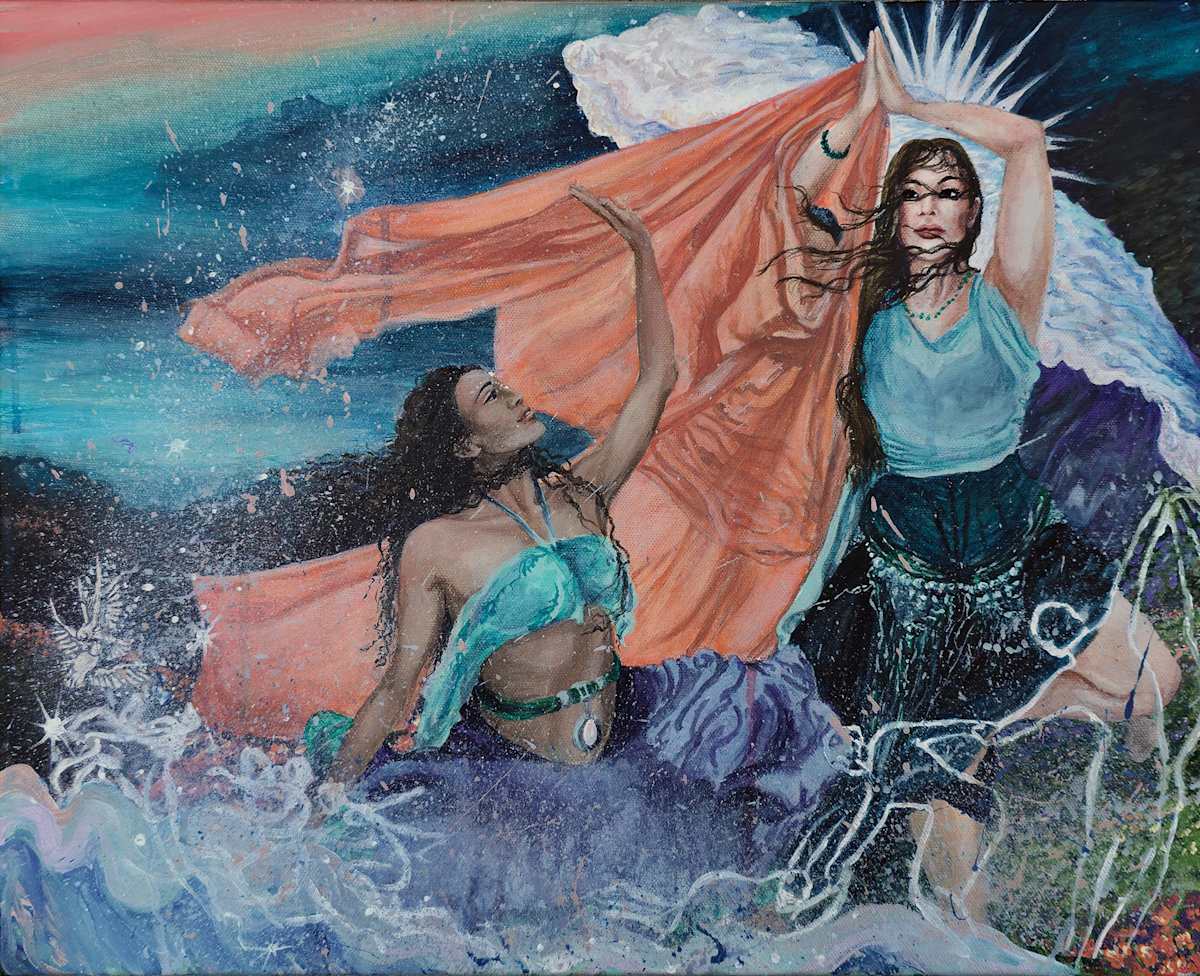
This painting centers on the truth that feminine strength is not solitary. It is formed through connection, recognition, and shared rising. The figures emerge together, from sea and air, as a communal force. Power here is not solitary or hierarchical. It is relational. It does not take the shape of dominance or separation, but grows through connection. It grows through intimacy without possession and sacredness without spectacle.
Their strength is not conferred through visibility or desire, but through presence, mutual support, and shared embodiment. Confidant, multicultural, and fully inhabited, they rise supported by a circle of women whose presence steadies and lifts them. Around them, feminine wind spirits move as forces of vitality rather than spectatorship. Veils, pearls, gardens, and birds appear as living symbols—no longer owned or bestowed, but shared.
This work reclaims Venus as a symbol of feminine power outside the frameworks of the male gaze and idealized beauty. Drawing from The Birth of Venus —a Renaissance image of a lone goddess rising into visibility—this contemporary painting transforms that moment into a collective emergence. Venus is no longer born in isolation, perfected through external gaze. Beauty here is diverse and self-defined. The figures are active participants in their becoming. They are not objects of desire, but co-creators of meaning.
They arrive through community, sustained by women who witness, support, and amplify one another. This is the strength that multiplies when women stand rooted in themselves and in each other.
The modern woman is not becoming divine.
She is remembering that divinity was never singular, silent, or owned.
Venus is no longer born alone.
She rises with her sisters.
- Collections: Figurative, Painting, She Remembers Herself