
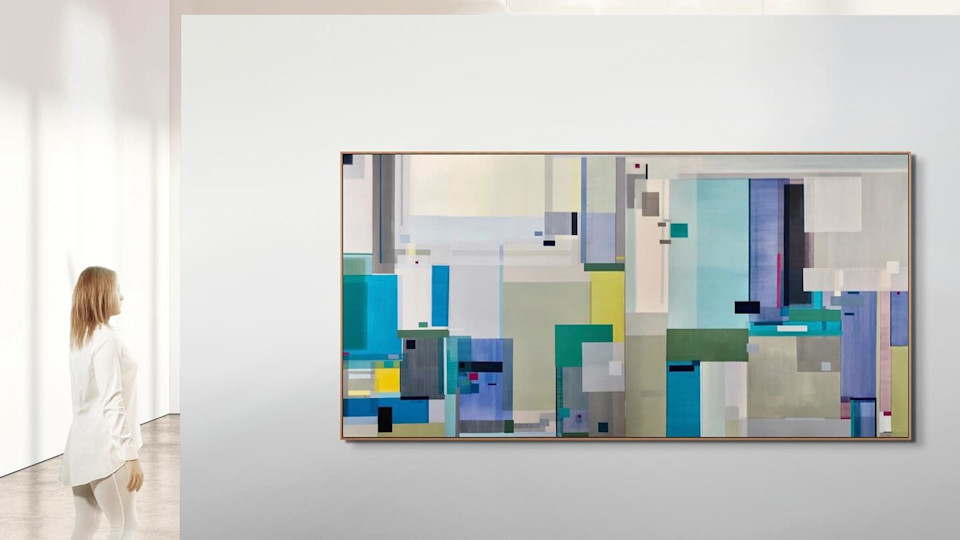
Most people think geometric abstraction is about perfection, clean lines, balanced forms, controlled color. Walk past a geometric painting and it can look predetermined, resolved before the first mark. That reading misses the point.
The Myth of Perfection
There is a persistent idea that geometric work is cold, that the grid removes the artist, that the tape line erases the hand. I understand where that comes from. Geometry implies system. System implies machine.
But I have never once stood in front of a canvas with everything resolved. The geometry is not the answer. It is the question I ask the paint to answer.
What I have found, over years of working with hard edges and structured compositions, is that constraint does not eliminate expression. It concentrates it. Every decision becomes more visible. Each deviation becomes a decision. Direction or reversal. Commitment or erasure.
Constraint as a System and a Practice
When I begin a piece, I work with grids, tape, and a rough compositional logic. There is planning involved. Mondrian had his horizontal and vertical absolutes. Agnes Martin had her penciled lines. These were not limitations; they were the conditions under which something true could emerge.
Josef Albers understood this deeply. His lifelong study of color interaction, how one hue shifts in the presence of another, was built entirely on constraint. He used the same square format for decades, not because he lacked imagination, but because the limitation was the point. The restriction forced him to see more clearly. I wrote about how his thinking has shaped my own approach to color in How Josef Albers Shaped the Way I See Color, and that influence runs through everything I make.
Richard Diebenkorn worked from a similar discipline. His Ocean Park series used a consistent structural logic as the container for color and light to move within. Like Albers, the constraint was never the limitation. It was the condition that made the work possible.
My own system is less rigid. I use geometry as a scaffold, not a cage. The shapes establish a field of tension. Then I work within that tension, adjusting, layering, sometimes tearing down what I built, until the painting finds its own equilibrium.
That word, equilibrium, matters to me. Not symmetry. Not stillness. Balance that feels earned.