
-
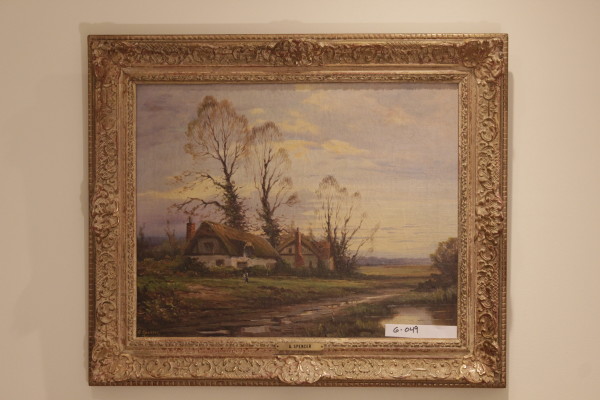
Artist: Augustus Spencer (British, 1860-1924)
With Smith’s encouragement and support, Spencer won a scholarship to the Royal College of Art in South Kensington in 1881 where he studied both the theory of art education and studio painting until 1885, when he was appointed Art Master of the School of Arts at Coalbrookdale, Shropshire. In 1888 he accepted the position of Headmaster of the Leicester School of Art where he served for twelve years during which he reorganized the curriculum of its art education classes.
From 1900 until 1920, Spencer served as an Administrator at the Royal College of Art, where he introduced the controversial educational theories of John Ruskin. He also he embraced the idioms of the growing Arts and Crafts movement in English art at a time when the English system was beginning to train both artists, teachers of art, and designers needed for the growing Industrial Revolution in England. Spencer was also a leading member of the critically recognized Aireville Group of working artists who were adapting the theories and practices of influential painter, Thomas Clifton, to their art.
While Spencer worked in stained glass, watercolor, charcoal and mixed media, he was a prolific and popular painter, who primarily specialized in romantic and colorful views of the Yorkshire and Sussex countryside, executed in a detailed and realistic style that captured the picturesque cottages, the terrain, the lakes and rivers, as well as the dramatic clouds and atmosphere of these sections of the United Kingdom. Augustus Spencer died on October 3, 1924.
Even though Spencer’s revolutionary educational reforms that united industrial design and the fine arts did not last in the curriculum of elite British art schools a decade after World War I, Spencer is universally considered an important contributor to the growth of the synergy between the fine and applied arts throughout the United Kingdom and the British Empire.