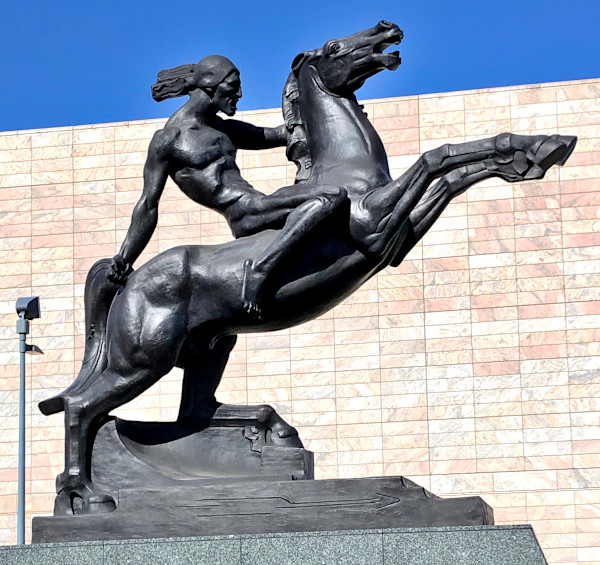

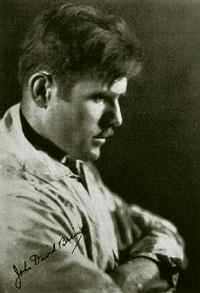
From the Joslyn Art Museum:
"Born in Gracac, Croatia, in 1899, John David Brcin (prounced Brr-chin) was raised by his uncle, who was a farmer, carpenter, and stonemason. Carving in wood was one of the many accomplishments of his uncle, and it was with him that Brcin learned how to handle simple carving tools and create such items as spoons, forks, and crosses. At age 14 Brcin joined his brother in Gary, Indiana, to begin what he called his "Americanization." In the fall of 1917, he enrolled in the sculpture class of the Art Institute of Chicago where he received a number of awards and honors that culminated in a fellowship to study in Europe. He spent 1921 in Serbia (by then part of Yugoslavia), Italy, and France, returning to further study and additional awards at the Institute in 1922 and 1923.
By the time Brcin was awarded the Joslyn commission in 1929, the young sculptor had been featured in a number of group exhibitions and in 1928 was the subject of a one-artist show organized in Chicago. The exhibition subsequently traveled to the Brooks Memorial Gallery in Memphis, the Art Institute of Omaha, the Museum of Fine Arts in Houston, and the Witte Museum in San Antonio. It is likely that Brcin's traveling exhibition played a major part in his selection as sculptor for the Joslyn Memorial.
Although not yet 30, Brcin had already developed three distinct approaches to his medium: traditional portraiture, sleekly stylized statuary, and sharply cut bas-reliefs combining geometric and figurative elements. Taken as a whole, Brcin's stylistic flexibility must have suggested to the Joslyn Memorial architects, father-son team John and Alan McDonald, that he was equipped to execute the sculptural components of Sarah Joslyn's temple to the arts.
The Joslyn commission, which occupied two years of his life, turned out to be the high point of Brcin's career. It established him as a notable representative of his era, and when the Memorial was completed, the critic of the Chicago Herald-Examiner declared: "Brcin's carvings are a new thing; they are full of dynamic thrust, a smooth sharp-edged symmetry which admirably interprets the spirit of an age governed by machinery." In the following decades, although Brcin continued to receive public commissions, the rise of Abstract Expressionism consigned him to the margins of 20th-century art history. He died in Boulder, Colorado, in 1983."