

Enne Tesse is a fiber, installation, text artist, and costume designer who has exhibited extensively in the United States especially in New York state as well as internationally in Japan. Her most notable exhibitions include MoMA PS1 in New York, Wadsworth Atheneum in Hartford, and the Museum of Modern Art in Kyoto. Recent exhibitions include Super Secret Projects in Beacon, New York, G-Town Arts in Georgetown, Connecticut, and Southern Vermont Arts Center in Manchester. Enne has been critically published by Woven Tale Press, ARTiculAction Art Review, Artscope Magazine, and Asahi Shinbun Tokyo.
Containing totem-like qualities and usually devoid of color or instinctively monochromatic such as the exposed surface of linen fibers, the textile works of Enne Tesse incorporate the written word, installation elements, and social commentary. The works range from elaborate yet haunting costumes drenched in angularity to conceptual installations containing assemblage elements such as texts, jars, and wood, to organ-like structures which may resemble body parts or various resemblances of human anatomy. Texts in recent works such as In our Depths, reveals words such as “sink”, “bury”, “burn”, and phrases like “in our skin”. These types of communications surrounded by shredded substances such as wood and restrained with linen reveals a minimalist narrative on reacting to experiences. The containment of the ominous texts suggests a sense of restrainment either by the self or others. Fiber installations which resemble anatomical parts or organs are expressed through linearity of loose fibers stretching out towards the viewer. These pieces are heavily abstracted and minimalist and reflect a willingness by the artist to convey indirect representation reminiscent of ancient totems from Mesoamerica.
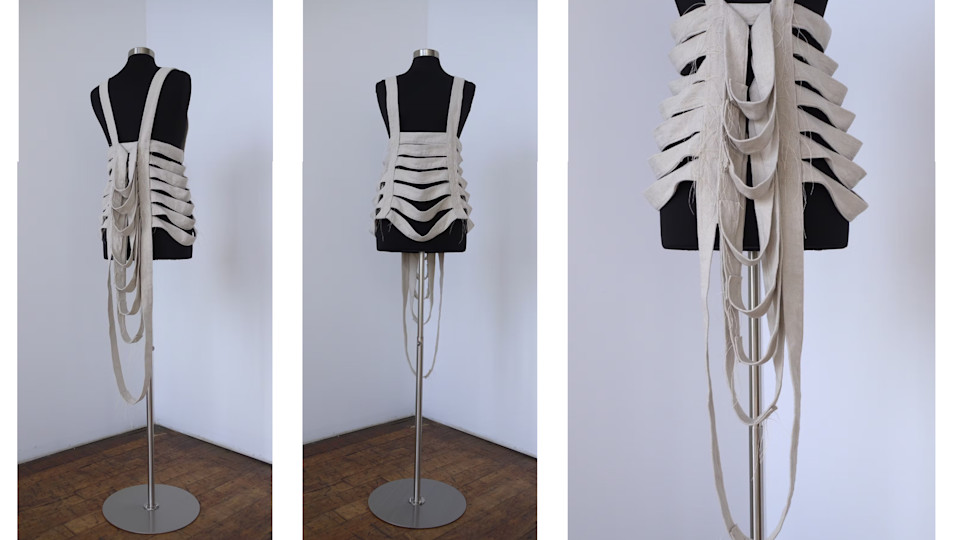
Some of the most interesting works by Enne Tesse are the figurative elements which resemble elaborate costumes and masks. These haunting fiber costume installations either function with or without a mannequin, and sometimes the costume is a functional mannequin. With angular distortion, sharp angles, net-like features reminiscent of fish traps as well as resembling and accentuating various portions of anatomy such as spinal cords or rib cages, the costume installations express dominance and theatrics. We will find pieces which behave as elaborate empty cloaks, as if worn by an apparition or masks which look like they are designed for mythological creatures rather than humans. In all aspects of her work, Enne Tesse is mysterious in her intentions, however the titles sometimes offer clues as to the conceptual purpose. Titles like She Mirrors and Spies as well as Zigra suggest fantastical connotations of character and creature-based entities, a narrative based on the composed structure of the installation through metaphorical form rather than a direct representation.
Passage depicts an elaborate green costume in the shape of a dress with fishnets as a form of structure. In the installation, the extended pieces of the costume are attached to the wall, instead of flowing on the ground to follow the figure. The extreme angularity and coral-like small cloak in the back of the costume suggest a character-based work of figurative art. This is not just a great work of fiber but also costume design accentuating theatrical elements based on extending the beauty of the human form beyond ergonomical capacity.
With a complex scope based on exaggerating figurative elements to metaphorically expressing conceptual narratives reflecting personal experiences, the works of Enne Tesse are as much a celebration as they are a disturbance of form. Often macabre or peculiar, the various fiber installations, structures, and costumes communicate a sense of yearning towards redefining imagined character-based elements. As a result, Enne Tesse’s works can be described as highly theatrical configurations expressing a performative touch to three-dimensional art. These conceptual works have us ponder upon the mystery and distortion of form beyond mere familiarity and imploring to discover new ways to define the figure and psychological impulses.