- Brendon McNaughton
- Karat, 2026
Karat
By Brendon McNaughton
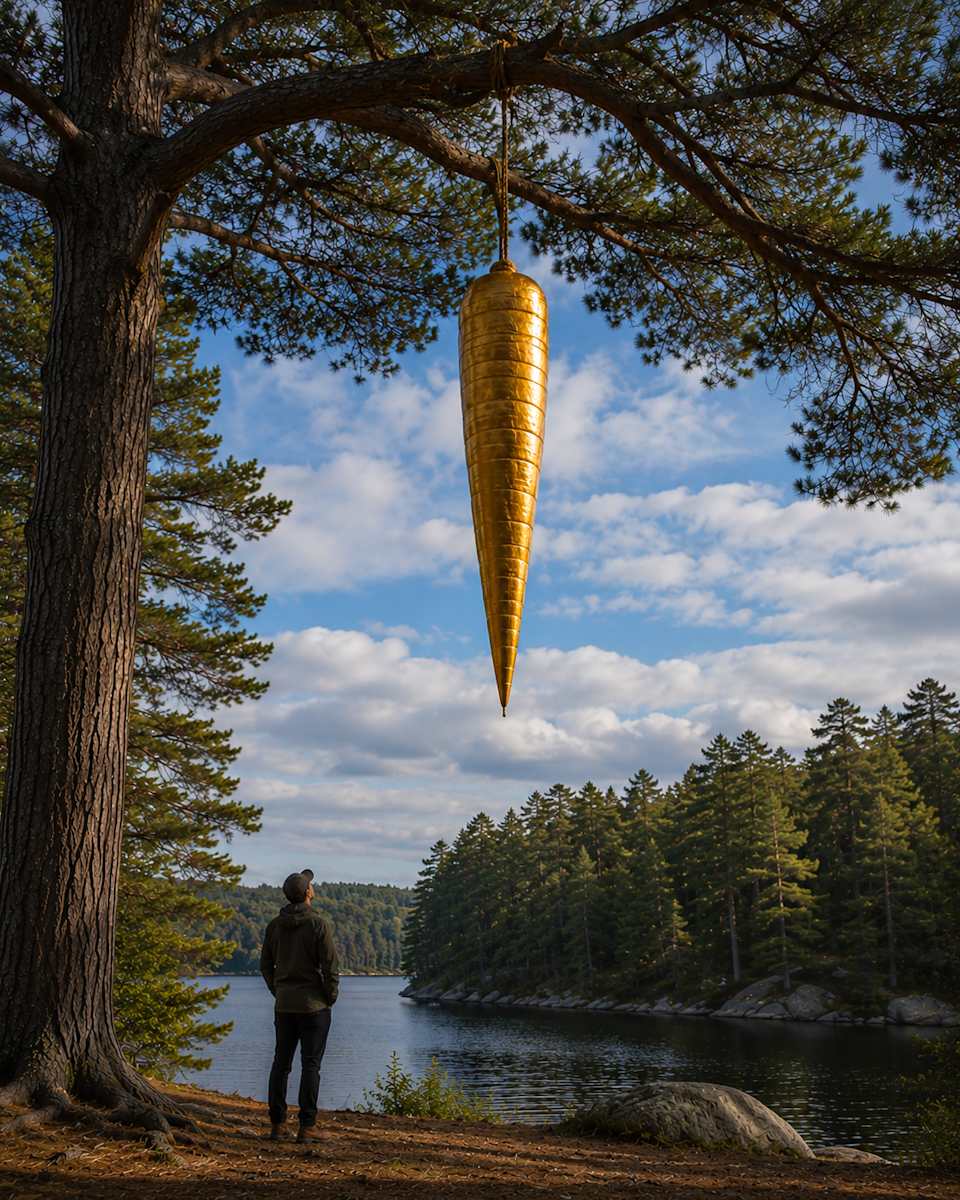
Suspended high above the viewer in the forests of Muskoka, Karat transforms the familiar “carrot on a stick” metaphor into a monumental public monument to desire, value, and pursuit. A colossal gold carrot hangs just beyond reach from the branch of a towering tree, confronting viewers with an object that is simultaneously absurd, seductive, and psychologically recognizable.
The title functions as a conceptual hinge. By replacing “carrot” with “karat,” the work collapses together two systems of human motivation: biological desire and constructed value. The carrot becomes gold. Incentive becomes commodity. Aspiration becomes financialized. What initially appears playful reveals itself as a meditation on the mechanisms that drive modern life — wealth accumulation, status seeking, ambition, consumerism, and the endless pursuit of fulfillment positioned perpetually just outside human grasp.
Art historically, Karat operates within the lineage of contemporary conceptual sculpture and institutional critique while borrowing the visual authority of monumental public art. The work recalls the psychological absurdity of René Magritte, whose surreal juxtapositions destabilized ordinary objects and exposed the instability between symbols and meaning. Like Magritte’s transformed everyday objects, McNaughton’s golden carrot shifts from literal form into philosophical proposition.
The piece also shares affinities with the monumental scale and material seduction found in the work of Jeff Koons and Anish Kapoor, artists who weaponize reflective surfaces, scale, and spectacle to explore systems of desire, ego, luxury, and perception. Yet unlike Koons’ celebration of consumer surfaces or Kapoor’s exploration of void and transcendence, Karat is grounded in behavioral psychology and economic metaphor. Its tension lies not only in the object itself, but in its inaccessibility.
The work can also be understood through the lens of late-capitalist critique. The hanging object evokes systems of incentive used to motivate labor, productivity, and social striving. The viewer is positioned beneath the sculpture not as an observer alone, but as a participant within the mechanism. The unreachable object becomes a mirror of contemporary existence: success continuously promised, quantified, pursued, and deferred.
Importantly, the wilderness setting is central to the work’s meaning. Installed within the forests and lakes of Muskoka rather than the controlled neutrality of a gallery, Karat stages a collision between natural reality and artificial systems of value. Gold — historically associated with extraction, wealth, empire, and permanence — hangs suspended within an ancient landscape indifferent to human ambition. The tree itself becomes both support structure and symbolic axis: nature literally carrying the weight of constructed desire.
At a distance, the sculpture reads humorously. Up close, it becomes existential.
Karat ultimately asks a deceptively simple question:
What is it that we are endlessly reaching toward, and who placed it there?