Levi Watkins Learning Center
The LWLC is the library of Alabama State University. Our mission is to provide opportunities for cultural expression, learning, and research.
Message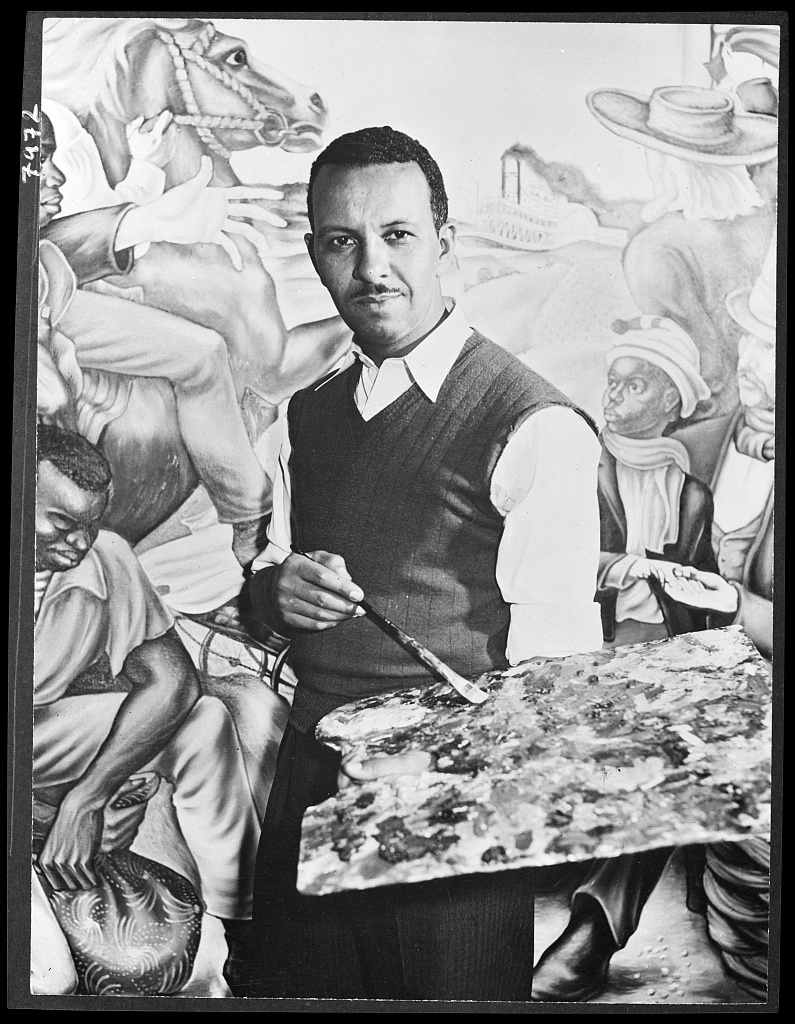
-
Artist: Hale Aspacio Woodruff (African American, 1900-1980)
Woodruff's earliest public recognition occurred in 1923 when one of his paintings was accepted in the annual Indiana artists' exhibition. In 1928, he entered a painting in the Harmon Foundation show and won an award of one hundred dollars. He bought a one-way ticket to Paris with the prize money and managed to eke out four years of study with an additional donation from a patron.
In 1931, Woodruff returned to the United States and began teaching art at Atlanta University. It was Woodruff who was responsible for that department's frequent designation as the "Ecole des Beaux Arts" of the Black South in later years. As he excelled as chairman of the art department at Atlanta University, his reputation also grew as one of the most talented African American artists of the Depression era.
Woodruff's figurative style of the 1930s was bold and muscular. Southern lynchings of Blacks stirred his conscience deeplyand inspired him to design a series of block prints that were as impressive as his oils and watercolors. His best-known and most widely acclaimed works at this time were the Amistad murals he painted between 1939 and 1940 in the Savery Library at Talladega College in Alabama. These murals were commissioned in celebration of the one hundredth anniversary of the mutiny by African slaves aboard the slave ship Amistad in 1849, their subsequent trial in New Haven, Connecticut, and return to West Africa following acquittal.
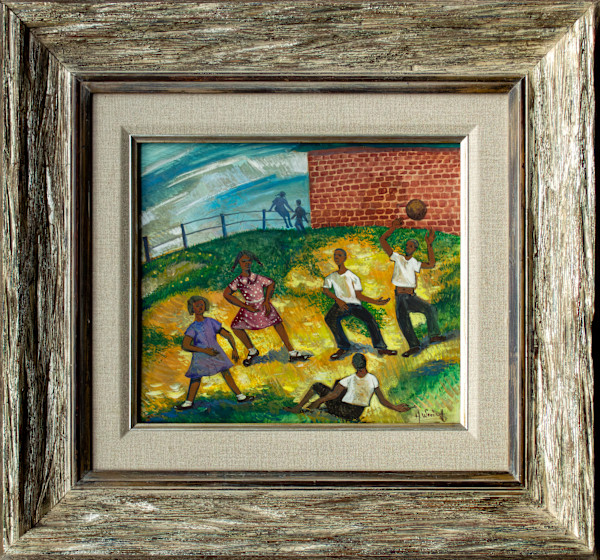
The curvilinear rhythms of Woodruff's Mexican muralist-inspired works such as the Amistad murals were absent in his productions of the 1940s. His Georgian landscapes of the 1940s are simpler in concept and dominated by diagonal accents and bold contrasts in darks and lights. Whether in oil or watercolor, many of Woodruff's landscapes of the 1940s depict tarpaper shanties, community wells, and outhouses to the extent that he frequently referred to this group of landscapes as the Outhouse School. These subjects were handled accurately and sensitively but without sentimentality.
During the 1940s, Woodruff also completed a series of watercolors and block prints dealing with Black themes related to the state of Georgia. In the September 21, 1942, issue of Time, Woodruff stated, ''We are interested in expressing the South as a field, as a territory, its peculiar run-down landscape, its social and economic problems-the Negro people."
In 1946, Woodruff moved to New York where he taught in the art department at New York University from 1947 until his retirement in 1968. During the mid-
1960s Woodruff and fellow artist Romare Bearden were instrumental in
starting the Spiral organization, a collaboration of African American artists working in New York.
Woodruff's New York works were greatly influenced by abstract expressionism and the painters of the New York School who were active during the late 1940s and 1950s. Among his associates were Adolf Gottlieb, Mark Rothko, Franz Kline, and Jackson Pollock. Following a long and distinguished career that took him from Paris to New York via the Deep South, Woodruff died in New York in 1980. Source: Perry.
Woodruff's paintings are found in private collections throughout the USA and are held in public collections including Atlanta University and Talledega College (Atlanta, GA), Detroit Institute of Arts, Newark Museum (NJ), Howard University and Library of Congress (Washington, D.C), and New York University and New York Public Library (NYC).