- Henry Speller
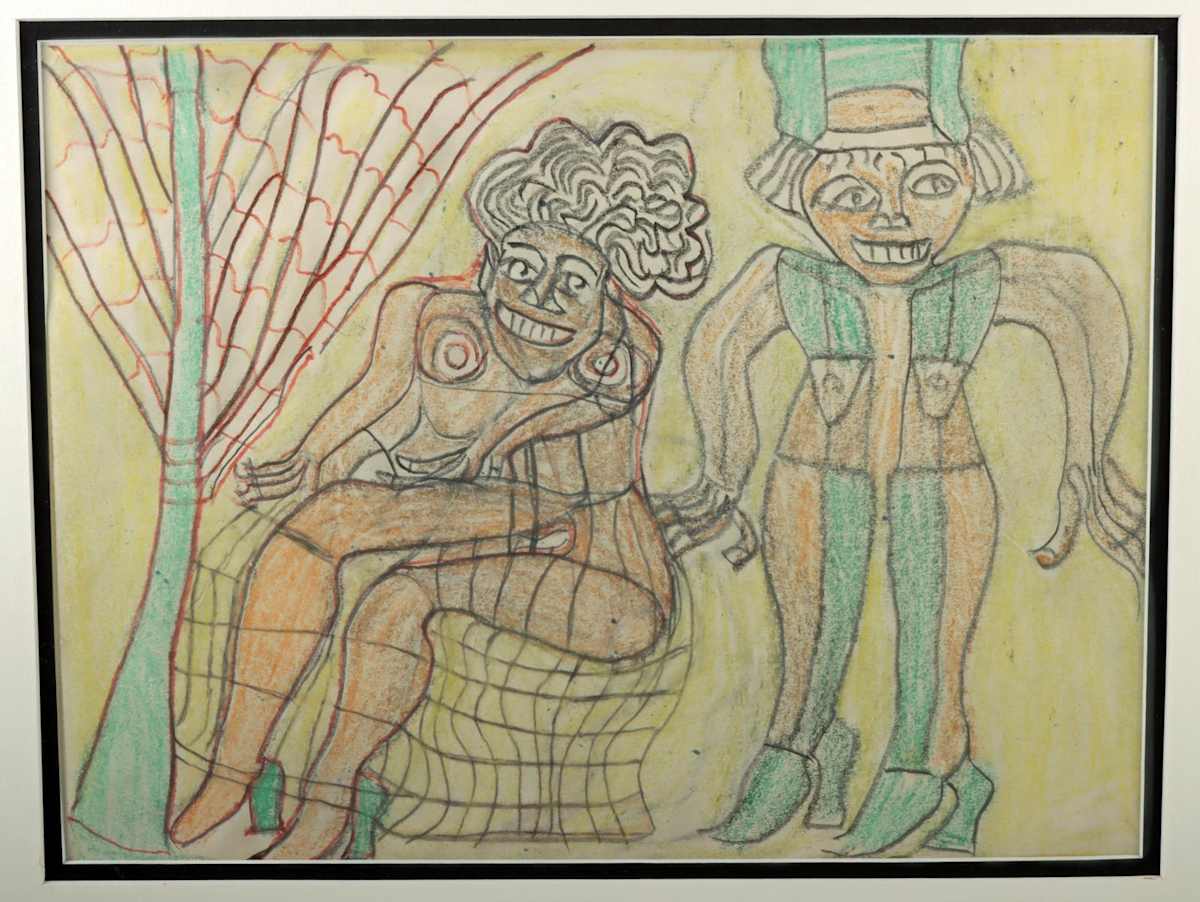
- Two Nude Figures
- crayon and pencil on paper
- 13.75 x 10.25 in
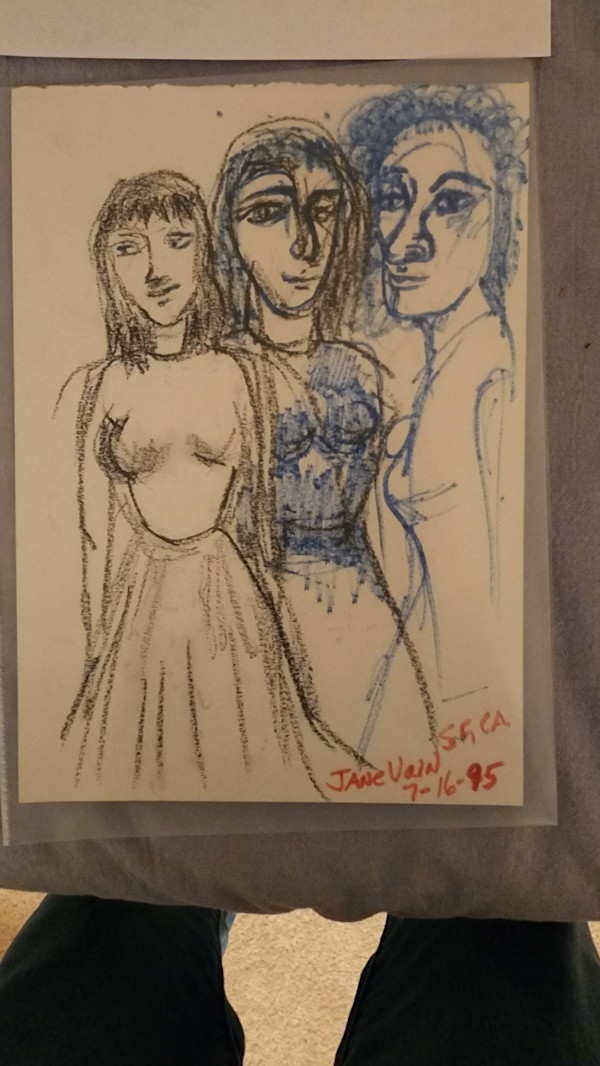
Henry Speller (American, 1900-1997). Untitled mixed media (crayon and pencil) on paper, n.d. An evocative mixed media drawing by American Folk Artist Henry Speller featuring two stylized figures rendered with a raw, uninhibited energy characteristic of the artist. On the left is a nude woman, depicted with exaggerated features: large, wide-set eyes, a broad, toothy grin, and prominent breasts. Her body is delineated with bold, dark lines, creating a semi-transparent, cage-like effect, suggesting both vulnerability and a sense of being confined. Similarly, the woman standing to the right is clad in a segmented outfit of green and brown, with a tall, narrow hat, adding to the whimsical yet slightly unsettling quality of the composition. The figures' expressions, though seemingly jovial, carry a hint of underlying tension, a common thread in Speller's work, which often grapples with themes of social constraints and personal desires. Size of drawing: 13.75" W x 10.25" H (34.9 cm x 26 cm); of frame: 20.5" W x 17.25" H (52.1 cm x 43.8 cm)
This piece is emblematic of Speller's oeuvre in its exploration of the human form as a vehicle for emotional expression. The figures' exaggerated features and the almost cartoonish quality of their depiction do not diminish their emotional impact. Instead, they amplify the underlying tension and desire that permeate Speller's work. The drawing serves as a visual manifestation of Spellers personal experiences and fantasies, offering a glimpse into the world he constructed as a means of coping with the realities of his life in the Mississippi Delta and beyond. It is a testament to the power of art as a form of personal expression and a window into the complex emotional landscape of a self-taught master.
About the artist: Henry Speller's life began in the Mississippi Delta, in a small, often overlooked community. Raised by his grandmother and her husband, sharecroppers, Speller developed a fascination with the world around him, particularly trains and the changing technology of his time. This early exposure to both the beauty and the harsh realities of rural life would later permeate his art. He found solace in creating, building imaginary trains and stations, and later, drawing the images that filled his mind.
The difficult realities of sharecropping and the limited access to education shaped Spellers early life. Despite his desire for knowledge and the potential it held for escaping his circumstances, he was bound to the land. The stark contrast between the opportunities he glimpsed and the limitations he faced fueled his creativity. He began to draw, finding a way to express his inner world and cope with the isolation and frustration of his daily life. His drawings became a form of "consolation," a way to navigate the monotony and anger he experienced.
Speller eventually left the Delta for Memphis in 1939, where he worked various jobs to survive. He found a connection to the vibrant music scene of Beale Street, which resonated with his own musical inclinations. He played music and drew, capturing the rhythm and essence of his experiences in his art. His work reflected the blues, a genre deeply rooted in the struggles and stories of his community. The music and art became an outlet for his emotions, mirroring the sounds and rhythms of the Delta life he left behind.
His marriage to Georgia Verges in 1979 was a significant chapter in his life. They shared a passion for art, often drawing together. Georgia, who had her own artistic vision, focused on themes of freedom and social commentary, often depicting powerful women and vibrant musical scenes. Their art became a dialogue, a way to process their shared experiences and the social realities they faced. Both artists, despite their different backgrounds, understood the limitations imposed upon them by society.
Speller's later life was marked by a poignant return to Beale Street, a place that symbolized both the vibrant culture he loved and the distance he felt from it. His emotional response to the music and the crowd reflected a deep sense of longing and a connection to his past. His life and art are a testament to the resilience of the human spirit, a story of finding expression and meaning in the face of adversity. His drawings and music serve as a powerful record of his journey, a reflection of the Delta blues and the enduring spirit of its people. (Summarized from "Handy Man" by William Arnett on the Souls Grown Deep website)
Provenance: private Rochester, Minnesota, USA collection, acquired from 1990 -1998
- Subject Matter: portrait of two women
- Collections: Outsider Art
Other Work From Leno Family Collection