-
Artist: Orland J. Rourke
Artist, educator, ceramist, collector; co-founder of The Rourke Art Gallery + Museum
Orland J. Rourke was an American artist, educator, and collector whose work and advocacy played a formative role in the development of the Fargo–Moorhead arts community in the second half of the 20th century. Working across disciplines including painting and ceramics, Rourke pursued a studio-based practice that reflected both modernist craft ideals and the vernacular realities of the northern Plains.
Rourke studied art at Concordia College in Moorhead, Minnesota, where he met his wife, Shirley. The couple married in 1958 and went on to build a life centered on artmaking, teaching, and collecting. Rourke became an art educator—teaching at the elementary level and later remaining closely connected to academic and regional art networks—while maintaining an active studio practice that included ceramics, paintings, prints, assemblages, and works on paper.
In 1960, Orland Rourke and his brother James O’Rourke co-founded The Rourke Art Gallery in Moorhead, Minnesota. Conceived as a venue for contemporary art and regional artists, the gallery quickly became a cultural anchor for the area. Shortly after its founding, Orland stepped back from day-to-day gallery operations to return to teaching and studio work, while James continued as director. The institution later evolved into what is now the Rourke Art Museum + Gallery.
Alongside his own artistic production, Rourke was a dedicated and discerning collector. Over approximately six decades, he and Shirley assembled a personal collection of more than 1,000 works of art, including paintings, ceramics, prints, photographs, drawings, and sculpture by colleagues, former teachers, students, visiting artists, and peers encountered through travel and regional art circles. Their home was described as one in which “every room was a little gallery,” reflecting the degree to which art was integrated into daily life.
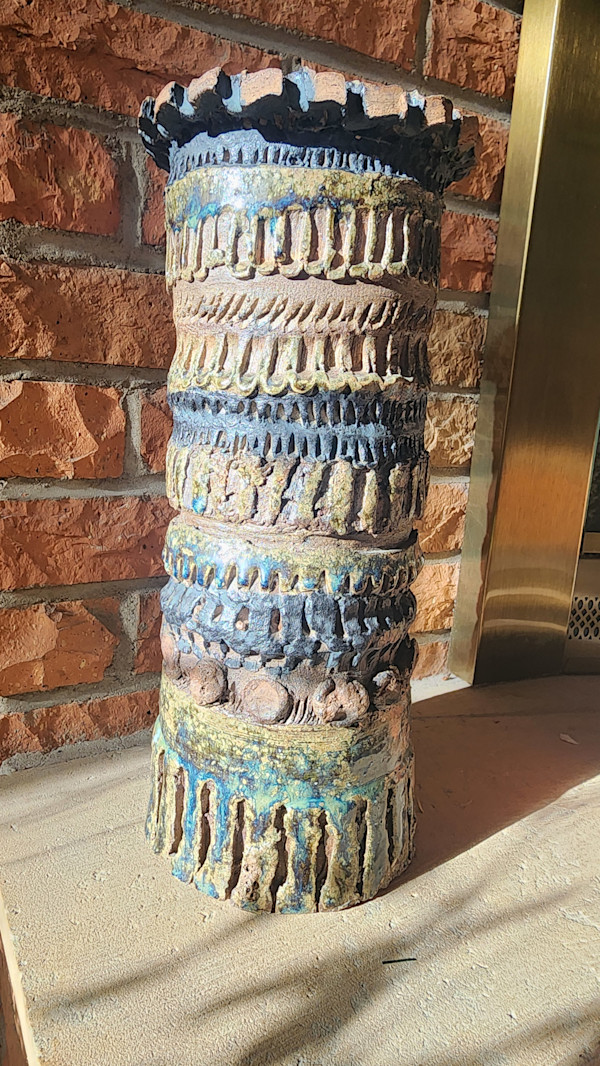
Rourke’s ceramic work, including handbuilt stoneware vessels such as his titled Weed Vase, demonstrates a sophisticated understanding of material, glaze chemistry, and form. These works align with mid-century American studio craft traditions, emphasizing earth-derived materials, ash glazes, oxide surfaces, and sculptural restraint rather while also serving as functional pottery. His paintings and other works similarly reflect a direct, unsentimental engagement with place and process.
After Orland Rourke’s death in 1997 and Shirley Rourke’s death in 2018, their extensive collection—containing a significant body of Orland’s own work—was dispersed through estate auctions, bringing renewed attention to his role as both an artist and a foundational figure in the region’s cultural history.
Today, Orland J. Rourke is best understood not as a national-market artist, but as a central regional figure: an artist-educator whose creative practice, institutional vision, and lifelong commitment to collecting helped shape the artistic legacy and foundation of the Fargo Moorhead arts scene, and more broadly, the northern Plains.