He studied art and history at Concordia College in Moorhead from 1952 to 1956 under Cyrus M. Running and Elizabeth Strand, then entered the United States Army, which stationed him first at Fort Meade in Maryland and later at Nuremberg in West Germany. The three years he spent in uniform proved unexpectedly formative. Europe opened to him — its Gothic churches, Irish castle ruins, Scandinavian stave churches and fjords — and the contrast between that deep cultural landscape and the comparatively young one he had grown up in seems to have sharpened his sense of what the upper Midwest lacked and what it might become. By the time he returned to Moorhead in 1960, he had resolved to do something about it.
That year he and his brother Orland opened the Rourke Gallery in the former Moorhead Daily News building — a modest start for what would become one of the most significant regional art institutions in the northern Plains. The gallery relocated twice in its early years before settling into the historic Martinson House in 1961, where O'Rourke lived in a small upstairs apartment and ran the operation largely on conviction and very little money. The city briefly threatened to close it on zoning grounds, but a public outcry persuaded the council to let it remain, reclassified as a school because of the art classes it offered. That designation was not entirely fiction: the Martinson House became a genuine gathering place for younger artists, among them James VerDoorn, Terence Larson, Charles Thysell, and George Pfeifer, who worked at the gallery and studied with O'Rourke in those early years.
To keep the enterprise alive through the 1960s, O'Rourke taught studio art and art history at the State School of Science in Wahpeton, Moorhead State College, and North Dakota State University, and briefly ran an artists' colony at Fort Ransom. In 1965 he helped establish the Red River Arts Center, and in 1973 the O'Rourke Art Gallery Museum, which merged two years later with the Arts Center to form the Plains Art Museum, with O'Rourke serving as its first executive director. He parted ways with the Plains in 1987 and returned full-time to the Martinson House and his own work. In 1992 the Rourke was reconstituted as a nonprofit institution, and it continues to operate today.
Through all of it — the fundraising, the teaching, the institutional building, the periodic near-collapses — O'Rourke kept making art. His prints, which the Rourke now holds as a complete archive, range across a lifetime of looking: Red River farmsteads, the Northern Pacific depot in Fargo, Fort Union, Nuremberg city walls, Norwegian fjords, Irish landscapes, Dürer's Nuremberg. The editions vary from intimate runs of fifteen to popular images printed in editions of two hundred. He also made paintings, drawings, wood assemblages, ceramics, and photographs, working across media with the restless curiosity of someone who had never settled on a single answer to what art was for.
O'Rourke died in early 2011 after a fall at his home in Moorhead. He left his estate, his art collection, and his remaining print inventory to the Rourke. His legacy is institutional as much as artistic: without his decision to open a gallery in 1960, the cultural infrastructure of the Fargo-Moorhead region would look substantially different. The Plains Art Museum, the Rourke itself, and the careers of the artists he supported and exhibited — Gordon Mortensen among the first of them — are all part of what he built.
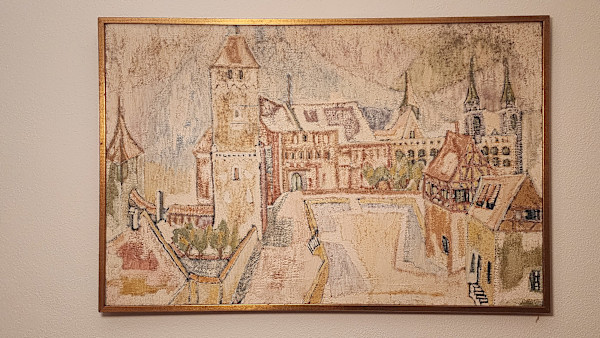
The painting Courtyard*, in our collection, originally sold in O'Rourke's 1960 solo exhibition, and is among the earliest documented works from his hand, dating to the year he founded the Rourke Gallery itself.