
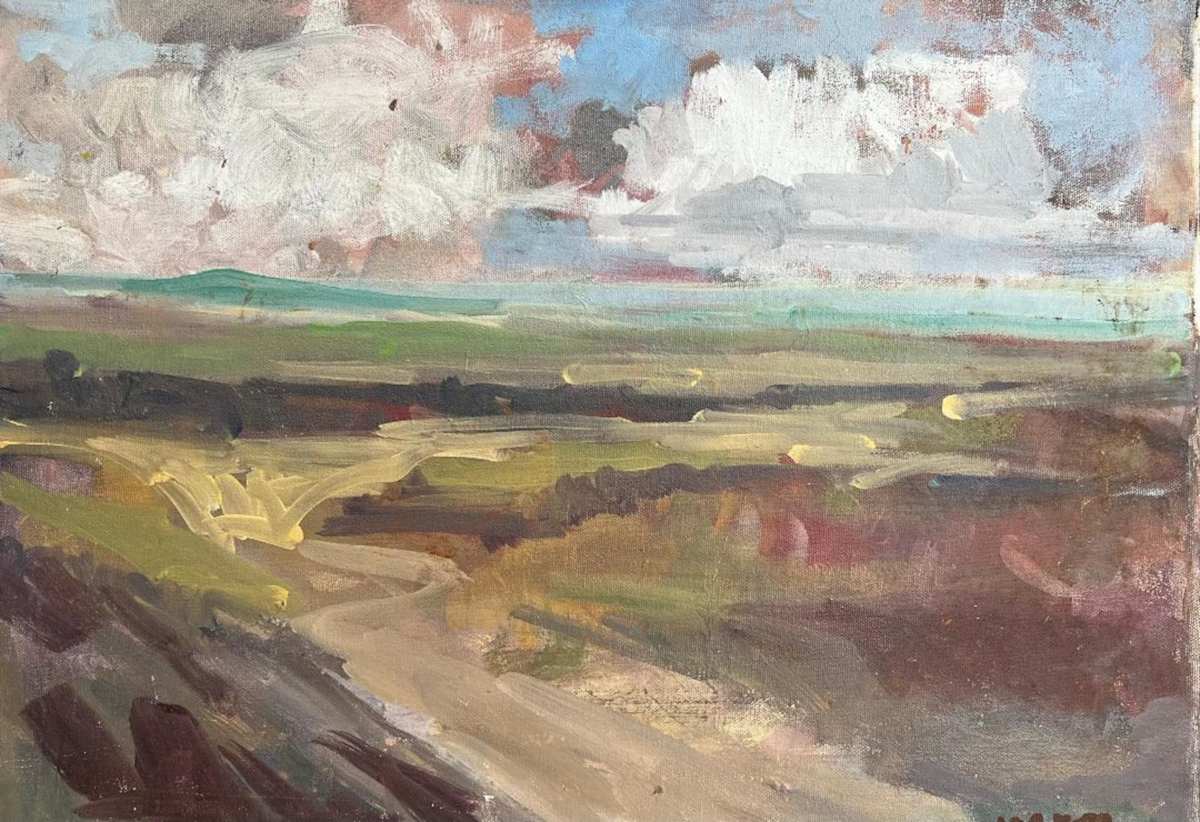
Willamette Valley Vista
Oil on canvas
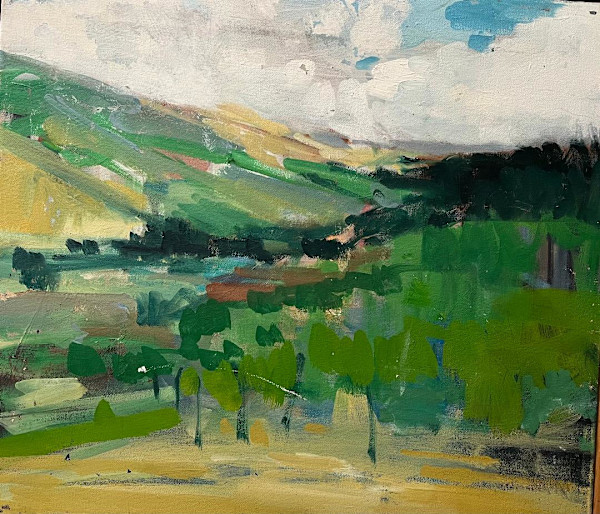
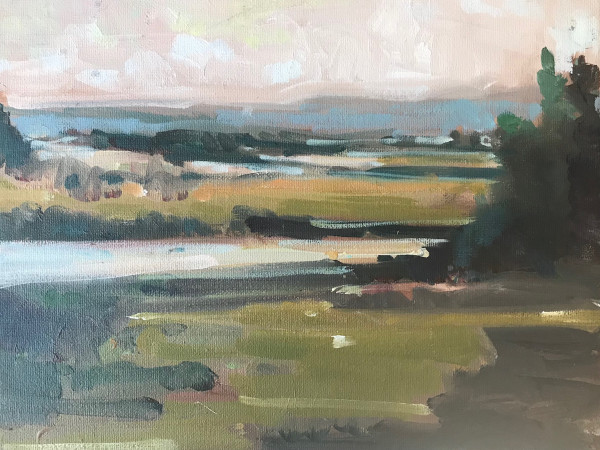
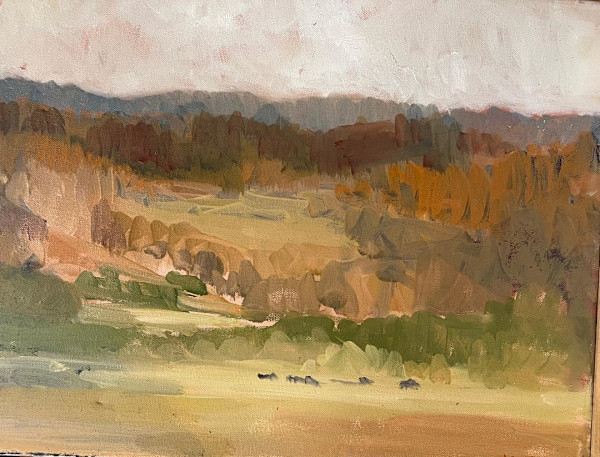
This expansive vista of the Willamette Valley is less concerned with topographical description than with atmosphere, movement, and the emotional architecture of open space. The painting unfolds through broad masses of earth, sky, and cultivated terrain, allowing the viewer to experience the valley not as a collection of objects but as a living continuum of light and distance.
The winding road in the foreground acts as both compositional anchor and invitation, drawing the eye inward through successive bands of muted greens, ochres, violets, and gray-blues. Rather than carefully rendering every tree or field boundary, the work depends upon mass macchia relationships — large tonal divisions that establish the essential structure of the landscape before detail ever appears. In this way the painting remains faithful to the principles of American Verismo: truth through simplification, immediacy, and direct observation.
The sky dominates emotionally. Towering cloud formations rise almost architecturally above the valley floor, painted with loose calligraphic gestures that preserve the freshness of plein air response. The clouds seem constantly in motion, carrying the damp luminosity and shifting weather so characteristic of western Oregon. Light breaks across the valley in fragments and ribbons, creating fleeting passages of illumination that appear and disappear almost musically.
There is also a sense here of the ancient agricultural character of the Willamette Valley itself — a place shaped equally by geology, farming, rain, labor, and seasonal transformation. The landscape feels inhabited even in the absence of visible figures. Roads, cultivated divisions, and atmospheric distances suggest human presence integrated into the natural order rather than imposed upon it.
The abbreviated brushwork is essential to the painting’s emotional force. Certain passages remain nearly abstract, dissolving into color fields and directional strokes, while others briefly crystallize into recognizable terrain. This oscillation between abstraction and representation gives the work its breathing quality, as though the landscape itself were still forming before the viewer’s eyes.
In verismo terms, Willamette Valley Vista becomes not simply a scene but an experience of seeing — standing before immense weather, immense distance, and the quiet grandeur of ordinary land transformed through light.
- Subject Matter: landscape
- Collections: Jack Sprat