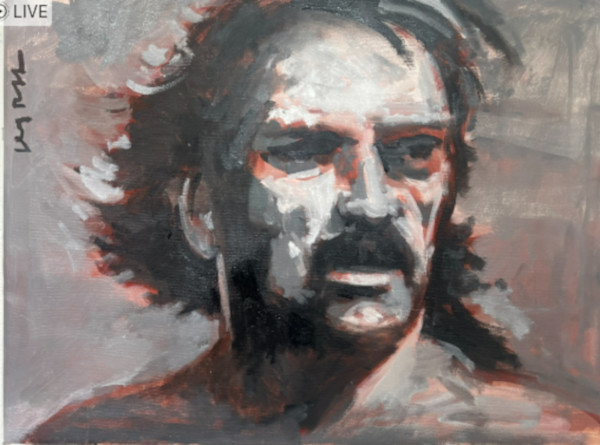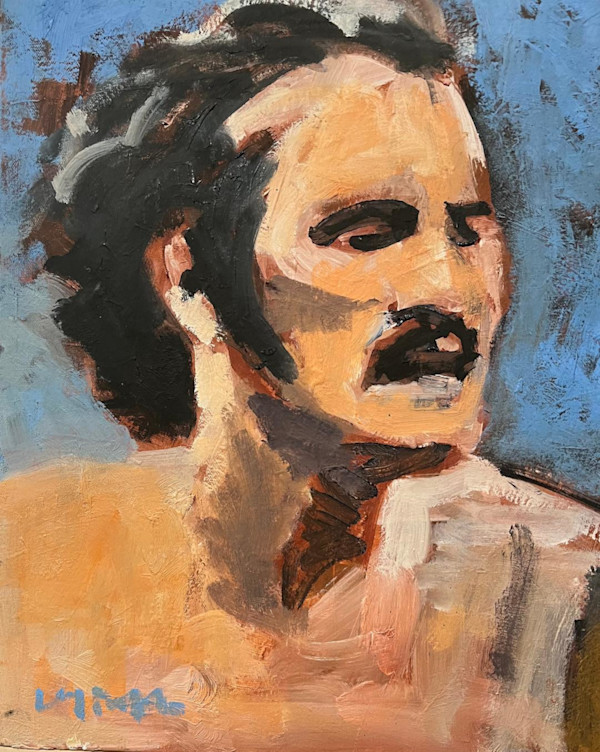
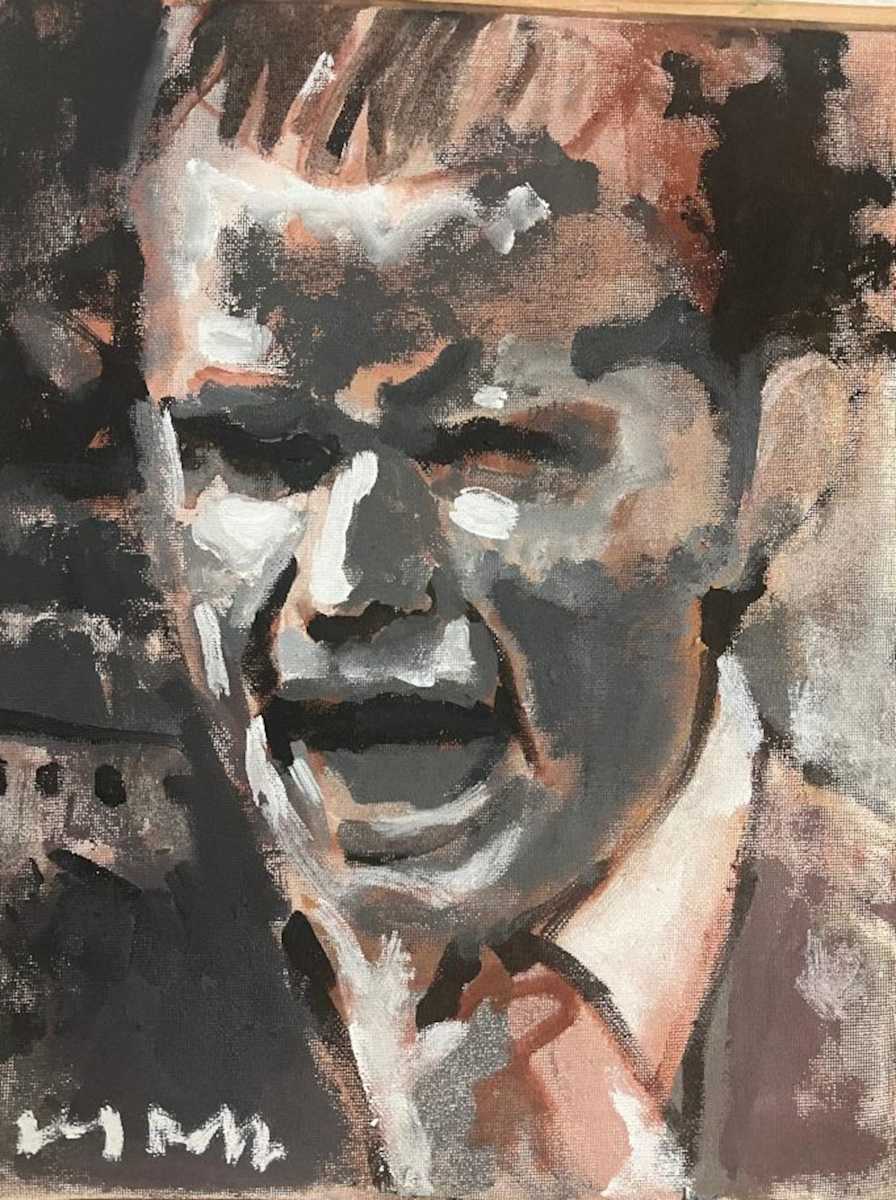
“Hegseth Off His Leash” transforms the public face of televised militarism into a raw psychological macchia — a portrait less concerned with likeness than with the spectacle of unleashed aggression in contemporary American politics. The mouth explodes open in a near-animal howl, suspended somewhere between patriotic performance, cable-news theater, and ideological frenzy. Rather than smoothing the image into polite portraiture, the brush fractures the face into violent planes of black, white, and bruised flesh tones, exposing the instability beneath the manufactured confidence.
The painting operates through extreme tonal compression, almost monochromatic in structure, recalling the urgency of wartime newspaper sketches or anti-fascist caricatures produced in moments of political crisis. The harsh whites slash across the forehead and cheekbones like interrogation lights, while the dark masses swallow portions of the figure into shadow, suggesting both menace and self-erasure. Here American Verismo moves decisively into political territory: the visible brushstroke itself becomes an act of resistance against polished propaganda imagery.
The title, “Hegseth Off His Leash,” sharpens the satire. The figure appears not as an independent force but as a creature released — animated by larger systems of nationalism, media spectacle, and militarized outrage. Yet the work avoids cartoon simplification. Beneath the grotesque energy lies something recognizably human: insecurity, performance, exhaustion, perhaps even fear. This tension gives the painting its psychological bite.
Now exhibited at Jack Sprats Restaurant, the portrait stands within the long tradition of socially engaged verismo — art willing to confront the absurd theater of power directly. Like the anti-authoritarian spirit of the I Macchiaioli before it, the work rejects academic neutrality. It insists that paint itself can still function as political witness: rough, immediate, unresolved, and alive
- Subject Matter: political satire
- Collections: Jack Sprat