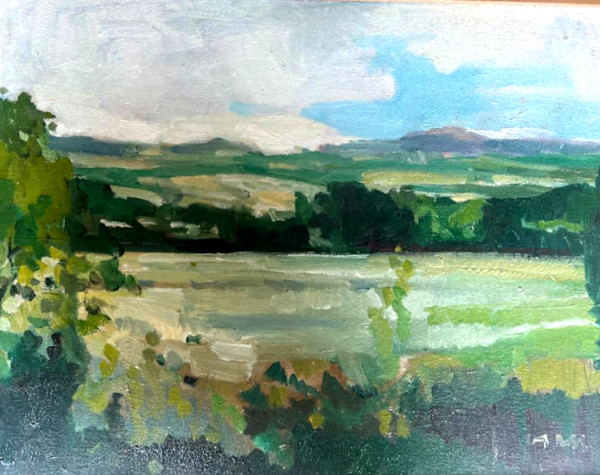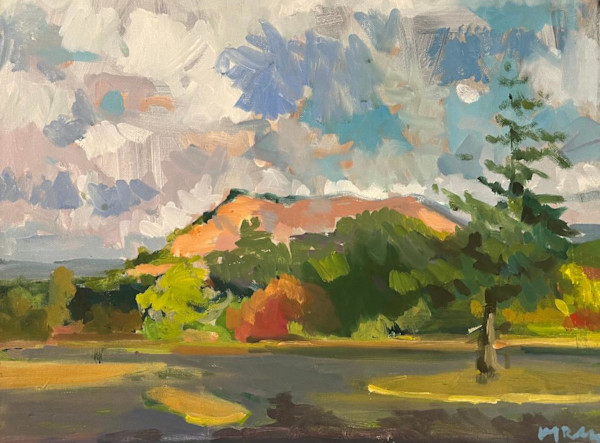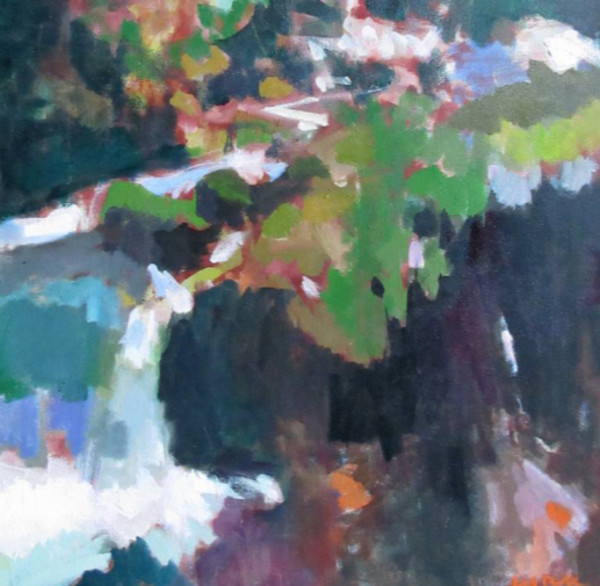

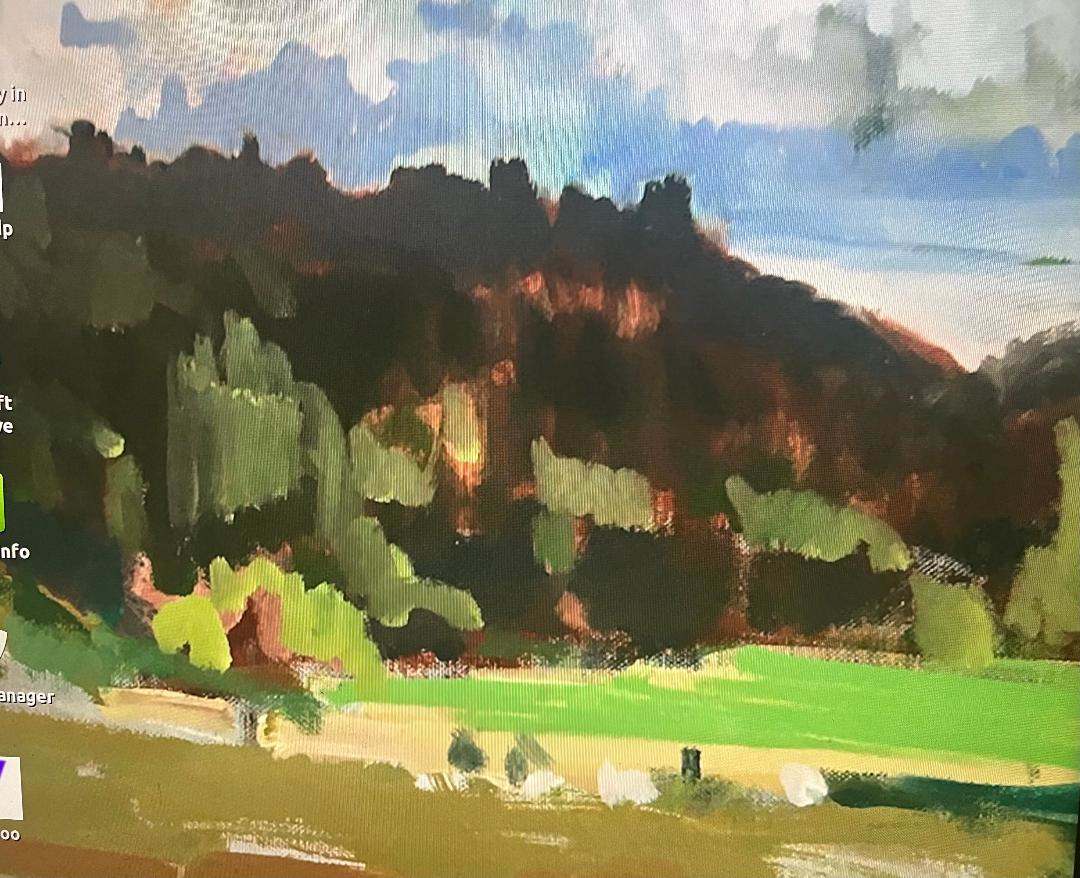
“Amazon Park” appears at first glance to be a simple plein air sketch of a familiar Eugene landscape, yet beneath its modest subject lies a profound turning point in the evolution of American verismo and mass macchia. Here the artist begins to discover the independent power of the painted dab itself — not merely as descriptive foliage, but as an architectural event upon the canvas surface. The lighter green passages hover and advance against the dark butte beyond, creating a dynamic “push and pull” tension reminiscent of Hans Hofmann, while simultaneously recalling the constructive color planes of late Cézanne.
Unlike the pointillists, whose dots dissolved form through optical vibration, these bold flattened dabs function as structural units, each one carrying weight, direction, and spatial force. The painting becomes a living matrix of interlocking masses where abstraction and landscape coexist in fragile balance. Trees are no longer “trees” in the ordinary sense, but luminous planes riding upon darker atmospheric fields, creating an almost tectonic sensation of movement across the surface of the painting.
The significance of the work lies precisely in its quietness. A local park, an ordinary hillside, a familiar walking place in Eugene — yet within this humble subject the artist uncovers a deeper aesthetic truth: that painting itself possesses its own independent reality beyond illustration. The landscape becomes an arena where dabs, planes, and tonal masses interact like living forces. In this sense, “Amazon Park” is not merely a depiction of place but a revelation about seeing, about the hidden architecture of paint, and about the moment when the ordinary world suddenly discloses its abstract and poetic structure through the language of verismo.
- Subject Matter: landscape
- Collections: Jack Sprat