-
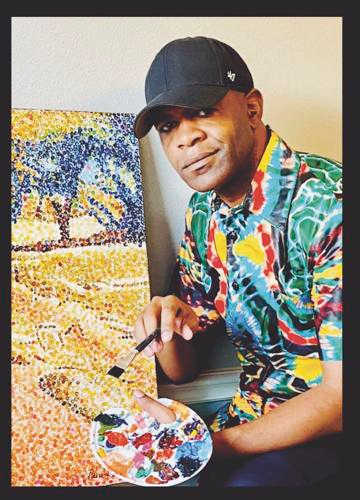
Artist: Sankho (Paul) Banda
On one particular night, he finished his drawing and threw it in the trash, his mindful activity completed and sleepiness averted. A coworker, however, asked Banda if they could keep it.
“It was in the trash,” he recalled with a laugh. But witnessing his coworker’s reaction confirmed that quiet voice that told him he had a gift — one that could work for him.
Drawing and sketching that point was a means of healing for Banda.
“Whenever I would draw, all the trauma I went through —”
He lets the rest of the sentence fall, not in pain, discomfort or bitterness, simply in thought. “I found a refuge in drawing,” he settles on before sharing that as a teenager, he was one of several boys trafficked from Zambia. He was recruited to be a member of a boys choir controlled by a US missionary organization that toured the choir nationwide.
“When we arrived it was a culture shock,” Banda recalled of arriving in Sherman, Texas, the organization’s headquarters.
The alleged purpose of the boys choir was to raise money through performances for a school and a clinic back home in Zambia. “What it turned out to be was different,” said Banda. “The money never went back home. He was using us to keep the money for himself.”
For years the boys were isolated and forced to sing. “Even when you got sick. You had to toughen yourself up,” he recalled. The boys didn’t attend school, weren’t taught English, or paid. “We were used. We were missing home,” Banda said. “We were orphans and even though we didn’t have anything back home, we wanted to go back.”
Eventually, some of the boys escaped, authorities were alerted, and they, including Banda, were adopted by American families. Banda ultimately made his way to St. Louis, where “[his] life took a turn.”
He started off stocking shelves, then found a security guard job in a parking lot for Washington University in St. Louis before being hired in the university’s security department.
That’s how he ended up on the third shift, sketching drawings that caught someone’s attention.
“It was just a sketch but it made someone happy,” Banda said. “I was treated like a commodity,” he said of his experiences with the deceitful boys choir. “But now,” he continued, a lift in his voice, “someone values me because of my art.”
Being a self-taught artist, Banda started experimenting. He sketched with pencils and tried oil paint and watercolor, but acrylic, he said, “was easy for me to work with.”
“I started drawing and I couldn’t stop,” he said with a laugh. “I didn’t want to stop. I was consuming something that was feeding my spirit.”
THE POWER OF EDUCATION
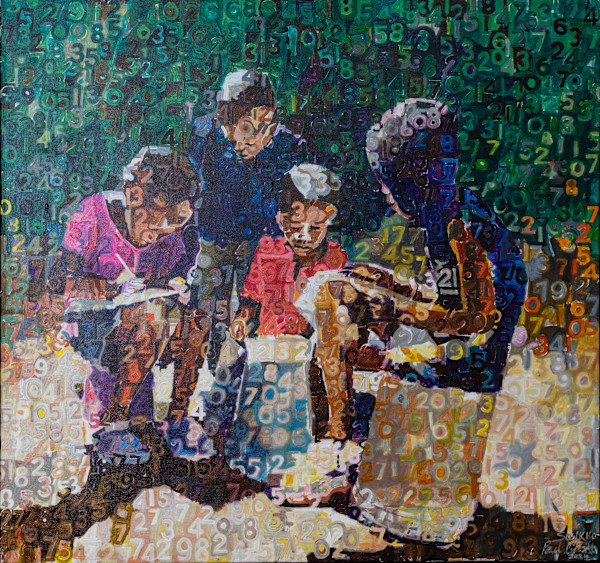
Upon inspection, viewers will find Banda’s canvases stained with educational symbols right along with the acrylic paint. Shapes, triangles, squares, numbers and more are intertwined in Banda’s vibrant works because of his adoration and respect for learning.
“I’m an advocate for childhood education, something I didn’t get as a child,” he said. “I value education, any education.”
Following his adoption, Banda earned his GED before enrolling in community college classes before earning his Bachelor’s in Global Leadership and Management and then master’s in Human Resources Management from Washington University in St. Louis and his School of Management Certificate from MIT Sloan School of Management.
And as he began his studies, Banda’s artistic endeavors were concurrently progressing: “My art would connect with people and then they were commissioning artwork from me.”
Today, Banda is the program director at the University of Houston.
“People ask me why didn’t I put art into my degree,” Banda said, posing the question before it was asked.
He lets a silence settle before he chooses his words. Although his art was capturing attention, it was healing and uplifting for him, his motivation for pursuing his degrees, however, was to be in a position to help others.
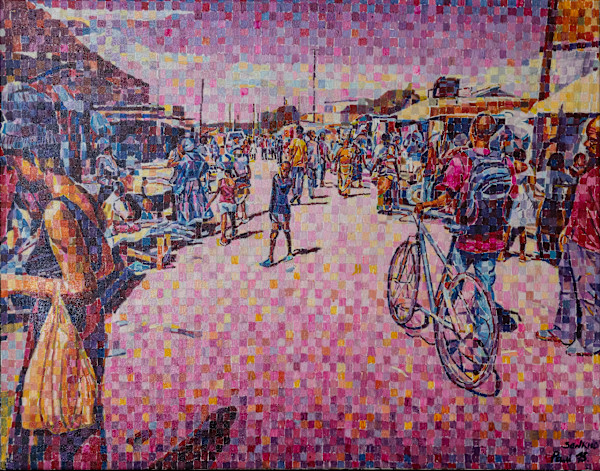
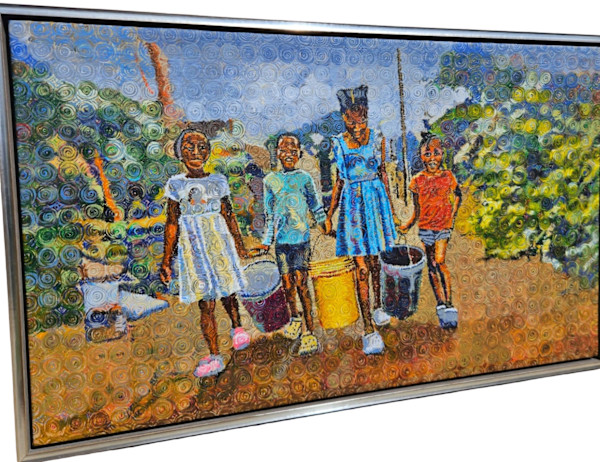
“They say, tell your story through your art,” he said. “Everything you see I’m drawing from memory. Every person I would include in my pictures, I remembered having had an interaction with them.”
He takes a moment to gently and straightforwardly explain that his memories and perspectives of his home in Zambia are limited to that of a child’s because that’s when he was taken. But the memories he does have, some of which he shares briefly but fondly, are rich with details. Just like his art.
“We were poor, but we were happy kids,” he said wistfully. “I incorporated that into my art, the memory I have of the children.
“I was the first one in my family to make it passed the age of 20,” he continued. “All my siblings died. That pain, I knew I didn’t want to live the rest of my life with that pain.”
When he creates, that pain bleeds out.
“That’s how my art evolved. ”
THE JOYS OF AN ART FESTIVAL
Among other measures, art helped Banda transform his longing and pain into vibrant and captivating paintings, while simultaneously nudging him to consider new perspectives: “I changed how I see things, I was thinking how to change the world around me, I was thinking how can we help each other?
“That’s why I like to be a part of these festivals,” Banda said about participating in the upcoming 2024 Sugar Land Arts Fest, a two-day festival highlighting the cultural and artistic diversity of Fort Bend County and beyond.
Created by the Sugar Land Cultural Arts Foundation and presented by Primeway Federal Credit Union, the Sugar Land Arts Fest is set for Saturday, April 27, and Sunday, April 28, 2024, at Smart Financial Centre in Sugar Land. The cultivated festival, now entering its third year, features a variety of art, including painting, sculpture, photography, mixed media, glass art, woodworking, and jewelry. Attendees can also enjoy a wine and beer garden, cuisine from local restaurants and live music during the festivities. For more information visit www.sugarlandartsfest.com.
After sharing other art awards he’s won, including earning 2nd Place Best In Show at the 2023 Bayou City Art Festival Downtown, Banda takes a moment to make a point he deems imperative to share:
“I’m always humbled to hear that,” he said of the comment that he is inspiring. “But it wasn’t just by my own will. There is a community of people — my adopted family, the guy we didn’t know as kids who helped save us and be a guardian, my neighbors, my coworkers, the guy who asked to keep my trash drawing — the people who encouraged me, the community around me to help me where I am right now.
“They helped mold me.”
That’s why he’s looking forward to the 2024 Sugar Land Arts Fest. There’s something about an art festival, he explained, that attracts not just interesting artists but people in general. And, if his past experiences are anything to go by, he knows he’s going to meet some memorable people. The Sugar Land Arts Fest, he said, is another chance to connect and heal through art, and perhaps, help someone else do the same.
“You know, you get around people [at these art festivals] and you feel like you’ve know them forever.”
Visit www.fbherald.com for more about Sankho (Paul) Banda, including a look at his art and why he changed his name. For more information about the arts festival, visit www.sugarlandartsfest.com.