
-
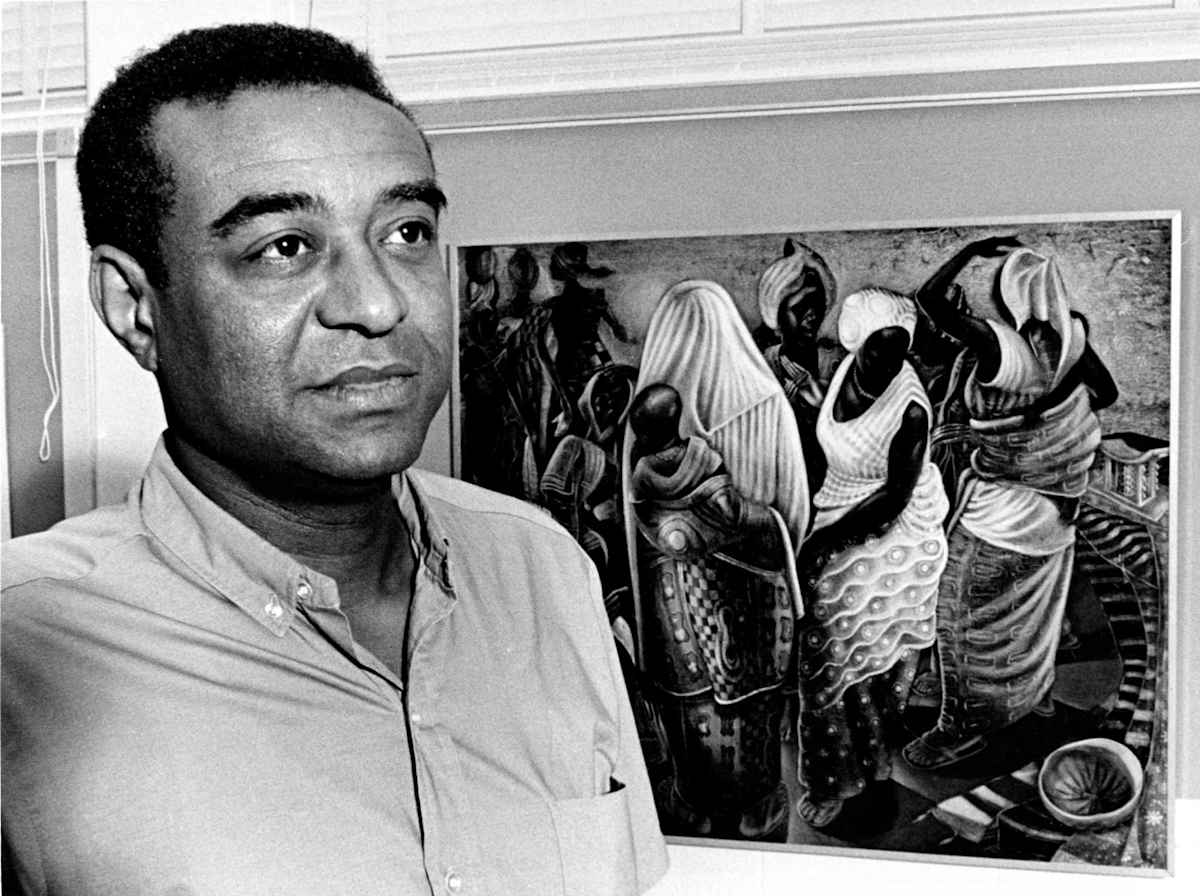
Artist: John Biggers (1924-2021)
Following two years of service in the United States Navy during World War II, Biggers went on to pursue both master’s (1948) and doctoral (1954) degrees at Pennsylvania State University. A technically gifted draftsman and skilled lithographer, Biggers—working primarily in conté crayon and oil paints—created striking images of unidealized figures coping with poverty and despair. In 1949, Biggers moved to Houston, Texas, where he served as founder and chairman of Texas State (now Texas Southern) University’s art department, a post he held until 1983.
In the 1950s, Biggers’s social realist emphasis evolved, largely as the result of travel in Africa. A UNESCO fellowship funded study of West African cultural traditions in 1957 and thereafter African themes were at the center of his work. Published in 1962, Biggers’s book Ananse: The Web of Life in Africa featured eighty-nine drawings and text he hoped would “portray what was intrinsically African.” A 1969 Danforth Award funded further travel on that continent. Following his retirement from teaching, Biggers continued to paint murals and increasingly symbolic abstract works grounded in African heritage and Black culture; the latter often included everyday objects such as patchwork quilts, cooking pots, gourds, and the shotgun houses so familiar from his Southern childhood. In 1995, he was the subject of a major one-man traveling exhibition, The Art of John Biggers: View from the Upper Room, curated by the Museum of Fine Arts, Houston, a museum that, in 1950, had not allowed Biggers to attend a reception in honor of his first prize-winning entry at the then-segregated institution.
Biggers’s murals may be seen at several public locations in Houston, as well as Hampton University and Winston-Salem State University. His work is represented in the collections of the Metropolitan Museum of Art, Smithsonian American Art Museum, Brooklyn Museum, Mint Museum of Art, and Gibbes Museum of Art, among others.
