
Ersta diakoni
Stockholm
Ersta diakoni is a not-for-profit association active in healthcare, social work and professional research and education.
Message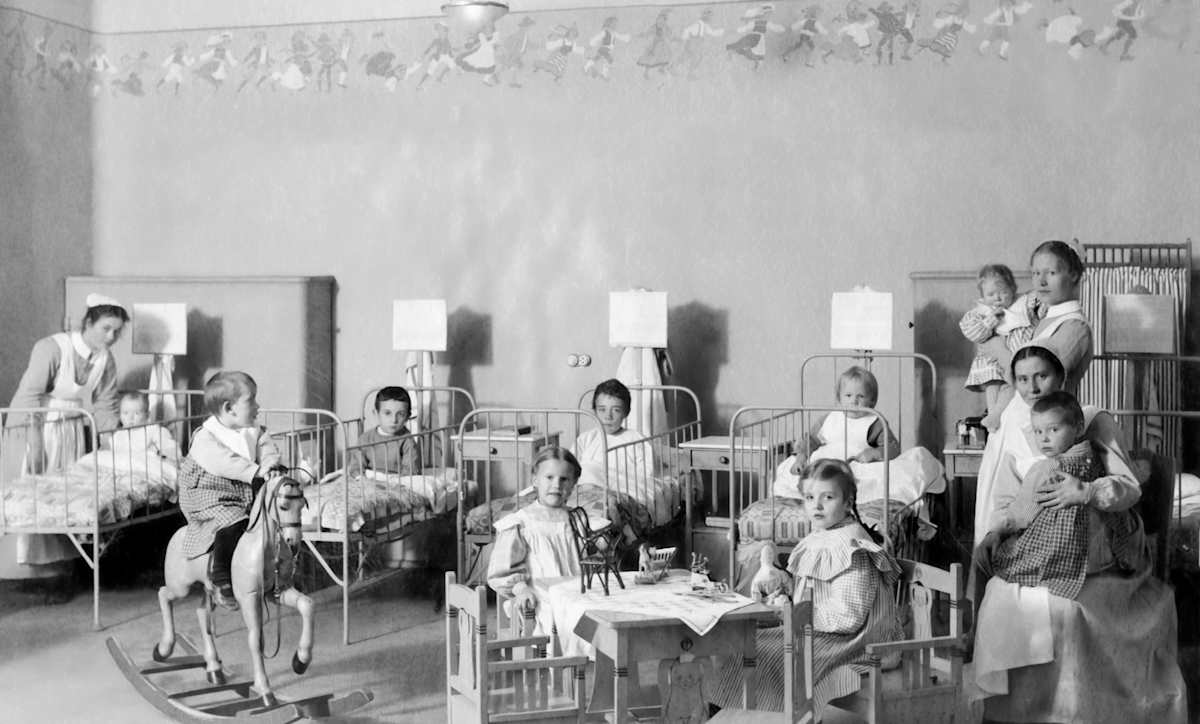
I sjukhuset som idag har entré mot Fjällgatan fanns förr i tiden en sal speciellt reserverad för barn. Lägg märke till den lekfulla bården vid taket, målad av en vän till diakonissan Ida Örwall, på hennes initiativ. Möbler och leksaker bidrog till hemkänslan och för en del patienter var detta kanske det finaste rum de sovit i.
Sjukhusets omsorger gällde inte bara det fysiska – hänsyn kunde visas till svåra hemförhållanden. Det vittnas om att patienter tillåtits ligga kvar på sjukhuset över till exempel julhelgen, fast deras fysik egentligen var god nog för hemgång.
Omsorgen om barnen har varit en röd tråd genom hela Ersta diakonis historia. Till det första sjukhuset kunde fattiga kvinnliga patienter ta med sig sina barn när de själva blev inlagda. På den tiden fanns ingen offentlig barnomsorg och barnens pappa förväntades inte ta hand om barnen ensam.
Här fanns också en skola. Ett litet lusthus på gården blev lektionssal och redan första dagen kom fyra fattiga gatubarn som ville få utbildning. På schemat stod att lära sig en av Betty Ehrenborg Posses visor och enligt föreståndarinnan Marie Cederschiölds dagboksanteckningar var eleverna ”villiga, glada och uppmärksamma.”
Ryktet om skolan spred sig och varje dag kom nya barn. Redan efter två veckor fick man sätta antagningsstopp och till vintern flyttade de 27 eleverna in i sjukhusbyggnaden.
Under sin utbildning hade Marie Cederschiöld lärt sig nya pedagogiska metoder – bland annat ljuda-metoden – och de diakonissor som utbildades under hennes ledning var sedan mycket eftersökta och kom att leda småskolor runtom i hela landet.
ENGLISH
”For the Children’s Well-fare”
In the hospital building, there was once a ward reserved especially for children. Notice the playful frieze running along the ceiling — painted by a friend of the deaconess Ida Örwall, at her request. The furniture and toys helped create a homelike atmosphere, and for some of the young patients, this may well have been the finest room they had ever slept in.
Care at the hospital extended beyond physical needs; consideration was also given to the circumstances children faced at home. There are accounts, for example, of patients being allowed to stay over Christmas, even when they were well enough to be discharged.
Throughout the entire history of Ersta diakoni, the care of children has been a recurring and significant theme. At the first hospital in 1851, female patients were permitted to bring their children with them. At that time, public childcare did not exist, and fathers were not expected to care for children on their own.
There was also a school. A small garden pavilion served as the classroom, and on the very first day, four poor street children arrived — eager to learn. According to diary notes by the head of Ersta diakoni, Marie Cederschiöld, the pupils were “willing, cheerful and attentive.” Word about the school spread quickly, and each day more children appeared. After only two weeks, admissions had to be closed, and by winter the twenty-seven pupils had moved to a room inside the hospital building.
During her own training, Marie Cederschiöld had learned new teaching methods — including sounding-out techniques for reading — and the deaconesses she trained became highly sought after. Many went on to establish or lead small primary schools across the country.
- Collections: Historisk utställning