

Inspiration-
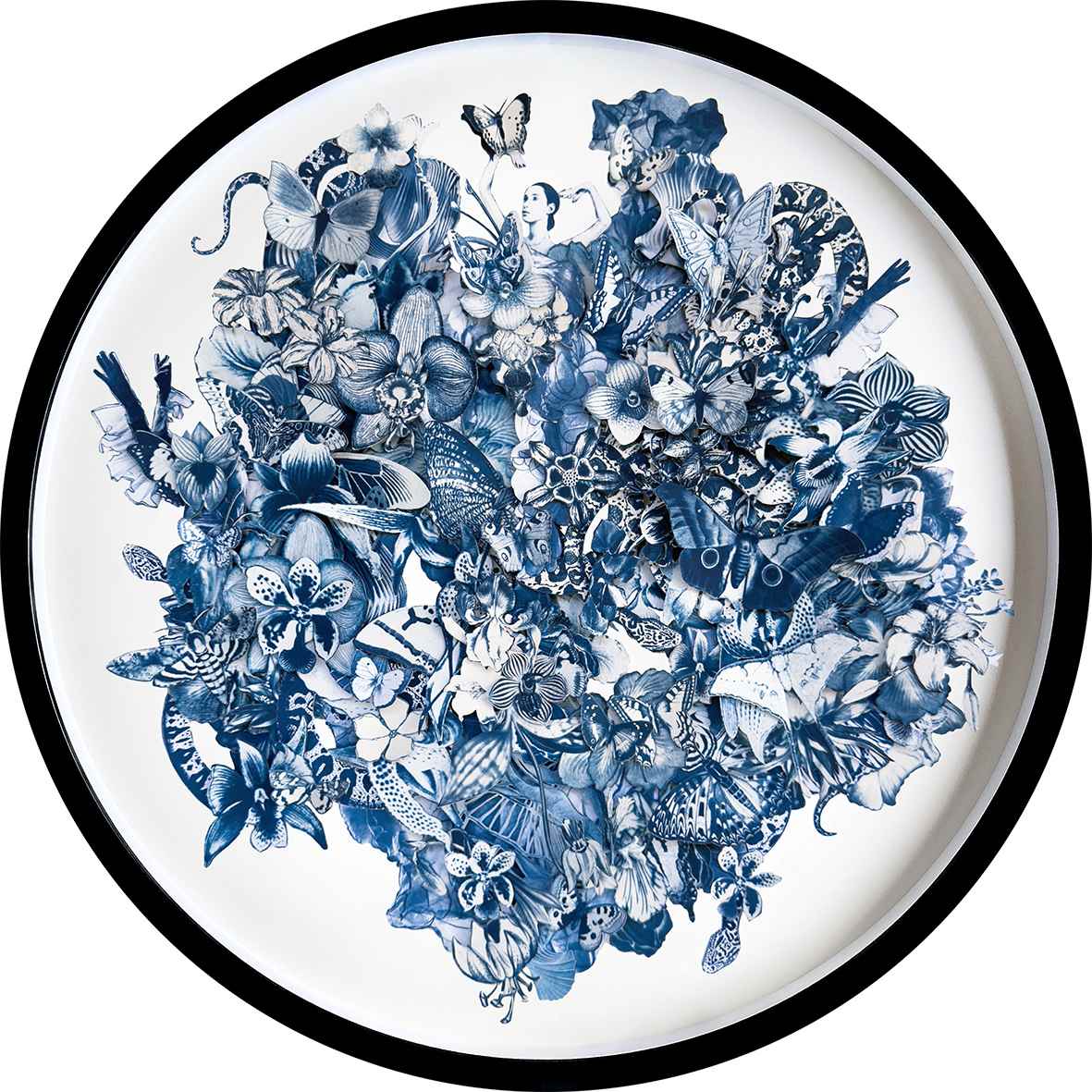
La Métamorphose de Loïe Fuller takes its name from the transformation at the heart of Fuller’s practice. My work looks back to an artist who redefined what the female body could be on stage.
Known across Paris as la Fée lumière and la Fée électricité, Fuller was a queer pioneer who dismantled the expectations placed on women performers at the fin de siècle. At a moment when dance was still constrained by Victorian convention, she built an entirely new visual language from light, fabric, chemistry, and motion; an aesthetic that shaped Art Nouveau itself.
Born in Illinois without formal dance training, Fuller arrived in Paris in 1892 and became the sensation of the Folies Bergère almost overnight. Most famous for her Serpentine Dance, with yards of silk suspended from bamboo wands, animated by her body and saturated with coloured light—turned her into a living sculpture. Audiences saw not a woman, but shifting, elemental forms: flames, lilies, butterflies, moonlight. She dissolved the performer into pure movement, pure atmosphere, pure light. Stéphane Mallarmé called her “the dancer who created the phantom of an era.” Rodin studied her obsessively; Toulouse-Lautrec sketched her repeatedly. The Lumière brothers filmed her. She was the only woman granted her own pavilion at the 1900 Exposition Universelle.
Fuller’s innovation was not only choreographic. She was an inventor, filing patents for lighting systems, projections, phosphorescent chemicals, fabric engineering, and stage architecture. She experimented with radium in the Curies’ laboratory and with emerging electrical technologies long before stage lighting existed as a discipline. That technical audacity allowed her to escape the male gaze entirely. Wrapped in light and motion, her body became abstraction, refusing the erotic script expected of women on stage, and opening the path toward modern dance.
Fuller lived for decades with Gabrielle Bloch (Gab Sorère), moving within Parisian lesbian art circles and teaching young dancers in deliberately female-centred spaces. The floral motifs in her choreography and in the nicknames she gave her students were not simply decorative; they acted as coded expressions of identity, autonomy, and desire. La Métamorphose de Loïe Fuller engages her not as a nostalgic figure but as a force of rupture.
Her performances were acts of disappearance and becoming, an identity dissolving into light, the work draws on that sense of motion, abstraction, and shifting form. These pieces reference the visual architecture of Art Nouveau, but also its underlying politics: a woman who invented her own mythology, guarded her innovations, and refused to be defined by the aesthetics imposed upon her.
Fuller didn’t simply dance. She engineered a new way of seeing. This artwork stands in conversation with that legacy.
La Métamorphose de Loïe Fuller honours the pioneer who transformed dance, light, and the female body on stage. Known as la Fée lumière, Fuller dissolved her own image into swirling silk, colour, and motion, shaping the language of Art Nouveau and modern performance. This work draws on her radical innovations—her abstract forms, her experiments with electricity and colour, and the autonomy that defined her life. The piece echoes her metamorphic energy, her luminous abstractions, and the legacy she carved into modern art.
TECHNIQUE
La Métamorphose de Loïe Fuller (La Fée Lumière) was created by constructing a hand-cut collage using female photographic portraiture and photograms of silk fabrics, photographs and illustrations of orchids, lilies and irises, butterflies and moth specimens, and serpents. Every element is anchored directly in Fuller’s life, work, and the visual language that grew up around her, rather than operating as free-floating decoration.
- Collections: Chloe McCarrick
Other Work From Da Silva Gallery / GALLERyLABS


